Louisiana can tell you exactly how long it jailed people it had no right to hold
Sep 15, 2026 | 11:45 am ET
Description
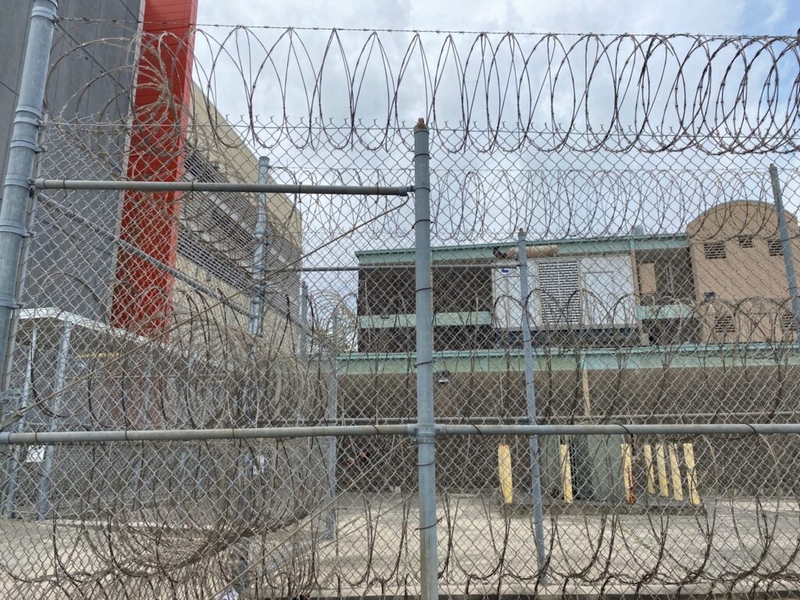
Razor wire and fencing surround the Orleans Parish Justice Center jail. (Richard A. Webster/Verite News)
An Orleans Parish judge ordered Lisa Andres to be released from jail May 30, 2025, according to court records cited in a new lawsuit against the state. She was not.
The Louisiana Department of Public Safety and Corrections secured the documents needed for Andres’ release Oct. 15 — 100 days after the judge’s order — according to a federal lawsuit from Andres and Jaren Brignac, who the state held nine days past his release date. Their complaint was filed Aug. 28 with the U.S. District Court in Baton Rouge. Gary Wescott, leader of the state prison agency, is the sole defendant in the case.
The plaintiffs attorneys are seeking class-action status for the case, hoping that others held beyond their release date will join.
Andres and Brigan are not outliers. The corrections department’s own numbers, cited in the lawsuit, show more than 1,200 people have been held past their release dates from when Westcott took over the agency in August 2024 through 2025. The U.S. Justice Department found in 2023 that Louisiana’s failure to put adequate policies and procedures in place was causing systemic overdention.
With Andres’ paperwork in hand Oct. 15, the state corrections staff made its calculations that same day and released her the next. The other 100 days, the lawsuit says, “were spent waiting for someone to be required to begin it.”
Court records show Andres was on parole from two Orleans Parish convictions — theft and unauthorized use of a motor vehicle — and under probation in a third case. Police arrested her Dec. 30, 2024, on a single count of misdemeanor domestic abuse battery, which prosecutors later reduced to keeping a disorderly place. By the time she was released, she had spent 151 days in jail on a charge that carries a 90-day sentence.
The lawsuit says Westcott has never told his time-computation staff to handle people entitled to immediate release first, and it claims he has never set a deadline for finishing a release-date calculation.
When asked about the lawsuit, a Department of Corrections spokesperson said the agency does not comment on pending litigation.
The additional days people are kept imprisoned beyond what their sentences prescribe cost more than time. Federal investigators have found the toll of overdetention includes job opportunities and family milestones.
Andres, who lost her apartment while she was in jail, had to rely on a shelter once she was released, the lawsuit says.
Overdetention is not a recent development for the Louisiana Department of Public Safety and Corrections
Its own review in 2012 found more than 2,000 people each year were held past their release dates, according to the lawsuit. A decade later, federal investigators found 26.8% of people Louisiana released from jails and prisons in early 2022 were held too long, at an estimated cost to the public exceeding $2.5 million a year.
A Louisiana Legislative Auditor’s report published in February found, for the fifth straight time, that the Department of Corrections had not made sure someone double-checked staff changes to prison release dates. Auditors recommended the agency follow its own policy requiring a second employee to check every change to an incarcerated person’s release date. Westcott’s response to the audit said his staff could not second-check every change to every inmate’s release date and still process new arrivals and clear releases on time.
Put another way, the department’s rule was changed to fit its staff. When those who set the standard lower it for themselves and demand the public meet it, a gap opens and respect drains through it.
Louisiana holds the people it sentences to the letter of the law. Its corrections department holds itself to whatever its staff can manage.
Questioned under oath in Humphrey v. Leblanc, another federal lawsuit over the same practice that has been pending since 2020, Westcott called overdetention “just the nature of sentencing sometimes” and said incarcerated people “would understand that sometimes, there are delays,” according to the complaint.
On the day Andres and Brignac filed their lawsuit, Attorney General Liz Murrill told WBRZ-TV it was “nothing more than an attempt at a money grab,” adding that her office spent years helping build a new system, and that calculating time is complex.
Andres and Brignac are asking for unspecified compensatory and punitive damages for themselves and everyone else the department held for too long, along with a court order requiring the state to stop holding people after their sentences.
No check buys back 101 days. No settlement heals the fear, the doubt, the weeks of hearing, as Andres put it, that “everybody treated me like I was crazy” for knowing her own release date. Calling that a money grab is disrespectful. It reads the ledger and never looks at the person.
A calculation that takes one day cost Lisa Andres 101. The state calls the gap complexity and the nature of sentencing. Neither one moves a single sheet of paper.
Setting a deadline for finishing a release-date calculation would. Andres’ lawsuit asks for required releases 48 hours from the moment a person finishes serving the sentence a court handed down, the same limit the earlier overdetention suit asks.
Setting this deadline requires no new system or an act of the legislature, and it wouldn’t cost the state a dime, the lawsuit argues.
Westcott has had that authority for two years. He has not used it.
Baton Rouge, LA