SC’s next CEO can build on this critical, life-saving part of McMaster’s legacy
Oct 06, 2026 | 8:45 am ET
Description
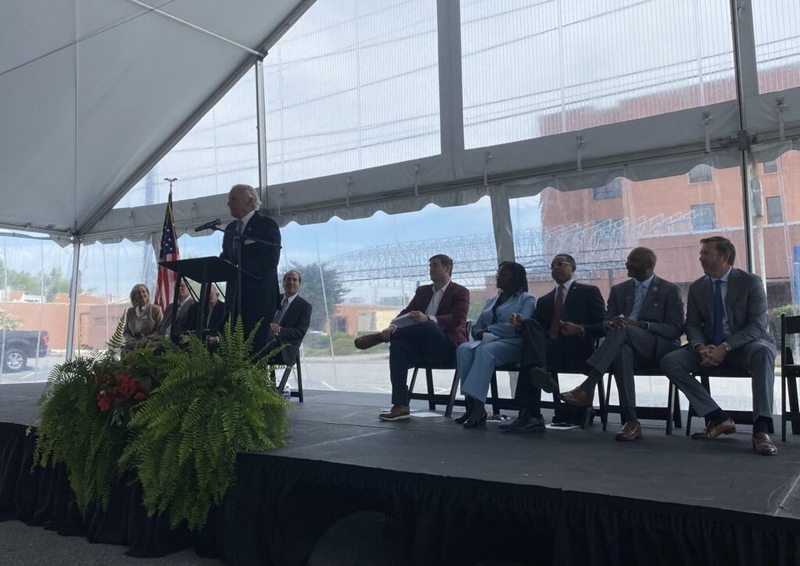
Gov. Henry McMaster speaks in Florence on June 15, 2023, to celebrate a $100 million state investment to build a regional behavioral health hub. The center that opened in August 2025 is named after the late Senate Finance Chairman Hugh Leatherman of Florence and his wife Jean. Behind McMaster are officials with McLeod Health, the Medical University of South Carolina, the state Department of Health and Human Services, and legislators. (Photo by Jeff Leieritz)
If you or someone you know is in crisis, please call, text, or chat 988 to reach the 988 Suicide & Crisis Lifeline. Help is free, confidential, and available 24 hours a day, seven days a week.
In January, South Carolina will swear-in its first new governor in 10 years.
If you’ve heard our current governor speak publicly, you’ve likely heard him beam with pride as he discusses the state’s booming economy and the $54 billion in new capital investment during his tenure. In other settings, Gov. Henry McMaster has touted raising starting teachers’ pay by 68% in South Carolina and providing funds to place a school resource officer in every public school in the state.
These are all legacy-building accomplishments.
However, the benefits of what might be McMaster’s greatest impact may never be fully known.
Mental illness, which often hides in plain sight, can be like that.
On Jan. 19, 2022, I received a call from the governor’s office advising that he was going to call on the South Carolina Department of Health and Human Services to address youth mental health.
A few hours later, in his State of the State address, McMaster declared “a mental health crisis exists in South Carolina” and tasked the agency with “an immediate review of our state’s behavioral health funding and delivery system.”
This declaration and call to action kicked off a series of actions. An audit, a study, fiscal analysis and Statehouse meetings. Within four months, policy proposals were developed to address the
state’s mental health-to-student ratio, which stood at a staggering one mental health counselor per 1,300 students.
These commonsense proposals became policy and took effect two months later.
The foundational change supporting these changes was an incentive structure that based reimbursement levels for these services on counselors’ level of licensure. This new incentive structure was coupled with a collaborative approach that made it easier for school districts to directly hire counselors and partner with licensed counselors from the private sector.
Importantly, these changes included a robust survey and data monitoring component to ensure services being billed were being delivered as authorized.
Announcing these changes came with an audacious goal: cut the ratio in half by the start of the following school year.
Mental health counselors in schools doubled since 2022, report finds
South Carolina did.
Survey data from the start of the 2023-24 school year showed a mental health counselor-to-student ratio of 1-to-653. Progress has continued as the rate improved to 1-to-567 at the start of last school year.
The state’s improvement in providing access to school-based behavioral health services led to additional, and sorely needed, investment in the state’s behavioral health system.
In June 2023, the Department of Health and Human Services awarded $45.5 million to hospitals across the state to build 13 specialized hospital-based emergency department units dedicated to behavioral health crises.
In August 2025, a collaborative effort between state agencies, hospital systems, educational partners and the city of Florence led to the opening of an innovative, $100 million-plus regional
behavioral health hub to serve the Pee Dee region.
In the Upstate, a $138 million Prisma behavioral health hospital is currently under construction in Easley.
Together, these efforts were designed to invest in infrastructure and help identify and address behavioral health issues from an early intervention system, in the case of school-based counseling, to high intensity intervention, in the case of hospital-based services.
More opportunities remain.
In 2024, an independent study described South Carolina as having the “most fragmented” health and human services system in the country.
Progress has been made on this front too.
In June 2025, McMaster signed a bill (S. 2) into law aimed at addressing that fragmentation by consolidating three adjacent state agencies into the newly created South Carolina Department of Behavioral Health and Developmental Disabilities.
Bill that aims to improve services for people who ‘fall through the cracks’ advances in SC Senate
Placing these agencies and their citizen-facing programs under a common governance and single point of accountability has the potential to streamline services while also increasing efficiencies by consolidating duplicative functions.
Effective leadership of these services can (literally) be a vital difference maker.
September is recognized as National Suicide Prevention Month; as we move later into the fall, I’m reminded of another call I received about a mental health crisis. On Valentine’s Day 2015, a neighbor called to tell me my dad had died by suicide.
That call was my real introduction to the need for effective leadership and access to these critical services.
Suicide is preventable.
Under McMaster, South Carolina has made significant progress in living up to its motto: “While I breathe, I hope.”
With the newly established agency’s placement in the governor’s Cabinet, Attorney General Alan Wilson or Rep. Jermaine Johnson will have an opportunity to build on a critical, albeit less-publicized, piece of McMaster’s lasting legacy.
Columbia