Missouri school funding task force nears final recommendations
Sep 15, 2026 | 8:00 am ET
Description
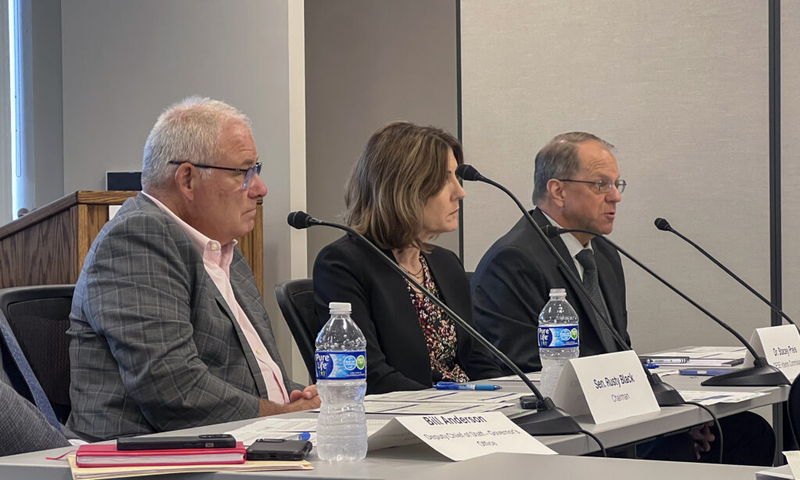
State Sen. Rusty Black, interim education commissioner Stacey Preis and former education department deputy commissioner Kari Monsees lead a meeting of the Missouri School Funding Modernization Task Force in Jefferson City Monday(Annelise Hanshaw/Missouri Independent).
The Missouri School Funding Modernization Task Force is entering the final stretch of its 15 months of meetings, preparing a set of recommendations that could change the way the state funds public education.
The group is poised to review a draft of its plan to update the public school funding formula on Oct. 19 — the first of just two meetings scheduled before the task force’s report is due to Gov. Mike Kehoe in December.
“We are in that phase of transition from all the research and building recommendations to getting a final product of a recommendation document or a task force report and collecting additional feedback from stakeholders,” Kari Monsees, the state education department’s former finance chief, said during a task force meeting Monday.
If all of the group’s recommendations become law, the cost of the formula would increase by over $600 million, Monsees estimated. The proposal’s impact on individual school districts has yet to be calculated, but the department will publish some simulations “at or around” the October meeting, he said.
Monsees, who has been facilitating the group’s 11 meetings, referred to the group’s work as the first of three steps to update the formula. Next, the governor’s office will have a chance to convey its preferences to lawmakers — who are ultimately responsible for passing a law to replace the old funding model.
The cost of the current formula has risen in recent years, drawing much concern during the legislature’s budget debates. During this year’s legislative session, lawmakers ultimately refused to fund a $190 million increase stemming from a 2024 law that tweaked the formula.
Officials are preparing for tight budgets in the years ahead as the state exhausts its reserve. Wary of the thin margins, even members of the State Board of Education are looking to scale back how much the department is asking for in the formula.
Those fiscal pressures will likely shape whatever changes lawmakers ultimately make to the education funding formula, and the task force’s report will include a number of elements that can be downsized or modified to reduce the price tag associated with the new formula.
Task force members had the political pressures facing lawmakers in mind Monday as they discussed recommendations for a handful of elements.
Hold harmless
The current formula has two provisions intended to safeguard districts from receiving less in state aid than they had received under the prior model, which was overhauled in 2005.
Districts with more than 350 students are guaranteed funding on a per-pupil basis at or above what they received in the 2004-05 school year with an adjustment for regional wage rates. Small school districts are guaranteed a total state appropriation at or above their 2004-05 state aid, also adjusted for wage rates.
These protections cost the state $150 million annually, according to a study of the formula led by education nonprofit Aligned and reviewed by the task force.
Monsees recommended that the new formula phase out the hold harmless provisions over 20 years, but some members on the task force were hoping for a sooner end.
State Rep. Ed Lewis, a Republican from Moberly who lost his bid for state Senate in the August primary, said any formula is likely to become obsolete in 20 years and recommended a 10-year phaseout.
“Our whole goal is to get to a modern formula,”said Kerry Casey, who also serves on the State Board of Education. “We won’t ever get there if we keep it longer.”
But Monsees pointed to another purpose of the provisions: helping get a formula change through the legislative process.
“Nobody wants to sign off on their districts getting less money,” he said, adding that any phase-out would be “breaking ground” after decades with hold-harmless provisions.
Under his proposal, districts’ baseline amount would change from 2004 levels to funding they receive under the current formula.
“We need to give a recommendation that is founded in logic,” Lewis said. “Then it can meet (the legislative process).”
Small-schools grant
The new formula could also overhaul the small-schools grant program, which gives districts with 350 or fewer students a chunk of $30 million on a per-pupil basis.
The program gives the most to districts with daily attendance closest to 350 students. If a district has an average of 351 students attending daily, they receive nothing.
The task force hopes to eliminate this “funding cliff” by building a weighting factor into the formula that considers enrollment numbers with an option to also fund districts with few students spread over a large geographic area.
Monsees charted the proposal, showing a smooth distribution that tapers off at both ends.
The current model incentivizes small districts to keep the status quo instead of merging with neighboring districts, he said.
“It drives unintended consequences,” Casey said. “I am in favor of what we can do to minimize that and allow for bigger considerations to happen, meaning primarily what’s best for the students.”
The group also liked that the suggestion would be incorporated into the formula and would not be a separate line item in the budget.
“I don’t want to keep the small school grant if we can account for it through the formula,” Lewis said, adding that lawmakers do not always understand what the grant means when looking at the line item in the budget.
Proration
The task force also looked Monday at changing how the formula adjusts to a funding shortfall.
Currently, when state lawmakers appropriate less than the formula calculates to be sufficient, a number called the state adequacy target is adjusted downward, reducing the per-pupil funding districts receive.
This burden is not shared equally among school districts because of the protections barring funding from plunging below 2004-05 levels. Those who fall under the hold-harmless provisions do not see cuts while districts who have grown in the last 20 years receive less than the formula’s calculation.
Monsees presented options including a flat per-pupil cut, a percentage adjustment or a reduction that changes based on a school district’s local funding ability. The group ultimately decided to include all three in their recommendations and eliminate the current method of adjusting the adequacy target from their report.
“Everybody’s got skin in the game when it comes to using the last three approaches,” Monsees said.
Before the next meeting, the department plans on creating an informational presentation to solicit feedback on the recommendations.
Jefferson City, MO