Fewer students, too many schools: Communities confront closures and consolidations
Sep 15, 2026 | 5:00 am ET
Description
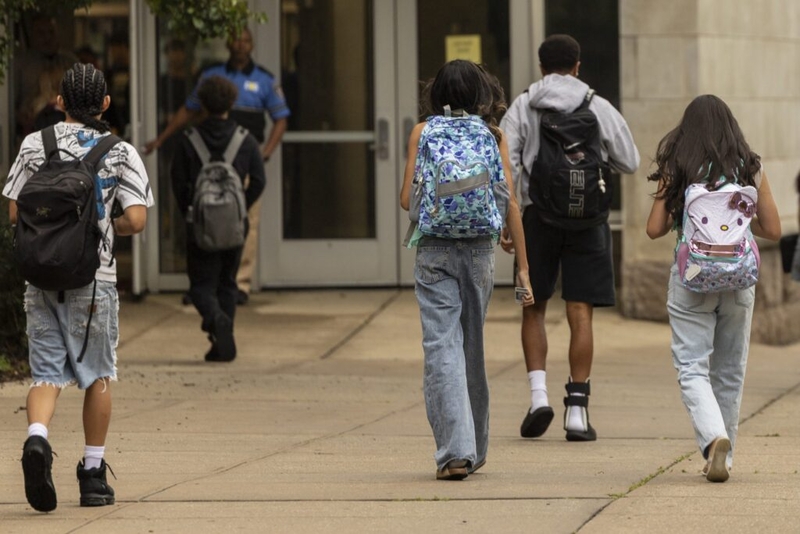
Students head into a New Jersey high school this month on the first day of classes. As student enrollment drops, more communities across the country are facing school consolidations and closures. (Photo by Anne-Marie Caruso/New Jersey Monitor)
Declining birth rates mean fewer students.
And that means more districts grappling with whether to close or merge schools.
“The big shrink” is how Marguerite Roza, director of Georgetown University’s Edunomics Lab, described what is happening nationally.
“When there are fewer young people, obviously it’s going to change the shape of public education,” Roza said. “As more and more schools are existing that are half empty, some downsizing needs to take place for them to live in their current financial structure, and districts are really loath to do that.”
Driven largely by declining birth rates but worsened by several other factors, district and school board decisions to close and consolidate schools can draw anger and anxiety from parents and students. Many states are stopping short of forcing mergers, but taking a variety of steps to encourage them.
The expiration of one-time federal pandemic relief funding has worsened the financial pressure on school districts, Roza said.
The COVID-19 pandemic also accelerated interest in homeschooling, virtual education and other alternatives to traditional public schools, according to Megan Bowen, high school director at the U.S. Career Institute, a Colorado-based online education provider.
And the immigration crackdown also may play a role. Before being elected and becoming House speaker in the Colorado legislature, Democratic state Rep. Julie McCluskie was a public school employee at Summit School District in one of the state’s rural resort towns. She told Stateline the reasons for the state’s yearly decline in public school students — and in her district — includes heightened immigration enforcement under the second Trump administration.
“I think the demographic decline in birth rate is an obvious factor to point to, but certainly in my community we have seen immigrants leave because of what’s happening on the national landscape and that has been part of our decline,” she said.
McCluskie in 2024 proposed a formal study of declining enrollment but the provision didn’t pass. She said the issue wasn’t getting enough attention then, but as student numbers continue falling, schools may seek a glide path.
“It is going to force us to do things differently in our school settings,” she said.
More than 1,000 public schools closed nationwide in the 2025-26 school year, according to preliminary National Center for Education Statistics data. It’s the fourth year in a row that school closures have gone up.
School closures were taking place prior to the pandemic, as National Center for Education Statistics data show more than 1,000 public schools closed each school year from 2010-11 through 2019-20. But closures took a dip during the pandemic.
Now closures and consolidations are rebounding and districts across the country are making tough decisions with budget challenges coinciding with falling enrollment.
In Austin, Texas, the school district’s board approved the closure and consolidation of 10 schools for 2026-27 that will affect almost 3,800 students. A restructuring plan in Cleveland, Ohio, will lead to 29 fewer schools across the Cleveland Metropolitan School District.
Other cities including Houston, Pittsburgh and Philadelphia have similarly identified schools for closure or consolidation as they grapple with similar trends of declining enrollment and aging facilities.
For districts and schools, this means continuing to pay for principals, nurses, librarians, custodians and maintaining other costs of running a school even when the student population drops.
The number of students is expected to continue declining. Nationwide, U.S. enrollment dropped from nearly 50.8 million to almost 49.4 million K-12 students between 2019 and 2024, or 2.8%, according to the National Center for Education Statistics. That number is projected to drop even further to about 46.9 million students by 2031, the center data estimated.
Enrollment declined in 40 states between 2019 and 2024, the data showed.
West Virginia saw the largest drop, at 8.1%. Hawaii, New Hampshire, Mississippi, New Mexico and Maine followed, with each losing more than 7% of its K-12 enrollment.
David Steiner, executive director of the Johns Hopkins Institute for Education Policy and a former New York state education commissioner, said this “demographic time bomb” poses financial trouble for schools.
“Just because your number of students goes down, doesn’t mean that your fixed costs go down,” Steiner said. “(Schools have) got fixed costs, they’ve got budgets that are shrinking, a school population and a teaching force that is shrinking and it’s very, very difficult to put all those pieces together.”
States encourage mergers
States have different rules and assistance for school consolidations.
Vermont has long been a unique case when it comes to education funding. Up until now, property taxes from across the state had been pooled under a complex funding formula; school districts proposed budgets that were voted on at the local level.
That’s changing. Although lawmakers dropped a proposal to force school districts to consolidate, they passed new laws under which funding formulas will change and the state will require school districts to form regional committees that will consider merging.
Vermont has lost about 20% of its student enrollment over the past two decades, the state’s Education Secretary Zoie Saunders told Stateline. Saunders said the decline has financially hamstrung districts and schools and access to public education, making it “more dependent on ZIP codes.”
“For the last two decades, the state of Vermont has been struggling to achieve scale,” Saunders said. “We want those dollars to get into the classroom and so the work that we’re doing in Vermont, is more than right sizing.”
4-day school weeks are growing in popularity, despite a lack of data on the effects
In Arkansas, a 2004 law had required school districts with 350 students or fewer for two consecutive years to consolidate or be annexed. In 2023, lawmakers softened their approach to make the decision to be consolidated or annexed voluntary.
The change came as parents and community members raised concerns over the loss of rural schools and long bus rides, the Arkansas Advocate reported.
A 2022 peer-reviewed study examining Arkansas’ consolidation policy found either no effect or small positive effects on math and English language arts achievement, but found no evidence that consolidation reduced overall costs nor shifted a larger share of district spending into classroom instruction.
In California, after the Oakland Unified School District approved a series of school closures in 2022 that drew criticism over their potential disproportionate impact on Black students and a lack of community engagement, the legislature passed a law that requires financially stressed districts to undergo an equity impact analysis before a school can be closed or consolidated.
California’s Department of Justice found that the proposed closures, rescinded by the Oakland school board in 2023, would have disproportionately affected Black and low-income elementary students as well as high-needs students with disabilities.
Under the 2022 law, districts need to publicly explain why schools were selected, where displaced students will go, how programs will be maintained, what happens to the vacated buildings and how transportation will work. In their analyses, districts must consider building conditions, operating costs and expected savings, unused capacity, student demographics and transportation among other things.
The policy comes as California’s public-school enrollment has fallen nearly 8% since 2016-17, a loss of roughly 485,000 students.
Illinois enacted a new law in 2025 allowing the State Board of Education to award grants to districts to encourage reorganization feasibility studies. Initial legislation would have gone further with a requirement that the state board identify neighboring districts that could be good candidates for consolidation studies, but lawmakers ultimately approved a voluntary grant program.
Beginning this year, the state can provide up to $16,000 for studies examining enrollment projections, school capacity, potential building closures, transportation, finances and academic programs.
What happens to students?
Olathe, Kansas, native Nicole Trendel has a second grader who attends Black Bob Elementary, one of the six schools that the Olathe Public Schools has recommended for closure. Trendel is one of many parents raising concerns before a final vote on the closures takes place in October.
In addition to declining enrollment caused by lower birth rates and rising home prices, district officials have cited financial pressures from special education underfunding.
For Trendel, the enrollment pressures facing Olathe are also tied to affordability, including rising property taxes, school bond measures and increasing costs of raising children.
She said she and other parents are criticizing a lack of communication and transparency on the decision to close the elementary school as well as how students of the school’s dual-language immersion program will fare being moved 2.3 miles to Arbor Creek.
“We’re just asking to get the full picture,” she said. “We know nothing about where our kids are going. We know nothing about what next year’s gonna look like for them.”
A recent study tracking students affected by hundreds of Texas school closures from 1998 to 2015, found that, although short-term test score declines generally faded, affected students were less likely to graduate from high school, attend or complete a four-year college or be employed as young adults, and had lower earnings in their mid-20s.
States try new measures to get chronically absent students back to class
Schools often serve as neighborhood hubs for after-school programs, health services, family support and other resources, while a vacant building can become a deteriorating asset if districts do not have a plan for what comes next.
Angira Sceusi, executive director of RedefinED Atlanta — a nonprofit focused on improving access to high-quality K-12 public education across metro Atlanta — said states could require districts to separately track the academic performance of students displaced by consolidation rather than simply measuring the overall performance of their new school.
“What are the students from the consolidated school doing?” she asked. “How are they doing as a cohort, and are they thriving or not?”
Sceusi said students should be moved to higher-performing schools when their previous schools consolidate, an approach she said research has shown is critical to creating better opportunities rather than merely moving children from one building to another.
States could also consider temporary “stabilization funding” to help districts manage the transition, she said, although she was not aware of states currently incorporating such a policy into their consolidation plans.
That money could support students leaving a school, but also students already attending the building that receives them, and the latter is frequently overlooked, according to RedefinED Atlanta officials.
“Even though there’s an existing school that kids are coming into, in effect there is a new environment that they’re all stepping into,” Sceusi said.
Roza, of Georgetown, said many current superintendents and school board members have never been in a situation with so much change to public schools enrollment and funding.
“A lot of the leaders of these districts haven’t lived through a moment of contraction,” Roza said. “So it’s really demanding a new skill set from them that they haven’t practiced.”
She added, “Another thing is that these districts don’t do the work of downsizing, and then they turn to the state and say, ‘Oh my God, we don’t have enough money. You need to give us more money.’”
In addition to deciding the future of a school, Roza said that districts are trying to avoid making other whiplash decisions that could cause community backlash such as eliminating advanced courses, electives, athletics or other programming.
Stateline reporter Robbie Sequeira can be reached at [email protected].