Eyeing copper, mining giant BHP returns to Alaska
Sep 14, 2026 | 4:30 pm ET
Description
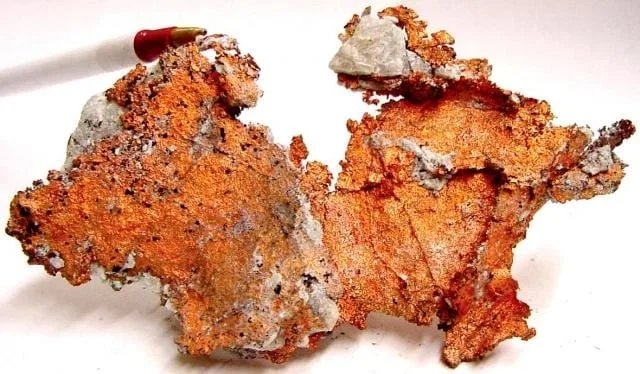
A sample of copper — a metal that one of the world's largest mining companies is now targeting in Alaska. (U.S. Geological Survey)
This story was originally published in the Anchorage Press. Subscribe here.
The world’s largest mining company is back in Alaska.
More than a decade after abandoning a search for coal in the western Arctic, Australia-based BHP quietly staked new mineral claims this summer in a remote part of Southcentral Alaska — with an eye for copper.
The company, which owns huge iron, coal and copper mines around the world, also conducted sampling and aerial surveys in Alaska in recent months, a BHP spokesperson told the Anchorage Press.
The project is still in the earliest stages of exploration, likely many years if not decades away from becoming an active mine. Most claims that mining companies stake never actually get developed; a subsidiary of a different mining giant, Rio Tinto, abandoned claims in 2013 in the same area that BHP is now showing interest, according to state records.
But BHP’s foray into Alaska is still notable given the company’s deep pockets and global reach, and as the latest example of the mining industry’s surging interest in the state.
Unlike the small, cash-strapped companies that do much of the claim-staking and early-stage exploration work in Alaska, BHP has the financial horsepower and expertise to turn a prospect into a mine.
“They are not going to farm it out to anyone if they find what they’re hoping to find,” said Dave Szumigala, a state mineral exploration geologist with decades of industry experience. “They’ve got the resources to take it all the way through development.”
BHP’s interest in Alaska comes amid high commodity prices, increased global demand for metals like copper and an intense push by the Trump administration to spur resource development in the state.
The company’s return to the state also reflects an uptick in new mining claims across Alaska, and it could contribute to a backlog in the Dunleavy administration’s processing of those claims.
The number of claims staked this year statewide is on track to double from last year, according to Steve Buckley, head of the mining section at the Alaska Department of Natural Resources.
Buckley’s team, which reviews and approves state mining claims, has reported a backlog of more than 10,000 claims this summer. The department has transferred three employees — more than doubling typical capacity — to help work through the backlog, Buckley said.
“It’s unprecedented,” he added.
Buckley declined to comment on BHP’s claims because they are still pending review. But he said large new claim blocks make up “a good portion” of the state’s backlog, which could take months for officials to clear.
State land managers have not yet reviewed and approved BHP’s claims, meaning they don’t appear on the state’s public mining claims database.
But documents filed with the state recorder’s office show that BHP staked dozens of claims across thousands of acres in the heart of the Alaska Range at the beginning of the summer.
Many of the claims appear to be deep in the mountains near the northern edge of Lake Clark National Park and the upper reaches of the Skwentna River, a tributary of the Susitna River, about 100 miles west of Anchorage and the state’s road system.
Szumigala called that region “very prospective” for massive, low-grade copper concentrations known as porphyry deposits.
He also noted that BHP’s interest in the area could draw more investment from other companies. Small exploration firms often stake claims next to majors, he said.
“One way juniors will get investment in their company is to say, ‘Well, we staked right next to BHP’s property,” Szumigala said.
BHP confirmed that it’s assessing the area’s copper potential.
“Through the summer months we commenced non-disturbing studies as part of a first, early-stage exploration program to better understand the area’s geology and resource potential,” the company said in a statement provided to the Anchorage Press. “As we advance this work, we are meeting with local stakeholders to learn more about the region.”
BHP has not applied for permits to conduct more intensive exploratory work like drilling.
“Exploration is inherently a long-term process,” the company said, noting that “the vast majority of exploration programs do not advance beyond the early stages.”
BHP has met with representatives from the region’s Alaska Native corporation, CIRI, to review maps and discuss cultural training, a CIRI spokesperson said.
Environmental groups, meanwhile, say they’re working to ensure that new mining in the state doesn’t come at the cost of public lands and wildlife.
The broad uptick in state mining claims is a “real cause for concern, especially when DNR can’t even keep up with them,” said Mary Catharine Martin, communications director at the conservation organization SalmonState, using an acronym for the Alaska Department of Natural Resources.
In an email, Martin cited four principles about development espoused by the late Alaska governor Jay Hammond.
“Do Alaskans want it? Does it pay its own way? Is it environmentally sound? Does it meet our constitutional mandate to manage our natural resources for the maximum benefit of all Alaskans?” Martin said.
Juneau