Kansas Republican Ty Masterson concentrates gubernatorial campaign on generational change
Sep 14, 2026 | 11:40 am ET
Description
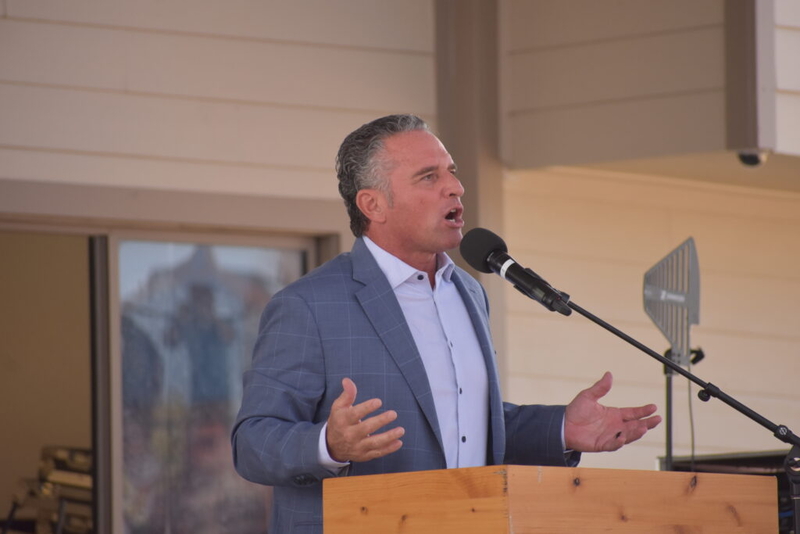
Senate President Ty Masterson, the Republican Party's nominee for governor, says on the Kansas Reflector podcast that he's eager to transform the state into a place that generations of Kansans find fulfilling. In this image from Sept. 12, 2026, Masterson speaks at the Kansas State Fair. (Photo by Jill Hummels for Kansas Reflector)
TOPEKA — A little-known fact about Kansas Republican gubernatorial nominee Ty Masterson is that he could be a real contender in a dairy cow milking contest.
“I know how to milk a cow by hand,” said Masterson, who grew up on a farm in Butler County with brothers assigned duties by his father. “We were the labor force out there.”
What’s well known is Masterson’s skill at snagging the pivotal endorsement of President Donald Trump. That campaign reality prompted former Gov. Jeff Colyer to drop out of the GOP primary. In August, Masterson leaned into the alliance with Trump to land 43.2% of the Republican vote in a field of seven candidates. He doubled the take of his closest rival, businessman Philip Sarnecki, who claimed 22.3%. He easily outperformed Insurance Commissioner Vicki Schmidt’s 13.6% and Secretary of State Scott Schwab’s 10.9%.
In the general election Nov. 3, he’s up against Democratic nominee Cindy Holscher, a Johnson County state senator who secured a 48.7%-to-38.6% victory over fellow Democrat Ethan Corson in August.
“The stakes couldn’t be any higher, the choice any clearer,” Masterson said on the Kansas Reflector podcast. “We’re clearly in different positions on all the big controversial things and we have records that show that.”
Masterson, 56, of Andover, started in politics in early 2005 as a member of the city council. He was eager to reform the city’s reliance on impact fees assessed for residential construction. His company built homes, but it didn’t survive the recession that crashed the global economy in 2008. He filed for bankruptcy in 2011, a process that left a lasting impression.
“It’s made me more relatable to a lot of people because I’ve been there,” he said. “I’ve been down. I’ve been up.”
He’s on leave as director of GoCreate, a community workshop located on the campus of Wichita State University. He said he was recruited to lead the Koch-funded initiative because it was interested in hiring a director who made it through life without a college degree.
“We go after what they call nontraditional kids, kids that aren’t typically aimed for college,” he said. “It’s a shop, and we have things like water jets and 3D printers and laser engravers and things that you wouldn’t have in a typical garage. We try to get the kids excited about learning about making things. It’s been incredibly successful.”
Masterson transitioned to state politics after being appointed to a vacancy in the Kansas House in 2005. He won election to the Kansas Senate in 2008. The conservative lawmaker has served as president of the Kansas Senate for five years.
“When I came up, I was I think a little intimidated, honestly, thinking I needed to be an attorney, right, because you’re dealing with statutes,” he said. “I realize this is just … about relationships, and you want everyday people there. I do like that we’re a citizen Legislature.”
He said the decision to run for governor stemmed from a desire to reshape government and build a stronger foundation for his six children and eight grandchildren, and others like them, so they could remain and prosper in Kansas for generations. Part of that involved pivoting from policies advanced by two-term Democratic Gov. Laura Kelly, he said.
“I just have a deeply vested interest in this state,” Masterson said. “I’m very conscious of the fact that my clock’s going to time out, and I’ve got little clocks that haven’t even started yet that I care about deeply. I want to make this the greatest state in the nation to live, work and raise a family. It’s pretty much that simple.”
State tax reform
Kansas voters have been eager for the state to do something about rising property taxes, but the task has proven challenging. The Legislature in 2025 eliminated the 1.5 mill property tax used to generate funding for building maintenance at public universities. But the heart of the matter remained local residential property taxes. Action by the Legislature would step into the jurisdiction of officials elected to city councils, county commissions and school boards. Politically, not even the House and Senate have reached consensus.
“It is the one tax that taxes people on an unrealized gain, all because your house may or may not sell for more in the market,” Masterson said. “You’re paying on that higher number, right? That doesn’t mean you have more money in the bank. They’re counting that as an asset, and you’re paying on that. And the result of that is we’re taxing people out of their homes, particularly the fixed income people.”
Masterson sought a constitutional amendment in the 2026 legislative session that would cap annual increases in assessed valuation of property at 3% per year to avoid big leaps in property taxes due to surging valuations. Other state legislators favored a mandatory cap on increases in property tax mill levies.
In 2024, the Legislature agreed to create just two state income tax rates — 5.2% on income up to $23,000 for an individual, 5.58% for income above that threshold — and raised standard deductions and personal exemptions. That amounted to an estimated $2 billion in state revenue reductions over a five-year period. Future growth in state income tax revenue has the potential of chipping away at the state’s income tax rates.
“That’s what’s missed by a lot of people. It’s if the growth growth is there, the tax revenue growth, then it buys it down,” Masterson said.
State lawmakers also eliminated the income tax on Social Security benefits and agreed to drop the state sales tax on groceries.
Reductions in revenue have been significant, but the state started a rainy day fund that holds more than $1.5 billion. During the past two years, lawmakers approved spending that was about $700 million more than the state collected annually in tax revenue. That deficit was covered by the state’s cash reserves, but burning through reserve funds could take Kansas back to a budget crisis initiated in 2012 when then-Gov. Sam Brownback slashed state income taxes without reducing spending a commensurate amount.
Masterson opposed repeal in 2017 of the Brownback’s program to eliminate the state income tax in Kansas.
Other key issues
Loud opposition has emerged in Kansas to construction of data centers. Part of the commotion reflected a 2025 state law granting a 20-year state and local sales tax exemption for construction, remodeling and equipment acquired for qualified data centers in Kansas. Some folks don’t want the facilities near the homes, and the tax break served to fuel their opposition.
Masterson defended the tax incentive, but said people failed to acknowledge the law required data center developers to purchase electricity rather than build their own power plants. Parts for data centers cannot come from China.
“I think we do need to add some additional guardrails,” Masterson said. “Make sure that it’s not possible to use eminent domain. I don’t think they can now, but that might need to be clarified.”
In the end, he said, decisions about individual projects should be made at local levels of government rather than at the state Capitol.
Masterson has been an opponent of abortion rights and objected to the 2019 decision by the Kansas Supreme Court that the Bill of Rights in the Kansas Constitution created a fundamental right to bodily autonomy, including the right to end a pregnancy. Kansas voters rejected an amendment to the constitution in 2022 that would have nullified that Supreme Court ruling.
In August, Kansas voters defeated a constitutional amendment that would have mandated direct election of Supreme Court justices. Advocates of that amendment said, in part, that elections for Supreme Court justices would change composition of the court to more easily restrict abortion.
Masterson supported both amendments, but argued the most recent measure wasn’t about forcing conservative decisions from the Supreme Court. He said the state’s nonpartisan nominating commission responsible for interviewing, vetting and suggesting finalists for the Supreme Court — governors make the actual appointment — was unfairly controlled attorneys on the commission. Passage of the amendment would have killed the nominating commission.
“It was about changing the system to put the people back in charge of that branch of government, because it has become the most powerful branch,” Masterson said.
Masterson, who attended Kansas State University for two years before moving to Wichita to start a business, said he supported the idea of using state tax dollars to support private schools because public school students deserved the opportunity to get away from underperforming schools.
“We have we have kids that in effect are trapped by their zip code,” he said. “We cannot leave those kids like that. They just learn to be on generational welfare or they learn crime pays.”
He said Kansas should mirror the Mississippi requirement that third-grade students demonstrate proficiency in reading before advancing to the fourth grade. The policy helped Mississippi rise from 49th to ninth in NAEP standardized testing of fourth-graders, he said.
“We have to do things inside public education to get … serious about literacy. Because no matter what you do on school choice, the public system is going to be the way most kids are educated,” Masterson said.
Topeka, KS