As Election Day 1876 neared, politicians hit the stump in Colorado’s mining boomtowns
Sep 11, 2026 | 6:00 am ET
Description
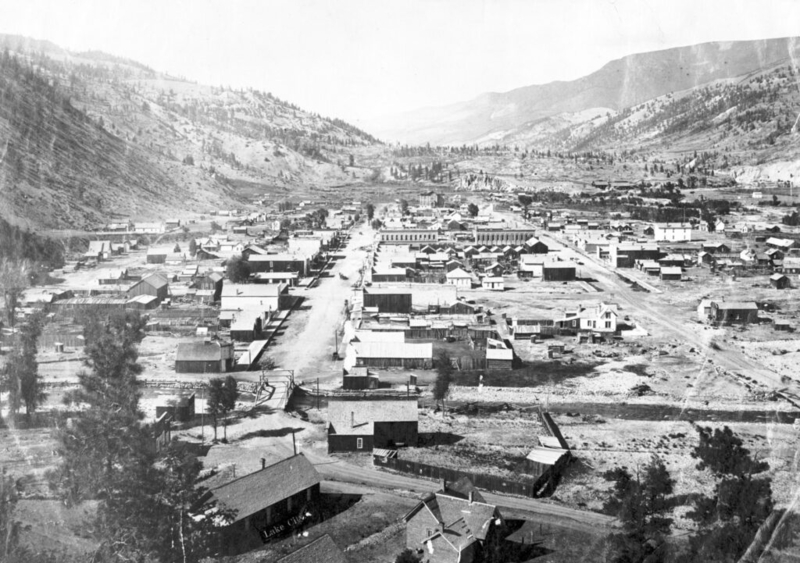
The town of Lake City, Colorado, is pictured in this photograph dated between 1880 and 1883. (Courtesy of Denver Public Library Special Collections, X-64)
With Republicans in control in Denver and southern Colorado considered solidly Democratic, the swing counties in Colorado’s 1876 election lay in its mountain mining districts.
Voters in these diverse, rough-and-ready boomtowns had been an important constituency since the early days of the Colorado Territory. They were pivotal in defeating an 1864 attempt at statehood out of concern about taxes and other government intrusions, and in 1874 they were instrumental in electing Democrat Thomas Patterson, an Irish-American Denver lawyer, as the territory’s non-voting delegate to Congress.
Patterson’s 1874 election sent shockwaves through a Republican establishment that had long dominated territorial politics, and now the “Little Tiger,” as the newspapers called him, hoped to return to Washington as the Centennial State’s first full-fledged congressional representative. He faced Republican nominee James Belford in what was shaping up to be the marquee race in Colorado’s inaugural state elections, set for the first Tuesday in October.
Colorado’s predominantly GOP-leaning press was forced to admit that Patterson was an energetic campaigner and gifted public speaker, even as they urged readers to remain loyal to the Republicans.
“Mr. Patterson as an orator has few equals,” said the San Juan Prospector of a Patterson speech in Del Norte on Sept. 11, 1876. “But while Mr. Patterson, by the suavity of his manner has taken a fast hold on the people of this country … many do not coincide with him in his views in regard to National questions.”
In 1876, Colorado railroads extended only as far west as Floyd Hill in the present-day Interstate 70 corridor, and Cañon City in the south. For statewide candidates like Patterson and Belford, campaign stops in frontier mining camps entailed long stagecoach trips over rugged mountain wagon roads. Despite “not feeling very well owing to his long ride,” the Prospector noted, Patterson addressed citizens in Del Norte for an hour and a half.
Dueling Democratic and Republican meetings in Georgetown on Sept. 9 “had the effect of bringing the miners to town by the hundreds, and persuading nearly all the residents to come out,” reported the Colorado Miner.
“We could note but little difference in the size of the audience in the two halls,” the paper added. “Both parties certainly manifested enthusiasm in giving their respective speakers good houses, and applauding them at every opportunity.”
In Lake City, as many as 1,200 people turned out for a Sept. 14 event featuring both Patterson and Belford, one of the campaign season’s few face-to-face debates between two candidates for the same office.
“There being no hall in the town of sufficient seating capacity to contain the audience, the meeting was held in open air,” reported the Silver World newspaper.
Corruption scandals, silver coins and grasshoppers were the hot topics in Colorado’s 1876 election
Belford took to a stand erected in front of the town drugstore and spoke for an hour and 15 minutes, followed by a 90-minute speech by Patterson, after which Belford was given a 15-minute reply.
“Despite the lateness of the hour and the growing chilliness, (Belford) held the audience till the close, and when his time was up was greeted with cries of ‘go on,’ but the terms of the agreement were adhered to and at half-past ten o’clock closed the largest and most enthusiastic political meeting ever held in San Juan,” concluded the Silver World.
As statewide candidates hit the stump across Colorado, county-level party conventions met to fill out their slates with nominees for the state Legislature and local offices, adding to the month-long political frenzy. Some newspapers, like William Byers’ Rocky Mountain News in Denver, were rabidly partisan and churned out a flood of commentary as Election Day neared.
“A big crowd … came out at Granite last night composed mostly of miners. Belford’s position on the silver question suits the people exactly,” reported a front-page item in the News on Sept. 12. “The Republicans are wide-awake and will elect the whole ticket.”
“The prospect south is very encouraging,” it added the following day. “The people are wide awake to the important issues of the day and alive to the danger of placing the government of the nation in the hands of the (Democrats).”
Other publications spilled far less ink on the day-to-day campaign drama. Especially in small-town papers, the printed material gathered to fill column inches could vary widely from week to week. On Sept. 16, the front page of the Colorado Springs Gazette featured poetry, an excerpt from a Rutherford B. Hayes campaign biography, and a short article on the latest fashion in fall bonnets, republished from Harper’s Bazaar.
And in Georgetown, the Miner’s Sept. 16 issue featured a short story about a boy who, upon being punished by his aunt with the chore of painting a fence, had “a great inspiration burst in upon him,” and contrived to trick his friends into doing the work for him.
“WHITEWASH — Tom Sawyer’s Discovery in Human Nature,” read the headline. “From Mark Twain’s New Book.”
Denver, CO