Florida university speech ranks above national average, damaged by incidents
Sep 10, 2026 | 2:31 pm ET
Description
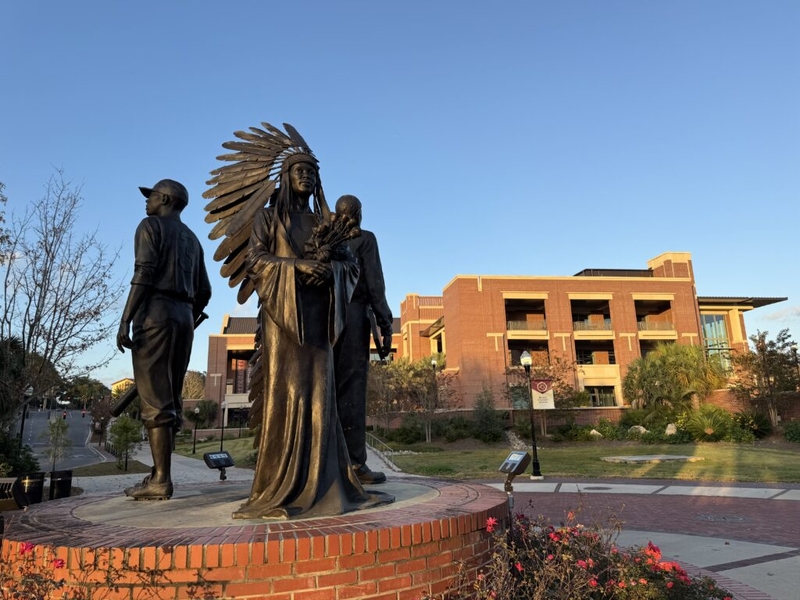
The Integration Statue stands in front of the Florida State University Student Union. (Photo by Jay Waagmeester/Florida Phoenix)
Florida universities deserve a “D” for their free expression policies and attitudes, the Foundation for Individual Rights and Expression announced in its annual 2027 College Free Speech Rankings.
The nationwide average is a D-, an improvement from last year’s F average. Florida’s average is D, calculated across seven universities, six of which are public.
Florida State University ranked highest among Florida institutions at 21st nationally, where it ranked among Florida schools a year ago.
FSU ranked highly for “administrative support,” which means students generally trust the administration to defend free speech.
The University of Florida dropped from 45th last year to 119th this year, with FIRE citing the UF College Republicans chapter being deactivated by the administration after a photo of members making a Nazi salute was circulated, as well as UF’s handling of retired UF law professor Jeffrey Harrison, who it stripped of his emeritus status after posting to social media about Charlie Kirk.
Florida International University damaged its ranking after attempting to punish students who protested the university’s cooperation with federal immigration enforcement. Also, FIRE pointed to FIU’s arrest of a student for sending WhatsApp messages in a large group chat asking Israeli Prime Minister Benjamin Netanyahu to bomb campus.
The FIRE survey does not seem to factor in a Florida Atlantic University professor who was placed on leave because of social media posts related to Charlie Kirk and subsequently filed a lawsuit against the university.
The survey gauges “comfort expressing ideas, self-censorship, disruptive conduct, administrative support, openness, and political tolerance.”
For Florida statewide, schools trended upward in five of those six categories and decreased in political tolerance.
According to FIRE, there are 1.53 “liberal students” for every “conservative student” at the surveyed Florida universities.
Nationwide
Of the 261 schools rated, 121 got an F for speech climate.
The nationwide overall free speech score of 61.4 out of 100 represents a seven-year high, according to FIRE. Florida scored 63.9.
“Too many college administrators wield their power to cancel controversial speakers, cave to government or student calls for censorship, and limit academic freedom. This report emphasizes the need for colleges to embrace their constitutional obligations wholeheartedly,” FIRE President and CEO Greg Lukianoff said in a news release.
Nationwide, 69% of students said shouting down a speaker they don’t like is acceptable, a 3% decrease from last year. Similarly, 30% said using violence is acceptable, a decrease from 34% a year ago.
At Utah Valley University, the campus where conservative influencer Charlie Kirk was shot to death, of the 204 surveyed students 94% said it is never acceptable to use violence to stop a campus speech. The year before, 81% of surveyed students answered that way.
“When asked to ‘share a moment where you personally felt you could not express your opinion on your campus because of how you thought other students, a professor, or the administration would respond,’ UVU students from across the political spectrum reported a chilling effect on their speech,” FIRE’s report states.
FIRE chief researcher Sean Stevens commented on the aftermath of Kirk’s killing: “Rather than view the tragedy as a warning about the extreme results of partisanship and inability to peacefully engage in dialogue, many college admins took it as an invitation to double down on censorship.”
The Israeli-Palestinian conflict, Donald Trump, Charlie Kirk, abortion, immigration, and transgender rights were atop the most difficult-to-discuss topics nationwide.
The top universities for free speech included the University of Chicago, Claremont McKenna College, and Georgia Tech.
The lowest-ranked included Texas State University, University of Washington-Seattle, and very last, New York University.
Only 24 schools were graded at C or higher.
Tallahassee, FL