Deep-pocketed donors flood the ballot-question field with cash
Sep 10, 2026 | 8:17 am ET

Description
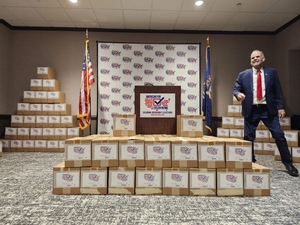
Opponents of a ballot question seeking to repeal the state’s 2016 legalization of recreational marijuana rally outside the State House on June 25, 2026.
THE SUREST SIGN that the election is fast approaching is the volume of donors and organizations who have begun to open their checkbooks. Yet despite the record-tying field of ballot questions going before voters, the money changing hands has not quite soared all the way up into the stratosphere — at least so far.
Campaigns supporting or opposing the nine measures on the November 3 ballot raised more than $18 million through the end of August, the most recent deadline to submit financial data to state regulators. Including in-kind donations, or work performed directly for a campaign in lieu of money changing hands, the total value rises to more than $21 million.
It’s a massive number, one that reflects the urgent stakes proponents and opponents attached to the ballot-box fights. With two months left until Election Day, the ongoing spending for and against nine different measures might well surpass the record for a single cycle set four years ago.
Yet campaigns so far have only raised about three-quarters as much as their counterparts did through the same point in the calendar in 2022 — an election that featured only four questions on the ballot.
The latest batch of financial data fills in a gap that stretched for most of the year: Under state law, ballot question campaigns do not need to reveal any new information about their fundraising or spending from the beginning of an even-numbered year until 60 days before the election, a blackout period that lawmakers want to change.

Some of the political battle lines are now clearer. Unions are lining up en masse against a business-backed effort to curb state tax collections. Recreational marijuana retailers have coalesced against an attempt to recriminalize the industry. And reform crusaders are willing to put big dollars behind separate but thematically linked proposals to reshape elections and government transparency.
Committees have already spent more than $13.7 million advocating for or against the nine questions on the ballot. Other groups burned additional cash on proposals the state’s highest court tossed from contention earlier in the year, including an attempt to revive rent control and a push to reduce the state’s income tax rate.
Already, each of the nine questions has prompted at least six figures of spending. The spectrum stretches from nearly $5 million in support of changing how primary elections work to a comparably paltry $156,000 behind the Secretary of State Bill Galvin-led push to allow Election Day voter registration.
Several proposals have generated significant financial activity even without much of a fight ahead. There are no formal opponents to questions allowing Committee for Public Counsel Serviceslawyers and other staff to unionize, permitting single-family homes on smaller lots, and earmarking a share of tax revenue for conservation efforts, yet supporters of each measure have already spent at least $1 million.
No group has hauled in more so far than the Coalition for Healthy Democracy, a campaign committee supporting both a public records law expansion question and a primary election overhaul measure. The group has collected nearly $5.2 million from donations and in-kind contributions, much of it from wealthy private-equity figures. Randy Peeler, a former managing director at Berkshire Partners, has already kicked in more than $1 million, and Andrew Balson of Cove Hill Partners has given the coalition nearly $800,000. (Peeler is a founding donor to CommonWealth Beacon.)
The effort to replace separate partisan primary elections with a single “all-party primary,” championed by Harvard University professor and former gubernatorial candidate Danielle Allen, could reshape the political landscape in Massachusetts. Wary of losing some of their influence, both the state Democratic Party and the state Republican Party oppose it, forming an unusual alliance with some unions and progressive critics of the status quo.
Tax policy is again one of the most potent topics in the mix this time around, a fact underlined by the amount of money already swirling around the debate about the cap on how much revenue the state is allowed to collect.
A coalition of business groups known as the Massachusetts Opportunity Alliance is pushing a question that would tweak the formula for how the annual limit on tax collection is set. If it passes, independent analyses suggest Beacon Hill would owe rebates back to taxpayers much more frequently than it does under the current system, which has only triggered the cap twice in nearly four decades.
The coalition itself has provided in-kind contributions worth $1.9 million since launching the campaign, while the Massachusetts High Technology Council — one of the coalition’s primary members — added another in-kind contribution worth nearly $46,000, records show.
The campaign added big-dollar donations from other noteworthy business groups and investors in recent months, too, including $100,000 from Ray Stata, the co-founder of Wilmington semiconductor manufacturer Analog Devices, and $50,000 from the Retailers Association of Massachusetts.
Most of the financial might marshaled in opposition to the tax cap reforms, more than $700,000 so far, has come from labor unions, many of which represent public-sector employees whose work and the services they provide could be affected if a tighter revenue limit prods state government to pare back its spending.
Meanwhile, almost all of the money for another politically fraught fight — whether to undo the 2016 vote legalizing recreational marijuana — has flowed into Massachusetts from out of state.
SAM Action Inc., a Virginia-based nonprofit fighting legal drug use in multiple states, has pumped nearly $3.2 million into the campaign behind the question. The nonprofit is not required to disclose its own funders, and only a handful of local donors have gotten involved so far with minimal contributions.
In the decade since its legalization, recreational cannabis has become a major industry in Massachusetts, and its members do not intend to roll over quietly. Local shops, industry groups, and other supporters have gathered almost $1.6 million so far in their attempt to convince voters they should keep pot widely available.
Regardless of whether the final financial numbers blast into record territory or fall to earth somewhat short of it, one outcome is certain: Between now and Election Day, a lot more money is about to be spent.
Boston