Alaska gubernatorial candidates participate in first forum since a post-primary ballot shuffle
Sep 09, 2026 | 9:36 pm ET

Description
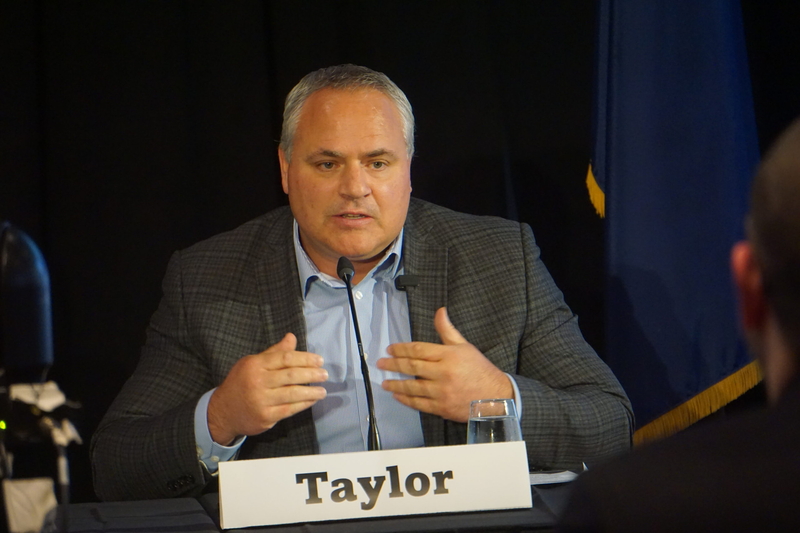
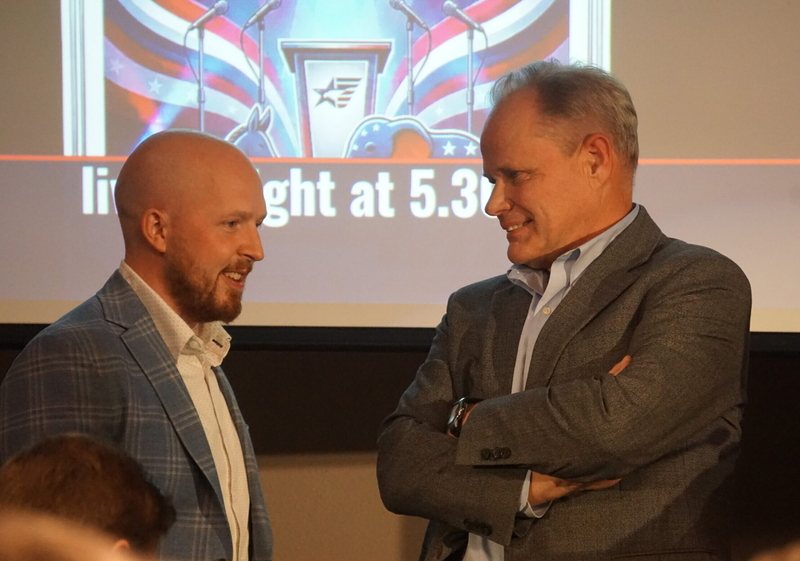
Former Anchorage Mayor Dave Bronson, a Republican candidate for governor, listens to a question at a Sept. 9. 2026, forum held by the Last Frontier Republican Club at the Petroleum Club of Anchorage. Next to him, from left, are former state Rep. Jonathan Kreiss-Tompkins, a Democrat, and former Attorney General Treg Taylor, a Repub.ican. The three, along with Republican Bernadette Wilson, who did not attend the event, are facing off in the general election. (Photo by Yereth Rosen/Alaska Beacon)
Three of the four remaining Alaska gubernatorial candidates discussed subjects ranging from the hard numbers that quantify the state’s fiscal challenges to more esoteric topics like quality of life on Tuesday in their first face-to-face meeting since a post-primary shakeup changed the field.
Former state Rep. Jonathan Kreiss-Tomkins, a Democrat, and former Anchorage Mayor Dave Bronson and former Attorney General Treg Taylor, both Republicans, pitched their visions for state leadership at a candidate forum held by the Last Frontier Republican Club.
It was a friendly audience for him and Taylor, Bronson noted at the event, held at the Petroleum Club of Anchorage.
“I’m assuming most folks in the room, except for maybe the media, are Republicans,” Bronson said.
It was the first post-primary forum for Taylor, who moved from the fifth to fourth spot on the open ballot after Democrat Tom Begich withdrew from the race. Among the 17 gubernatorial candidates in the open primary, Kreiss-Tomkins finished first, with 22.5% of the vote. Begich, a former state senator, finished second with 20.8% but pulled out of the race at the end of August and endorsed Kreiss-Tomkins.
Taylor joked about the rapid changes to the election field — he was removed from the ballot at the end of August because of financial reporting problems but then placed back on the ballot when Lt. Gov. Nancy Dahlstrom reversed her disqualification decision.
“I’m back!” he said in his opening statement. “Surprised nobody out there has a neck brace on. I certainly needed one for a little bit there, but it’s great to be back.”
Not attending was Bernadette Wilson, the top-ranked Republican with 10% of the primary election vote, putting her in third place among the 17 contenders in the primary and second among the four candidates advancing to the general election.
Bronson, who finished the primary just behind Wilson with 8.1% of the vote, aimed some veiled criticism at her, nonetheless.
One barb came during a discussion about the Alaska Permanent Fund dividend.
“Some people will tell you that you can cut your way to a full PFD. You can’t do it. It’s not mathematically possible,” he said.
Wilson has argued that state government should be drastically reduced and that the annual dividend payout should revert to its older and more generous form. That would not be possible, even if every state worker were fired, Bronson said.
Kreiss-Tomkins’ criticism during the forum was aimed at outgoing Gov. Mike Dunleavy, a Republican.
He said his plans for working with Republicans and independents as well as Democrats contrasted with what he characterized as a combative, highly partisan and unproductive approach taken by the current governor.
“If you have liked the last eight years of governance in the state of Alaska, you should not support us. If you want change, if you want a different approach to government in the state of Alaska, a problem-solving approach, a bipartisan approach, you should consider supporting me and Zac,” he said, referring to his running mate, Anchorage Assembly member Zac Johnson.
Variety of issues
The forum covered a wide range of issues, including fiscal topics, education, the proposed North Slope liquified natural gas pipeline, Cook Inlet natural gas needs, fishing, public employee pensions and data centers.
A key difference between Kreiss-Tomkins and the two Republicans at the forum concerns the use of public money for students’ education. Kreiss-Thomkins said he supports varied educational options that give students and families choices — including neighborhood schools, charters schools, correspondence schools — but he emphasized that public education money should go only to public schools.
“If parents want to educate their children in a private or parochial school, by all means, that should be their right, but I don’t think public money should pay for that education,” he said.
Taylor, an advocate of vouchers that can be used to pay for private schools, said parents should be able to use state funding to provide whatever they consider to be the best educational choice for their children.
“I, for one, am fully on board with a constitutional amendment that allows the money to follow the child,” he said. “The only way our education system gets better is if there’s competition, and there has to be viable competition.”
As the state attorney general, Taylor defended the Dunleavy administration’s policy of providing homeschool funding for students attending private schools. The issue continues to play out in the courts.
Bronson articulated a position on school choice similar to that of Taylor, including support for a constitutional amendment.
Under the approach he would take, “the money goes in the kid’s backpack and wherever the parent says the kid goes, the money goes with them figuratively,” he said.

For Kreiss-Tomkins, education shortcomings are at or near the top of the list of factors that feed the demographic trend.
“A lot of the people who are leaving the state are people in my generation,” he said. “Key reasons they’re leaving: They’ve lost confidence in the quality of schools in Alaska.”
Bronson agreed with Kreiss-Tomkins that Alaska’s educational system has deteriorated and that the poor quality is a big factor in the state’s negative demographic trend.
But Taylor said the key to reversing the loss of working-age adults was to expand resource extraction industries. More economic activity through resource development would draw more working-age people to Alaska and keep more here, he said.
“We haven’t fully embraced the idea that we are a resource state, in my opinion,” he said.
Other differences on display concerned labor issues.
Kreiss-Tomkins said he would have signed a bill passed by lawmakers, House Bill 78, that would have restored a defined-benefit plan for public employees. To save money, the state switched two decades ago to a defined-contribution pension system. But lawmakers supporting House Bill 78 concluded that the change made working in Alaska less attractive. Dunleavy vetoed that bill, and lawmakers fell short when they tried to override the veto.
Taylor said he opposed the bill and agreed with Dunleavy’s veto and considers defined-benefit pensions to be bad for the economy.
“People with pensions do not generate generational wealth,” he said. “They mean nothing to their children. They work all those years and have nothing to give to their children.”
Pensions, unlike 401(k) retirement accounts, do not transfer to heirs. But people who receive pensions can invest them in ways that benefit their heirs.
Bronson said he would not have allowed House Bill 78 to become law, either. He said it is possible for the state to support defined-benefit pensions, but that would require management by an outside financial adviser.

“I think it’s important for the state of Alaska to stand up for people who are otherwise really going to struggle to make ends meet,” he said.
Taylor said he opposed the law, and considers it government intrusion that dampens business opportunities. “I’ve heard over and over and over again from small business owners being suffocated by that new law and the requirements for that new law,” he said.
Bronson was not specific about his position on the new law, but he agreed with Taylor’s statements about government regulation.
The candidates also discussed the idea of data centers in Alaska. The idea of large-scale data centers is controversial because of potential stresses on local energy and water supplies, as well as possible disruptions to neighborhoods.
Kreiss-Tomkins said he supported a moratorium on data centers until the legislature approves a bill to regulate them and ensure that they fit with Alaska’s needs.
Bronson said data centers are inevitable because of the use of artificial intelligence in industry, the military and other spheres. They should be properly regulated, he said, but the state and nation should not delay their development because China and other competitors have already embraced them.
“AI is coming. It’s here. You’re not going to stop it,” he said. “You can be mad. I know the buggy whip manufacturers are still mad from 120 years ago when we got rid of the horse and moved to that thing called an automobile.”
Taylor stated a position similar to that expressed by Bronson.
“It’s reality in our lives,” he said. Alaska could heed lessons from other states and regions where data centers have been built, he said. “We’ve seen where it works right. Now, it’s really loud where it doesn’t work right, so we know what works.”
The Last Frontier Republican Club recorded the forum. It is one of dozens scheduled this fall for gubernatorial, U.S. Senate and U.S. House candidates.
Juneau