2025 GOP tax law will cost Oregon nearly $1.3B for Medicaid over next four years, officials say
Sep 09, 2026 | 4:56 pm ET

Description
A stethoscope sits on money. Oregon lawmakers on Wednesday heard from state officials about the cost of the new federal tax and spending law Congress passed last year. (Stock photo by Getty Images)
SALEM — Over the next four years, Oregon will need to come up with nearly $1.3 billion to keep its current Medicaid system functioning due to cuts and restrictions from the GOP’s 2025 federal tax and spending law, state health officials told lawmakers Wednesday.
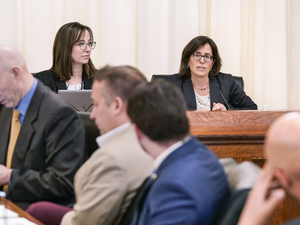
Legislators on the Senate Health Care Committee heard from Fariborz Pakseresht, interim director of the Oregon Health Authority; Vivian Levy, the agency’s Medicaid deputy director, and Jillian Johnson, deputy director of the Oregon Department of Human Services’ Oregon Eligibility Partnership. They offered a presentation in which they noted that the agencies predict a $421 million deficit for the next two-year budget cycle under the new federal law, and a gap more than twice that size for the next two years at $868 million.
“I also need to be very candid with you,” Pakseresht told lawmakers. “Even with our best work, there are going to be people who lose coverage. We need to know that before we step into this”
Those concerns stem from the implementation of the GOP’s 2025 federal tax and spending law, which slashed roughly $1 trillion over the next decade for Medicaid while instituting resource-intensive work requirements and more frequent eligibility reviews that are costing states hundreds of millions of dollars to implement.
Earlier this year, state officials allocated around $110 million for the Oregon Department of Human Services due to increased eligibility review staff required to implement the law, among other resources necessary.
Health authority officials now say they are improving technology so people can upload payroll documents for quick verification and helping people get enrolled in the Supplemental Nutrition Assistance Program or the Temporary Assistance for Needy Families program, which have similar requirements.
They said the agency anticipates it will inform 600,000 people by late September about upcoming requirements to prove they complete 80 hours monthly of work, volunteering or education. Those requirements apply to adults aged 19 to 64. Parents or caregivers of children under 14 do not have to complete the work requirements, nor do people with medical conditions that severely impact their ability to complete work.
In Oregon, around 200,000 people are estimated to lose their Medicaid coverage under the federal law as it is implemented over the next few years, according to researchers at Princeton University. By the end of 2027, the health authority says most Oregonians on Medicaid — known as the Oregon Health Plan — will be subject to more frequent eligibility reviews every six months, rather than every two years, which could lead to people losing their coverage due to increased paperwork and administrative burdens.
“There is no questioning the fact that this is an already difficult and cumbersome process that is going to become more difficult and cumbersome,” Levy told lawmakers.
Changes for immigrants to Healthier Oregon
The new federal law also changed eligibility for immigrants with certain forms of legal status, including refugees, asylees and survivors of domestic violence or human trafficking. These individuals previously qualified for programs such as Medicaid and SNAP, but the new law made them ineligible.
The health authority said that by October, around 7,000 people who fall into those categories will be moved onto the state’s Healthier Oregon program, which pays for Medicaid coverage using state funds to cover low-income Oregonians who would otherwise qualify for the federal program were it not for their immigration status.
Oregon is the only state in the nation that offers such a program to low-income adults and children who do not have permanent legal status without restrictions on coverage or enrollment, according to the nonprofit research group Kaiser Family Foundation. Other states, such as California and Colorado, have limited or closed their enrollment for such programs, which offered coverage to different age ranges.
Dems criticize federal actions
Lawmakers gave little indication on Wednesday about how they would work to address the agency’s expected budget gaps. State Sen. Deb Patterson, a Democrat from Salem who chairs the committee, took a swipe at the federal government after Levy informed lawmakers that officials from the U.S. Department of Health and Human Services have cast doubt on states’ ability to apply for “good faith” waiver delaying implementation of the work requirements.
“I’m going to take the chair’s prerogative in stating that one would think that good faith would go both ways,” she said.
State Sen. Lisa Reynolds, a Portland Democrat who is also a pediatrician, said Oregon is doing “incredible gymnastics” to keep people on health care. She said the federal government is banking on administrative burdens leading to people losing their coverage in order to pay for a tax cut for the wealthiest Americans.
“This is like upside-down world right now,” she said.
Salem, OR