New Mexico, Facebook make opening arguments in state’s latest case against social media giant
Sep 09, 2026 | 6:36 pm ET
Description
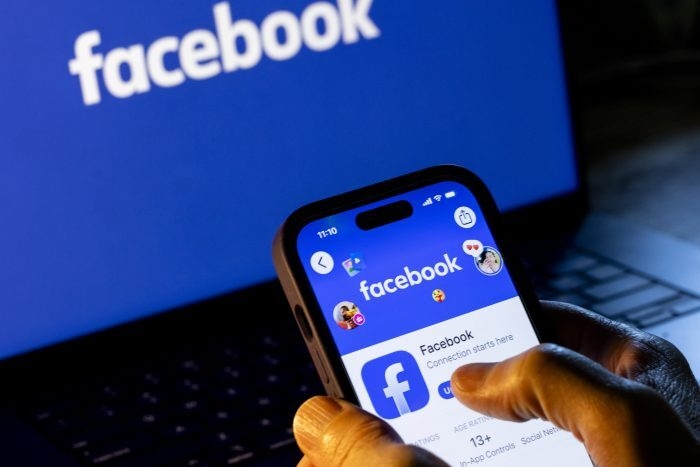
The New Mexico Department of Justice’s latest trial against Facebook began with opening arguments in Santa Fe on Sept. 9, 2026. (Photo by Anne-Marie Caruso/New Jersey Monitor)
Attorneys for the New Mexico Department of Justice and Facebook made their opening arguments before a Santa Fe jury Wednesday morning as the state’s latest trial against the social media giant began.
The state initially filed its case against Facebook in 2021, following news reports of the Cambridge Analytica data breach in which users’ personal information was used for political advertisements leading up to the 2016 election. The trial follows two high-profile courtroom victories for the state in unrelated cases against Meta, Facebook’s parent company.
The New Mexico Department of Justice’s attorneys on Wednesday argued that Facebook has long employed a practice of deceiving its users about whether their information is secure and about whether the company sells it to third parties.
That argument is best illustrated through the Cambridge Analytica scandal, attorney Randi McGinn told jurors.
NMDOJ: “Facebook knew things about you that even some of your best friends and family didn’t know”
McGinn described how users typically share their data with third-party apps that operate on Facebook, such as personality quizzes and games like FarmVille. In the case of the Cambridge Analytica scandal, an academic created a personality quiz titled “thisisyourdigitallife” for the consulting firm and posted it to Facebook. In those days, McGinn said, a user who clicked on a third-party application like that often surrendered not only their data, but their Facebook friends’ data, as well.
While only 270,000 people took the survey in question, it exposed the data of more than 87 million people, McGinn said, adding that nearly 350,000 of those people were New Mexicans.
“Facebook knew things about you that even some of your best friends and family didn’t know,” McGinn told jurors.
Cambridge Analytica officials then used that data to aid the campaigns of President Donald Trump and Ted Cruz, McGinn said.
She gave jurors a preview of the evidence she and her colleagues plan to explore over the course of the trial, which is scheduled to run through early October, including video depositions of Mark Zuckerberg and former Facebook Chief Operations Officer Sheryl Sandberg.
McGinn also walked jurors through documents she plans to explore during the trial, including internal email threads in which Zuckerberg and other Facebook executives appear to internally argue over whether they should be honest in public statements about the extent to which the company collects and sells users’ individual data.
She also argued that Facebook’s vacillating stances on countering misinformation — such as instituting a fact-checking program while “whitelisting” accounts like Alex Jones and Andrew Tate — underscore the company’s unreliability.
Facebook counters that state’s argument is ‘frozen’
Facebook’s attorneys quickly countered that hypocrisy clouds the state’s case.
“What you heard was a long speech about how terrible Facebook is,” Dane Butswinkas, an attorney representing Facebook, said to the jury. “You know who is an enormous Facebook user? The State of New Mexico.”
He pointed to Facebook accounts for various state agencies and municipalities in New Mexico and noted that the governmental entities rely on the platform to reach New Mexicans with news, updates about their services and more.
“They didn’t tell you that, did they?” Butswinkas asked.
During his opening arguments, Butswinkas argued that the New Mexico Department of Justice’s attorneys cherry-picked inflammatory details from company records without providing the jury with the full context.
For instance, regarding the internal emails that McGinn showed the jury, he argued that the full email threads show Zuckerberg and other company leaders coming to agreements. As for sharing data, advertisers only receive demographic information of who their ads reach, not personal identifying information, he said. And McGinn’s arguments about content moderation ignore that the company’s digital safeguards prevent the vast majority of objectionable content from ever hitting peoples’ news feeds, he said.
“The details matter,” he said. “Soundbites are not proof.”
Butswinkas contended that Facebook has implemented serious changes since the data breach scandal, which became public nearly a decade ago. After that scandal, the company spent millions investigating the matter and banned about 120 third-party app developers, which were responsible for about 80,000 apps, he said.
“Much of the government’s case is frozen in place,” he said.
Santa Fe, NM