Denny Hoskins asks federal judge to block Missouri Supreme Court contempt hearing
Sep 09, 2026 | 3:24 pm ET
Description
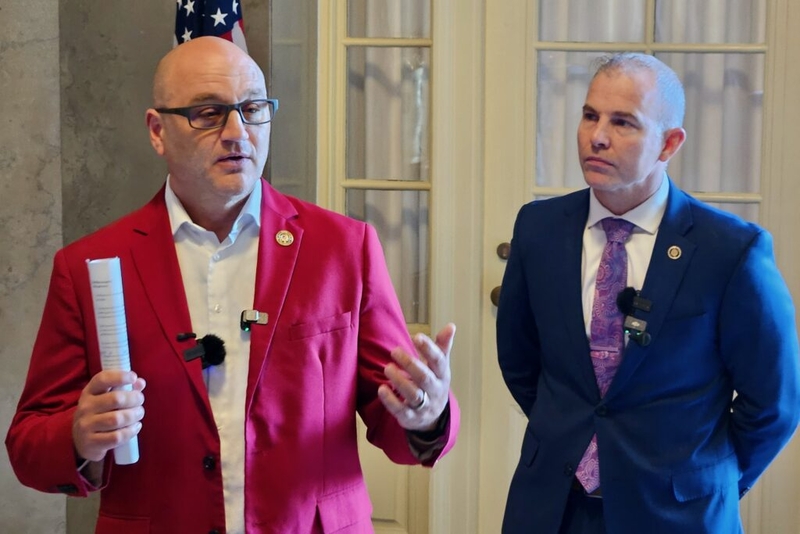
Missouri Secretary of State Denny Hoskins, left, is asking a federal judge to block an order for him to answer contempt charges before the Missouri Supreme Court. (Rudi Keller/Missouri Independent)
Secretary of State Denny Hoskins asked a federal judge Wednesday to block the Missouri Supreme Court from holding a contempt hearing over his decision to implement a congressional map the state court barred him from using.
The Missouri Supreme Court issued an unusual late-night order Tuesday demanding that Hoskins appear in person to explain why he isn’t following its injunction on the congressional district map that will govern the Nov. 3 elections. The order gave Hoskins until noon Wednesday to respond in writing and set his hearing for 10 a.m. Thursday.
Hoskins filed his response just a few minutes after the deadline and, at the same time, filed a request to Chief U.S. District Judge Stephen Clark of the U.S. Eastern Missouri District Court for an order blocking the state Supreme Court hearing.
“This court should bar the Missouri Supreme Court’s attempt to punish Secretary Hoskins for complying with this court’s order,” Lou Capozzi of the attorney general’s office wrote on Hoskins’ behalf.
The state Supreme Court order to Hoskins capped a day of conflicting actions over which congressional map Missouri must use in November.
When Tuesday began, the Missouri Supreme Court’s order meant the legislation creating the map would be on the Nov. 3 ballot as Proposition A. If a majority of Missourians vote “no,” the map would be defeated and would not become law.
Along with sending voters the referendum sought by the political action committee People Not Politicians, the state Supreme Court also issued an injunction directing Hoskins not to use the gerrymandered 2025 map for the November elections.
Instead, the map that would govern congressional elections is the one drawn by lawmakers in 2022 and used the last two cycles.
Hoskins appealed that ruling to the U.S. Supreme Court, where Justice Brett Kavanaugh denied it without comment.
Minutes after Kavanaugh acted, Clark issued a temporary restraining order in a separate federal lawsuit filed by U.S. Rep. Bob Onder, state Sen. Rick Brattin and two voters. Clark’s order seemingly contradicted the state Supreme Court by blocking Hoskins from “implementing, using, publishing, distributing, or mandating the use of any congressional district map other than the (2025) map” in November.
Using that decision as the controlling authority, Hoskins directed local election officials to use the 2025 map because Clark’s order “takes precedence over the Missouri Supreme Court’s order.”
That brought People Not Politicians back to the state Supreme Court, asking that Hoskins be held in contempt for failing to follow the court’s order not to use the 2025 map. Chief Justice Brent Powell responded by demanding that Hoskins appear to explain why his email to local election officials “is not an affirmative violation of this court’s injunction” and why he thinks “this court’s injunction is not still in full force and effect.”
In the request to Clark for an order blocking the Thursday hearing, Hoskins blames Richard von Glahn, director of People Not Politicians, for his position stuck between two courts.
“Von Glahn’s motion is a blatant attempt to frustrate this court’s order,” Capozzi wrote. “Indeed, Von Glahn proclaimed that the Missouri Supreme Court should ‘make clear that regardless of other orders (except from the United States Supreme Court) the Missouri Secretary of State must comply with [the Missouri Supreme Court’s] injunction…Remarkably, the Missouri Supreme Court is taking Von Glahn’s motion very seriously.”
Clark did not rule immediately. He set a 5 p.m. Wednesday deadline for People Not Politicians to file a response to the request to stop the Thursday state court hearing.
And People Not Politicians is seeking to overturn Clark’s decision by seeking review from the Eighth Circuit Court of Appeals.
In the response to the Missouri Supreme Court, Capozzi argues that the state’s jurisdiction over Hoskins ended when Clark issued his ruling.
“This court’s order can no longer compel the secretary,” Capozzi wrote.
Clark’s decision came just before the deadline for fixing the ballots for November and was the operative decision, Capozzi wrote.
“So long as the district court’s order stands, the secretary must obey it,” he wrote.
The two cases argue unrelated points of law and therefore do not overlap, Capozzi wrote.
“The court must not,” he wrote, “take the radical step of holding the secretary of state in contempt for following a federal court order.”
This story will be updated.

Jefferson City, MO