More Wisconsin communities are dropping Flock
Sep 09, 2026 | 4:30 am ET
Description
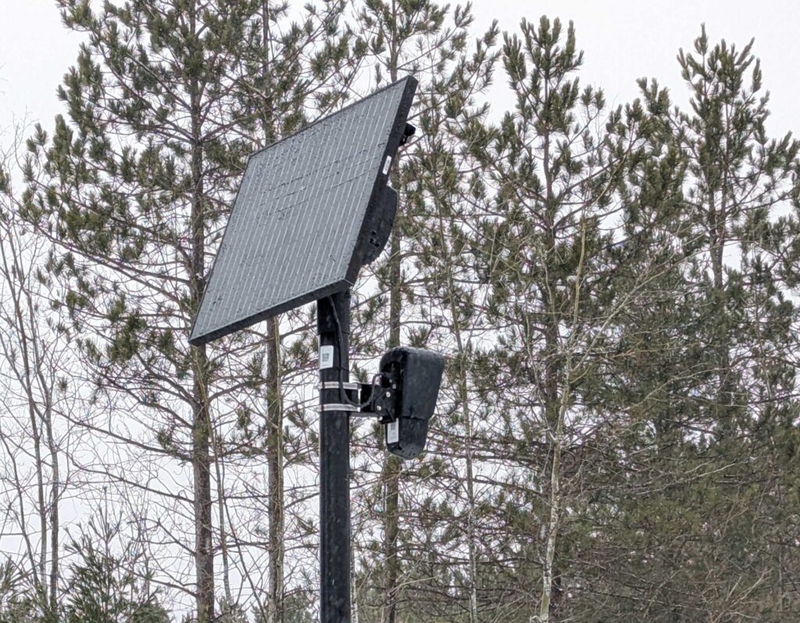
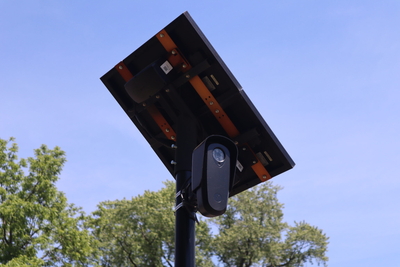
A Flock camera on the Lac Courte Orielles Reservation in SawYer County. (Photo by Frank Zufall/Wisconsin Examiner)
Stevens Point, Winnebago County, Fond du Lac County and Sheboygan are among the Wisconsin communities that have recently moved away from Flock license plate reader cameras. On Tuesday, city staff in Stevens Point began covering the cameras while local elected leaders determine whether they can cancel their Flock contract altogether.
Meanwhile Sheboygan broke ties with Flock after the company reportedly attempted to sell the city back traffic data it was unaware the multi-billion dollar surveillance company was even collecting. Flock cameras capture images of vehicles and their license plates on the roadways. Law enforcement officers can search the data to see where a vehicle has traveled.
Investigative reporting has shown that the cameras can also recognize human features. Over 5,000 agencies had Flock contracts in late 2025, creating a network of tens of thousands of cameras that can be queried simultaneously. Police often say that the technology has been invaluable in solving crimes including carjackings, kidnappings, homicide, drug trafficking and gun violence. The cameras are also used for less serious reasons such as for traffic enforcement and in policing evictions.
“Reports are surfacing all over the country about the system being misused by municipal and state employees who have access to the data,” said Stevens Point Mayor Mike Wiza in a press release late last week.
A few of those cases have played out in Wisconsin courts, police departments and sheriff’s offices. Four officers across Wisconsin have been charged with misconduct in public office and other offenses for misusing Flock cameras.
Josue Ayala of the Milwaukee Police Department (MPD) was given a year of probation and avoided jail time earlier this year after misusing Flock. Cristian Morales of the Menasha Police Department was sentenced to six months in jail and three years probation for a similar infraction. In Kenosha County, former sheriff’s deputy Frank McGrath was charged with misconduct in public office last month for misuse of the surveillance technology. In July, Milwaukee police detective Tehrangi Chapman — who worked the internal affairs investigation into Ayala’s Flock misuse — was charged with misusing the system to track someone he had been monitoring since 2019, years before Flock came to Milwaukee. Chapman and McGrath are still going through court proceedings.
Ayala, Morales and McGrath all used Flock to monitor their current or former romantic partners. The exact relationship Chapman has to the people he allegedly monitored is not mentioned in available court records. McGrath used Flock and a squad car tracking system called Polaris to monitor his girlfriend, who was also a Kenosha County Sheriff’s deputy. Chapman allegedly employed both Flock cameras and car-mounted GPS trackers. McGrath was caught after a supervisor noticed some suspicious Flock searches in an audit, while Ayala and Chapman were both reported to police by the victims themselves.
Numerous other officers have been investigated or charged with misusing Flock around the country. In Racine County, the district attorney admitted that a few unnamed officers have been investigated for their use of Flock cameras.
The rash of misuse is not the only thing motivating local communities to drop Flock. When the city of Verona decided to cover its cameras in February, Mayor Diaz said that while the community trusted its police department, it no longer trusted Flock Safety. At that time the first cases of misconduct were beginning to emerge in Wisconsin, and many people had expressed fears about how the federal government — especially immigration enforcement — could leverage local Flock networks for its own priorities. Trust was also broken in Oshkosh months later, after the police chief learned that the cameras could create heatmaps of vehicle movements, contrary to what a company representative had said.
The sheriffs and police departments in Fond du Lac County recently announced they will cancel their contracts because out of state agencies had used open records requests to obtain audit data the sheriff said was confidential and in some cases linked with ongoing investigations. Journalists and other citizens nationwide had begun requesting Flock audit data from local police departments to learn how the cameras were being used.
In 2025, a Wisconsin Examiner analysis showed that at least 221 law enforcement agencies were using Flock in Wisconsin. Many of the searches used vague search terms such as “investigation,” “suspicious,” or non-law-enforcement terms such as “cooch,” or single characters such as “.” or “s”. Some of these vague search terms have appeared in confirmed misconduct cases. Officers in other parts of the country have also used Flock for controversial reasons, such as tracking women suspected of traveling out of state to get an abortion.
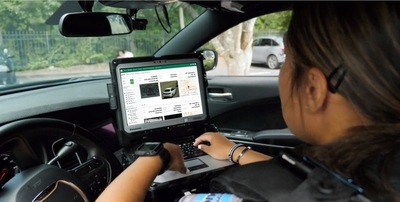
Flock Safety has struggled to adapt to canceled contracts and misconduct investigations. Although the company has released new features including requiring case numbers when searching the database, fixed options for search terms, and the ability to flag suspicious searches, it has also worked to hide information in the audit data such as officers’ names. Flock Safety has claimed that people have used the audit data to identify undercover officers. However, the information which Flock is making harder to view is also the very information that allowed citizens and journalists to detect instances of misconduct.
Winnebago County, Neenah, Menasha, and Chetek have each canceled a Flock contract, are considering it or have covered up their cameras. In Chetek, the police chief responded to public criticism of Flock cameras by threatening to run background checks on citizens who disagreed with his use of the cameras. Other Wisconsin communities including Kaukauna, Sturgeon Bay, Appleton, Dane County, Stoughton and Manitowoc which have also canceled their Flock contracts.
Other communities have chosen to heighten oversight of their Flock cameras In Milwaukee, County Executive David Crowley asked that all Flock operations on county property be paused until new transparency and oversight measures could be developed.
Milwaukee County Sup. Justin Bielinski, who is also chairman of the Committee on Judiciary, Law Enforcement, and General Services, has also called on the Milwaukee County Sheriff’s Office to disable its Flock network. “Residents should not have to wait for another disclosure before we act,” said Bielinksi. “Even if you have confidence in the Sheriff’s Department’s use of Flock, the question remains: do we trust Flock itself with this information?”
The Milwaukee Police Department has restricted its Flock network from other local agencies, limited access to the system to supervisors only, and launched a new Flock transparency portal. The portal notes that data captured by Flock cameras in Milwaukee is only retained for seven days, and that there were 983 “search sessions” over the last 30 days. It also keeps track of the number of “hot list hits” over the last 30 days. Hot lists are lists of vehicles which law enforcement have flagged in the system. When a camera sees the flagged vehicle, a notification goes out to police in the area. The Milwaukee police transparency portal does not track the number of vehicles detected, unlike a transparency portal released by the Green Bay Police Department.
“This effort underscores the commitments MPD has made in partnership with the Mayor to establish appropriate guardrails for the use of this technology while providing greater public understanding of how Flock [Automatic License Plate Reader] technology is used to support public safety,” the Milwaukee department said in a press release. “MPD remains committed to transparency, accountability, and the responsible use of technology. Through this new resource, MPD is continuing its efforts to provide the public with meaningful information about the tools we use to support the safety of the Milwaukee community.”
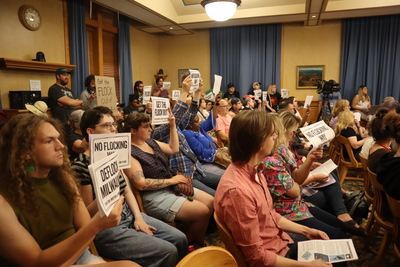
People in the community continue to push back against the cameras. Last Thursday, dozens of residents filled a Fire and Police Commission meeting to capacity in Milwaukee. An overflow room was opened to accommodate all the people who showed up to testify, unanimously rejecting Flock and calling for the city to cancel its contract. Speakers argued that Flock is a form of indiscriminate mass surveillance which can and has been used in abusive ways by police. Many of the speakers expressed deep frustration with the commission, city government and police, saying that they’d called for an end to Flock for months only to see some of their fears realized.
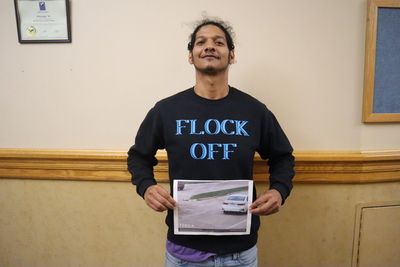
Napoleon Jones, 32, was one of those people. Although Jones is from Sussex, he came to the Milwaukee FPC meeting to describe his experience of Flock surveillance. Jones, a Navy veteran, was stopped by a Waukesha County Sheriff’s deputy after filming a traffic stop. Jones was arrested and taken to jail, only to be released without charges. When he filed a complaint about the deputy’s conduct, according to a federal lawsuit, Jones became the target of a Flock search by that deputy, who was directed by his supervisor to conduct the searches.
“When I first found out I was just super surprised,” Jones told the Examiner. “I never thought it would happen to me. And when I found out and I got the records and seen how many different searches there were, I was at a loss of words because it’s hundreds and hundreds and hundreds of searches and the network is so big on these Flock cameras.” Jones added that “I drive all around. If this guy really wanted to put together a timeline of where I’m at, or who I know, or whose house I’m at, he could have done it.”
He added, “I drive past these things all the time. Everyone does.”
Madison, WI