What’s the Lincoln Party? Ballard’s secretary of state run could expand Indiana ballot access
Sep 08, 2026 | 5:00 am ET
Description
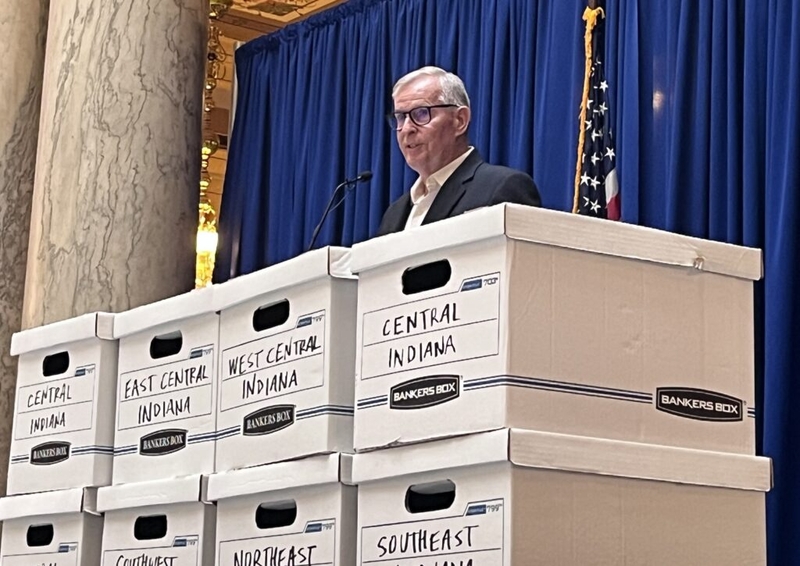
Indiana secretary of state candidate Greg Ballard speaks at the Statehouse before delivering petition signatures needed to qualify for the November ballot on July 14, 2026. (Photo by Tom Davies/Indiana Capital Chronicle)
Former Indianapolis Mayor Greg Ballard touts his run for secretary of state under the new Lincoln Party banner as a way to burst open an easier path for independent-minded candidates to make the election ballot.
ClaraMary Winebrenner, a Republican office holder-turned-independent candidate in DeKalb County, hopes the new party could break up what she sees as the current two-party monopoly.
But Max Engling, the Republican secretary of state candidate, has taken aim at the Lincoln Party push as lacking a defined ideology and transparency in how it would select future candidates.
Ballard’s success in the November election is key for the Lincoln Party initiative — if he receives at least 2% of the vote the party’s candidates will get their names on general election ballots for the next four years; if he tops 10% of the vote the new party would join Republicans and Democrats in nominating candidates through primaries.
How the Lincoln Party came about
Ballard, who won Indianapolis mayor races in 2007 and 2011 as a Republican, announced his independent bid for secretary of state in March.
But the following week he adopted the Lincoln Party identity, saying it was needed to “unlock ballot access” for other independents. Otherwise, they would need to clear Indiana’s requirement of obtaining certified petition signatures of registered voters totaling 2% of the most recent secretary of state’s vote in their district — nearly 37,000 for a statewide office.
Ballard is on the ballot against Engling, Democrat Beau Bayh and Libertarian Lauri Shillings.
Ballard argues that Indiana’s signature requirement was set up by Republicans and Democrats to box out competitors from appearing on the ballot.
“The laws in the state have made it practically impossible to overcome that obstacle,” Ballard told the Indiana Capital Chronicle. “It’s very purposeful, very punitive to make sure nobody will clear that hurdle.”
Ballard’s candidacy was spurred by the work of Nathan Gotsch, a 43-year-old former Fort Wayne high school video production teacher who ran a 2022 independent campaign for northeastern Indiana’s 3rd congressional district seat and got 5% of the vote.

Gotsch started a nonprofit group in 2025 that formed Independent Indiana, with the stated aim of supporting independent candidates.
Gotsch approached Ballard late last year about the secretary of state’s race after the group’s polling found Ballard with support from nearly one-quarter of voters in a hypothetical matchup against current GOP Secretary of State Diego Morales and Bayh.
Despite Engling defeating Morales in the Republican state convention, Gotsch said Ballard remained competitive and the goal of achieving ballot access was achievable.
“If the General Assembly changes the rules on independents, which I think they still should, then we may not need this path,” Gotsch said in an interview. “We probably wouldn’t. But we’ve seen over and over that they have protected their monopoly on the political process. The way to break that is to create a party that allows other folks to compete with them on the same playing field.”
Picking future Lincoln Party candidates
The Libertarian Party has maintained automatic ballot access for its candidates since clearing the 2% mark in the 1994 election, with its secretary of state nominee gaining 5.7% of the 2022 vote.
Indiana law gives a “minor party,” such as the Libertarians, broad latitude to set rules for how delegates are selected for its state convention nominating candidates for the general election ballot.
Just how the Lincoln Party would organize itself under such a scenario isn’t clear.
Gotsch is listed as the Lincoln Party’s chairman under its organization statement filed with the Indiana Election Division in June.
Indiana secretary of state hopefuls clash over voting rules, office audit
Gotsch said he has had discussions with people around Indiana who are interested in helping the party, but did not say who might join him in its statewide leadership.
“We’re trying to talk to smart people from different walks of life, people that have experience in politics, people that don’t,” he said. “Ultimately, it’s on us to be able to put something forth that the public can feel good about.”
Both Ballard and Gotsch indicated they would be involved in selecting the candidates who would gain the party’s support.
“The intent, in the future, is to run what we call practical problem-solving people that you’d be proud to have in office,” Ballard said. “Both parties have numerous purity tests. They have extreme ideology.”
Ballard said he’s in the secretary of state’s race to win the office but that it would take time to build out a party structure across Indiana.
“We’ll go little by little as we go,” he said. “We’re not going to flood the zone in the ’27, ’28 races. That’s not the intent. The intent is to find high-quality people who want to run. People who have a chance to win.”
State law calls for any party clearing 10% in the secretary of state race to select nominees for most federal, state and local offices through a primary.
Gotsch said the Lincoln Party could take advantage of the state law requiring a county party chair’s approval for any potential primary candidate who hasn’t cast their two most-recent primary ballots for that party.
“No one will have been able to say, ‘Well, I already voted in two of your primaries,’” he said. “That’s one of the things that the party, I think, will be able to use to make sure that we’re putting high-quality candidates up who can win. The size of the race, the size of the office, will determine kind of what the qualifications are.”
An independent candidate’s view
After previously winning four elections for DeKalb County prosecutor as a Republican, Winebrenner decided to run in 2024 as an independent for county commissioner.
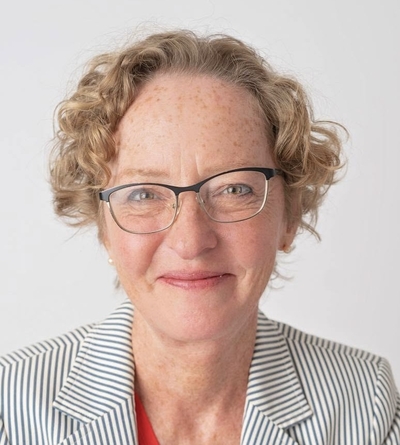
A self-described “never Trumper” in a county where Donald Trump won nearly three-quarters of the presidential vote and no Democrats sought county offices, Winebrenner got 32% in her unsuccessful race.
Winebrenner said she spent about two weeks going door to door in collecting the roughly 250 petition signatures she needed to make the northeastern Indiana county’s ballot as an independent.
Independent candidates face many legal hurdles and “you’re on your own,” she said.
“Luckily, I’m an attorney and, luckily, I had run for office four times before this and worked on a number of campaigns,” she said in an interview. “But it is not easy to run as an independent because you have to figure out how and get the signatures. I would say that’s one thing that makes it easier at the local level. It’s doable, but it’s almost not doable at the state level because of the magnitude.”
Winebrenner said she intended to vote for Ballard in hopes that the Lincoln Party would give voters more choices and break up the control that Republicans and Democrats now hold.
“There’s not much of a platform for the Lincoln Party. It’s whoever wants to sign on, but maybe that’s OK,” she said. “People need to pay attention to who they’re voting for, and, frankly, the first step I think would be to get rid of straight-ticket voting. That should not be an option.”
Pushback on the new party
Engling — the Republican secretary of state nominee — has swiped at Ballard as insufficiently conservative on issues such as Indiana’s law banning transgender youth from girls sports and local tax increases during his time as Indianapolis mayor.
Engling extends that criticism to the Lincoln Party as presenting voters a blank slate of future support for what it regards as “high-quality candidates” without any stated ideology.
“To me, that says nothing about what they stand for,” Engling said in an interview.
Engling argues the Lincoln Party isn’t a serious political organization.
“You would think that they would have a party that has thought through what they want to do with that (ballot) access and what the point of the access is,” he said.
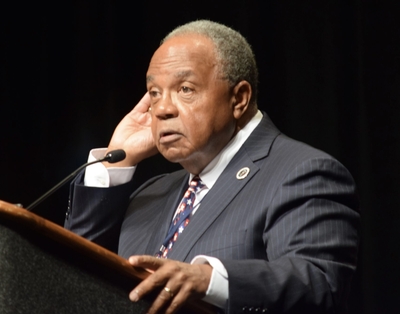
Former state Democratic Party Chair Robin Winston said Engling and Ballard have spent “an inordinate amount of time back and forth on each other” on matters unrelated to the secretary of state’s office.
Winston said he doesn’t understand the branding of the new party after Abraham Lincoln who not only was the first Republican elected president but has long been celebrated as the GOP’s historic leader.
“I don’t know that voters will necessarily see the name Lincoln Party as being an independent party,” Winston said. “It would be like us saying it’s the Kennedy Party, but it’s really not Democrats.”
The lack of information about how the Lincoln Party would select candidates also draws criticism from Engling.
“If they get over 2% then what will happen is that the chairman of the party, which is not Ballard, it’s Nathan Gotsch, could, by Indiana law, select a few of his friends to be the caucus, sit in a dark, smoke-filled room at a steakhouse basement in Indianapolis and pick who they want to run in races all around the state,” Engling said. “Not an open and transparent process.”
Indianapolis, IN