At least 61 employees left Nebraska Department of Economic Development within 15 months
Sep 08, 2026 | 6:45 am ET
Description
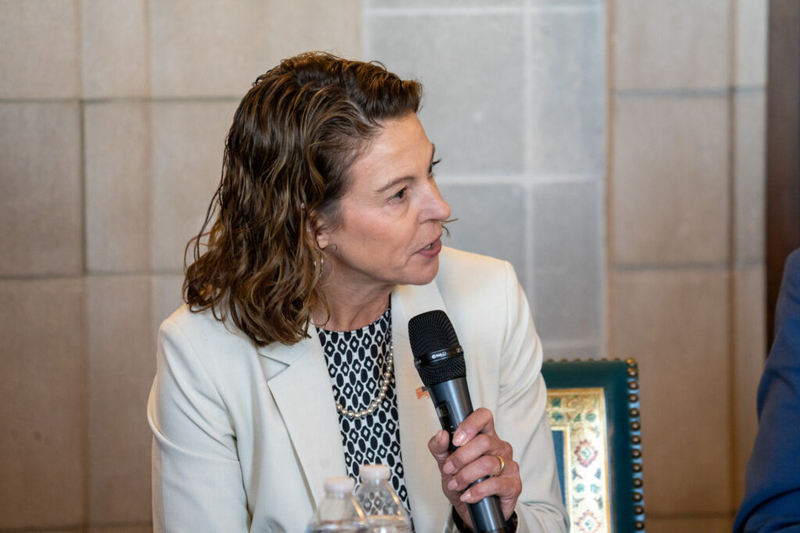
Maureen Larsen, director of the Nebraska Department of Economic Development and former general counsel to the governor, at an inaugural public roundtable of Nebraska Gov. Jim Pillen's cabinet. April 20, 2026. (Zach Wendling/Nebraska Examiner)
LINCOLN — After 26 years working in Nebraska’s Department of Economic Development, former director of field operations Sheryl Hiatt said she didn’t want to retire, but she felt she had no other option.
According to Hiatt, changes made within the department — most of which came after Gov. Jim Pillen’s appointment of Maureen Larsen as interim director in July 2025 — made her time working there unpleasant enough that she chose to leave earlier than she previously planned.
She isn’t the first former DED employee to make such claims, as several have said the impacts of budget cuts and other new policies were designed to push employees out and shrink the department.
“They’re not doing anything right, and just tearing it down for the sake of tearing it down,” Hiatt said of the current DED leadership.
In less than a year-and-a-half, at least 61 employees have left DED, with only two of those involuntary terminations, according to department spokesman Justin Pinkerman. The department currently employs 69 full-time workers.
Data that Pinkerman shared with the Examiner shows that DED hit its peak of full-time employees in May 2025 at 115.25, which had dropped to 69.75 as of Aug. 26 this year. In that same time, Pinkerman said in an email, the department made 15 new hires, which factored in means that 61 employees left DED within that period.
The decimal points represent part-time employees in how the department measures its full-time equivalents.
Unprecedented attrition
Justin Hubly, executive director of state employees union Nebraska Association of Public Employees, said he’s never seen attrition numbers like this in any state agency, calling it “mind-boggling.”
“We ought to be doing everything we can right now to grow our state, considering the budget situation,” Hubly said. “And losing frontline staff at the Department of Economic Development is certainly not the way to do that.”
Pillen appointed Larsen interim director in July, replacing former director K.C. Belitz, and announced she would become the permanent director in November. Prior to her appointment, Larsen served as Pillen’s general counsel and deputy director of his Policy Research Office.
Pinkerman has said the department’s downsizing is part of a winding down of pandemic-era programs. He said because of this, the department’s spending dropped more than $185 million between fiscal years 2024-25 and 2025-26.
Hiatt said the economic recovery division — charged with managing DED’s allotment of American Rescue Plan Act (ARPA) funds — at one point had more than 20 employees, and now DED’s website lists seven employees in the division.
A notable departure was the division’s former administrator, Javier Saldaña Jr., who left in June to take a job with the city of Omaha as its deputy chief of staff for economic development.
Hiatt said DED’s housing division also has been hit hard in the latest downsizing. She estimated the department had about 15 housing staff in early 2025, and now DED’s website displays six staff in the division.
That number may continue to shrink, as Pinkerman confirmed the department moved three housing positions — filled by employees based across Nebraska — to its central headquarters in Lincoln. Pinkerman said those employees were told they must work from the Lincoln office to continue in their positions.
Hiatt said one employee who lives in Omaha resigned shortly after receiving the order. Hubly confirmed this and said he believes the employee would have stayed at DED if he hadn’t been told to relocate. Hubly said he found it strange that the employee was asked to move, given that his supervisor in Omaha was not asked to relocate.
Of the two other affected employees, one based in the Panhandle chose to comply with the order, which took effect Aug. 24. Hubly said the other, based in Kearney, refused to move under their contract, which states that employees asked to transfer more than 50 miles can refuse, but the agency can terminate them in response.
Hubly confirmed that DED has initiated a layoff procedure for the Kearney employee. He said he found it frustrating because the employee could have been transferred to a DED vacancy near Kearney. Hubly said DED’s list of vacant positions is “dozens long,” and department officials didn’t give him a good reason why this employee couldn’t be transferred.
Pinkerman said there are currently 33 vacant positions at DED and the openings do not have assigned locations. He noted the department is currently hiring for an economist and a paralegal, and plans to add more job postings in other divisions in the future.
Pinkerman said the positions DED is seeking to fill were requisitioned before a hiring freeze Pillen enacted in a July memo. These positions, along with any new job postings, will be reviewed by the State Budget Division to ensure they align with the governor’s spending objectives.
Impact on rural communities
Hiatt said she knew of at least three vacant regional positions, including her own, that have not been filled, but couldn’t say if there were any close to Kearney. However, she noted that the placement of regional positions is not set in stone, and DED officials have the power to move them.
Pinkerman said the three impacted positions work on state housing programs that are being transferred to the Nebraska Investment Finance Authority under a bill the Legislature passed this year. DED has taken steps this year to transition the administration of some of its housing programs to the independent agency.
According to Hiatt, these regional positions have existed for decades and were added after the creation of the Affordable Housing Trust Fund, which has not yet been transferred to NIFA. She said the original purpose of the positions was to forge connections with local housing nonprofits to help generate applications, which later evolved into monitoring the projects awarded in their respective regions.
Hiatt said it’s difficult to find developers willing to work on housing projects in rural Nebraska right now, so losing that direct line of support will be challenging. She described the relocation order as a “big slap in the face to rural Nebraska.”
The reductions to regional DED positions, combined with limitations placed on field staff while she was there, made Hiatt feel that the department was intentionally reducing its footprint in rural Nebraska.
The number of DED employees who worked outside of Lincoln or Omaha fluctuated over the years, according to Hiatt. Prior to the latest downsizing, she said, it typically ranged between 15-20 employees, and now it’s down to about 10.
Leadership concerns
Hiatt listed several other changes implemented under Larsen’s leadership that she claimed were designed to push people out of the department. Following Pillen’s return-to-work order, Hiatt said, employees working from the Lincoln office were not allowed to leave before 4:30 p.m., and Larsen and other DED leadership routinely patrolled the office to make sure workers remained in their cubicles.
“It doesn’t matter what you’re doing as long as your butt is in the chair,” Hiatt said.
When asked about this, Pinkerman said, “Director Larsen has taken responsibility to ensure the agency’s compliance with the return-to-work order.” He did not answer whether these patrols were still in practice.
Under Larsen’s leadership, Hiatt said, communication across DED divisions also sharply declined. Before Larsen was appointed, Hiatt said, division leaders would hold regular meetings at least once a month; Larsen attended a couple and then canceled them.
Nebraska Legislature approves Maureen Larsen’s appointment as DED director
The cancellation drew concerns from division leaders, Hiatt said, as they were already seeing signs of degrading communication. In response, she said, division leaders opted to hold their own meetings without Larsen. Hiatt said she took the initiative to set the recurring calendar item.
This lasted until shortly after Stacey Parr was named deputy director of DED. Hiatt said Parr told division leaders that Larsen wanted to restructure the management meetings, so she canceled the calendar items.
The meetings Larsen scheduled had short agendas with little to no substance, Hiatt said. The last one she attended had two agenda items, one of which involved where employees should park outside the Lincoln office, she said.
Pinkerman said Larsen “changed the cadence of the agency’s regular management meetings to aid agency productivity and better prioritize strategic objectives.” He said DED leaders have scheduled daily meetings and hold monthly management meetings with division directors.
Overall, Hiatt said, DED’s new leadership showed a lack of care in managing the employees who work for them and didn’t put in effort to recognize their work.
Two weeks before her last day on June 2, Hiatt said, she sent an all-staff email announcing her departure, in which she included some leadership tips. She said she didn’t hear any response from Larsen, and on June 2 Parr sent a one-sentence email to DED staff acknowledging that it was Hiatt’s last day with the department.
After she cleaned out her desk at the Lincoln office, Hiatt said, another division director walked her out of the office. She said they reminisced about how former deputy director Dan Curran handled departing employees.
“Do you remember when Dan was here and somebody would leave … and we’d have cake and Dan would say really nice things about the person that was leaving?” Hiatt said the director asked her. “And I started laughing, and I said, ‘Yeah, this is not that.’”
Larsen and other DED leaders declined requests for in-person or phone interviews, instead answering questions via email through Pinkerman. Pinkerman said the agency does this for documentation and to ensure accuracy in their responses.
“Having this documentation allows DED to hold media outlets accountable for fairly and accurately reporting the agency’s statements,” Pinkerman said.
Lincoln, NE