Labor unions are growing, but where depends on state politics
Sep 04, 2026 | 3:12 pm ET
Description
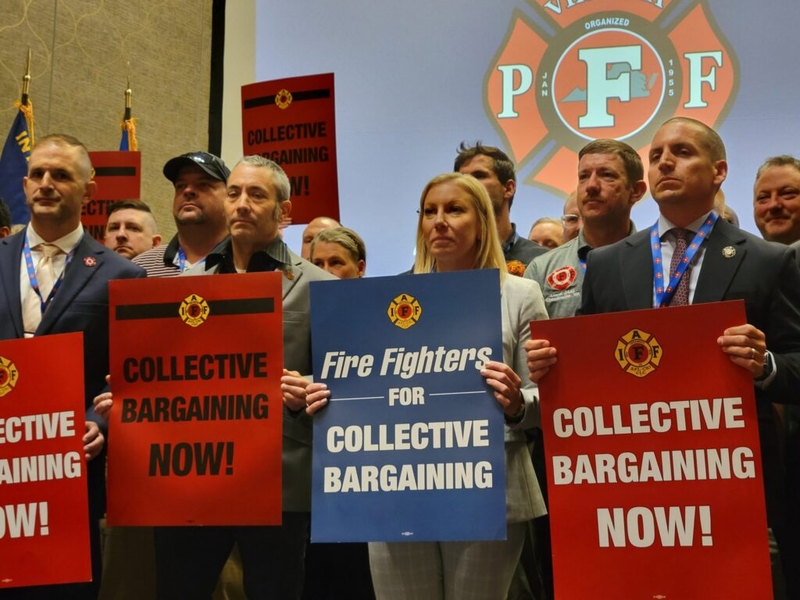
Members of Virginia Professional Firefighters association hold signs during their biannual convention in May to protest Democratic Gov. Abigail Spanberger’s veto of collective bargaining legislation. New research found a significant spike in labor union membership, but growth is highly dependent upon state politics. (Photo by Charlotte Rene Woods/Virginia Mercury)
Labor union membership continues to climb in the United States, though the increase remains sharply divided by the politics of individual states.
Last year, the nation added more than 411,000 union members — the largest annual growth since 2008, according to a study published just ahead of the Labor Day holiday by the Illinois Economic Policy Institute and the Project for Middle Class Renewal at the University of Illinois at Urbana-Champaign.
At the end of last year, more than 14.6 million American workers belonged to a union — about 10% of the workforce, the study said.
While union membership grew across the country, the State of the Unions report found that states that have sought to protect or strengthen collective bargaining rights added three times as many union members as so-called right-to-work states, which prohibit mandatory union membership or dues as conditions of employment.
“What seems to be the number one driver is the state of the state,” said one of the study authors, Robert Bruno, who leads the labor education program at the University of Illinois at Urbana-Champaign. “If the policy is anti-union, it suppresses worker will. Where the law allows worker will to flourish, as I would argue it should, then you see higher numbers. So you can’t ignore politics. You can’t ignore policy.”
State governments are nearly evenly divided on labor policy, with 26 states having right-to-work laws. Union membership rates sit at about 14% in collective bargaining states and 5% in right-to-work states, the study found.
As a key labor union pushes into the South, red states push back
The study shows that workers in collective bargaining states earn significantly more than those in other states. After adjusting for cost of living variances, the report calculated average hourly earnings of $34.16 in right-to-work states and $37.24 in collective bargaining states.
Union density is nowhere close to its record high. In 1954, more than a third of American workers belonged to unions. Today, that rate is about 10%. And unions face major policy headwinds at the state and federal levels. In recent years, Southern states have passed new laws aimed at curbing union expansion. And President Donald Trump has sought to strip collective bargaining rights from more than 1 million federal workers.
Researchers said it’s unclear how federal actions will affect union membership figures. Many of the president’s moves are being litigated in courts and more federal workers have sought to unionize under this administration.
But public support for labor unions is growing among Republicans and Democrats, Gallup polling shows.
“More Americans are turning to unions as a bulwark against the rising cost of living, and more public sector workers turned towards unions last year in the wake of some federal actions and federal headwinds,” said State of the Unions coauthor Frank Manzo IV, an economist at the left-leaning Illinois Economic Policy Institute.
Conservatives have long argued that unions’ benefit on wage growth has been overstated by pro-labor interests.
In a 2025 review of 147 studies, researchers at the free-market think tank Mercatus Center concluded that powerful labor unions can lead to slower job growth and fewer jobs for unionized workers, reduce company investments in research and development, and increase the likelihood of company closures.
Researchers at the George Mason University think tank said the difference between the wages of unionized workers and nonunionized workers has declined in recent years and may even be negligible.
Minimum wages will rise in more than 20 cities, states in July
“When powerful and adversarial unions operate with government-granted monopoly privileges and press for unsustainable terms, it can backfire and result in lost jobs and fewer opportunities for workers,” that report said.
This year, state lawmakers passed dozens of bills seeking to boost worker protections across 19 states, according to tracking by State Futures, a nonprofit coordinating hundreds of Democratic lawmakers across the states.
Those measures included three bills aimed at expanding collective bargaining.
Illinois lawmakers granted rideshare and gig drivers the right to organize and to bargain collectively. Washington state extended collective bargaining rights to certain university student employees.
And Virginia lawmakers approved a measure to repeal the state’s longstanding ban on public-sector collective bargaining. That would have expanded the possibility of union membership to half a million public employees in the commonwealth. But Democratic Gov. Abigail Spanberger vetoed that measure in May.
The governor said she agreed with the goal of expanding collective bargaining rights. But she urged the legislature to adopt specific amendments, including delaying provisions of the bill until 2030 and shifting authority over how the system operates to a state board.
“While preserving the enrolled bill’s focus on allowing public employees to achieve collective bargaining, my amendments would have also provided additional flexibility for public employers to take into account existing local budget timelines and processes,” Spanberger wrote in her veto message. “However, the General Assembly rejected these amendments.”
Stateline reporter Kevin Hardy can be reached at [email protected].