Ohio lawmakers approve 90-day gas tax holiday just weeks ahead of election
Sep 30, 2026 | 5:36 pm ET

Description
Republican candidate for governor, Vivek Ramaswamy (speaking) flanked by his running mate and Senate President Rob McColley shortly after lawmakers approved a 90-day tax holiday. (Photo by Nick Evans, Ohio Capital Journal.)
Ohio state lawmakers have approved a 90-day gas tax holiday at the urging of Republican candidate for governor Vivek Ramaswamy. The House and Senate also cobbled together the two-thirds supermajority necessary for an emergency clause which ensures the measure takes effect immediately.
The move comes as the rising cost of gas and diesel threaten Republicans’ chances at the polls this November. The bill now heads to Gov. Mike DeWine, who has said he intends to sign it.
Democratic candidate for governor Amy Acton proposed the tax break first, and Republican state leaders quickly co-opted the idea. What followed was a hastily arranged effort to call lawmakers back to Columbus to fast track legislation.
Ramaswamy joined Republican House Speaker Matt Huffman and his running mate Republican Senate President Rob McColley to announce the plan just a week ago. Senators got their chance to discuss the legislation Tuesday, and in the House, lawmakers held their first hearing the day of the vote.
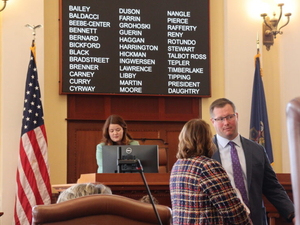
Most lawmakers made it in for session — 31 of 33 senators and 96 of 99 representatives were on hand for Wednesday’s votes. That head count was particularly important in the Ohio House, where the partisan split is tight enough that Republicans needed to bring a handful of Democrats on board to pass the bill as an emergency measure. The GOP dominates the Senate thoroughly enough to clear the two-thirds requirement without any Democratic votes.
Last minute Senate changes
Wednesday morning a Senate committee abandoned the gas tax holiday proposal it discussed the previous day. Instead, members took up a House proposal explicitly criminalizing the use of unauthorized key fobs — a response to a rash of car thefts in Ohio, most notably by the “Kia Boys” in Columbus. Senators tweaked that bill, removing a requirement that youth offenders go to juvenile hall.
And then added back in the gas tax holiday.
In a nod to the earlier bill’s critics, Ohio state Sen. Jerry Cirino, R-Kirtland, explained Ohio House Bill 519’s new tax holiday wouldn’t require gas stations to provide an itemized receipt showing the state and federal tax rates, and includes changes to give retailers more flexibility in submitting tax filings.
H.B. 519 had already passed the House, and its sponsor, Ohio state Rep. Andrea White, R-Kettering, was also cosponsoring the House’s gas tax proposal, Ohio House Bill 1019. By switching gears to H.B. 519, lawmakers in the House would only need to concur with the Senate’s changes.

Ahead of the Senate vote, Minority Leader Nickie Antonio sent McColley a letter asking him to recuse himself given his position on the Ramaswamy ticket. McColley turned her down.
On the Senate floor, Ohio state Sen. Michele Reynolds, R-Canal Winchester, described the measure as a way to show constituents that lawmakers are listening.
“No one state legislature alone can eliminate vehicle theft entirely and much less end a war,” she said. “But this body has an opportunity to respond to both crises by putting $725 million back into the hands of our taxpayers through this legislation.”
Immediately after Republican lawmakers finished introducing the measure, Ohio state Sen. Bill Reineke, R-Tiffin, made a motion to end debate — effectively cutting off Democrats’ opportunity to offer amendments. That motion passed, and the Senate quickly voted to approve the bill.
After the vote, McColley defended the procedural move. Republicans were “committed to delivering $725 million of cost relief” he said, while Democrats were more concerned with “theatrics.”
“Our caucus thought it was important to get in, get the job done on behalf of Ohioans across the state who desperately need this relief,” he said.
Antonio said her caucus was “disappointed” with the GOP’s tactics, and accused McColley of using the Senate “as a campaign ad.”
“There was a bill introduced in the House in May. If this had been so important, we would have acted then, but we didn’t,” she said. “Three weeks ago, all of our Senate sessions were canceled. They said we have nothing more to take up until after the election, and then suddenly they got polling numbers, and the polling numbers told them they were behind.”
House concurrence
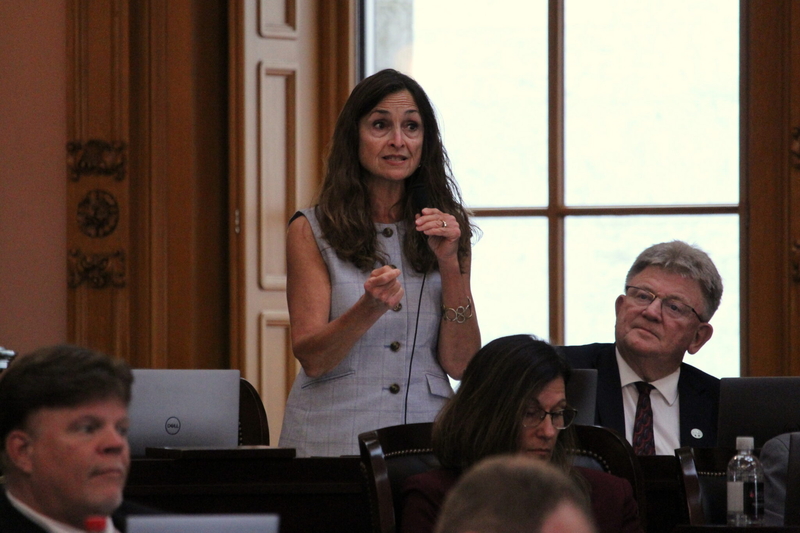
On the House floor, White said constituents keep asking what she can do to lower the cost of gas and groceries. Cutting state taxes on gas and diesel, she said, would flow through the economy lowering prices at the pump and many other retailers, too.
“The bottom line is three things: immediate relief, fully funding our roads at the local and state level, and making sure transparency is there so it’s consumers that are pocketing the money,” White said.
Even before the House session began, Democratic leaders explained they’d set aside their misgivings and support the measure. All told, 15 House Democrats voted in favor of the proposal.

Still, the caucus didn’t go quietly.
Ohio state Rep. Bride Rose Sweeney, D-Westlake, dismissed the savings Republicans touted.
“We’re talking about $3 a week,” she said. “And if the options are nothing or $3 a week, if that’s all this body can do, then yes, I will vote for it. But I don’t think anybody should be proud of that.”
She also criticized the majority for posing the issue as a concurrence with changes made in the Senate, which again, closed off Democrats’ opportunity to offer amendments to the bill.
Minority Leader Dani Isaacsohn called it “embarrassing” for Republican lawmakers, only now, to declare an emergency.
“Was it not an emergency in April when gas prices spiked over $4?” Isaacsohn asked, “I don’t remember an emergency clause then. Was it not an emergency this summer when utility bills went to $800 for the first time for Ohio? Was that not an emergency that demanded that we come back and take action?”
“No, it’s an emergency on Sept. 30th — that’s the date today — less than five weeks before Nov. 3rd,” he added. “Now it’s an emergency.”
After the vote, House Speaker Matt Huffman acknowledged Isaacsohn had a point but explained he was optimistic things might improve on their own a few months ago.
“At some point you have to make a decision,” Huffman said. “If we said, well, we’re not going to do it because it will look too political, that’s a terrible reason not to do it.”

Victory laps
In a press release after the vote, Acton’s campaign took credit for forcing the issue.
“As the first candidate in this race to propose a gas tax holiday, Dr. Acton is glad the Statehouse has voted with bipartisan support to establish a gas tax holiday and provide Ohioans much needed relief at the pump,” said spokesperson Virginia Schaus.
Schaus went on to criticize Ramaswamy for not embracing her other proposal for a “conditional moratorium” on data centers.
“Ohioans know they can’t trust Ramaswamy to take their concerns seriously or make life more affordable,” she added.
Ohio GOP lawmakers tee up votes for gas tax holiday after Acton, then Ramaswamy, back idea
But for Ramaswamy, the episode must’ve felt like a tidy little victory. One week later, he was standing on the same stage with the same legislative leaders, congratulating them on getting a bipartisan tax cut across the finish line.
“You can consider this a preview of the way my administration, beginning in January, will work — a constructive partnership with leaders in both chambers, working together to solve problems for Ohioans.”
Pressed on Democrats’ complaints about being left out of the process, Ramaswamy said “we’re starting with a clean slate in January,” and promised to work with anyone regardless of party.
While Democrats downplayed the scope of tax relief, Ramaswamy insisted a few bucks might make a big difference for some households.
“That may be the difference between being able to afford a Christmas gift for your kids or not,” he said. “It may be the difference between being able to take a weekend trip in the holiday season versus not. That’s a big deal.”
Follow Ohio Capital Journal Reporter Nick Evans on X or on Bluesky.

Columbus, OH