Getting amped for football season in Kansas means ignoring another bleak study on head injuries
Sep 04, 2026 | 4:33 am ET
Description
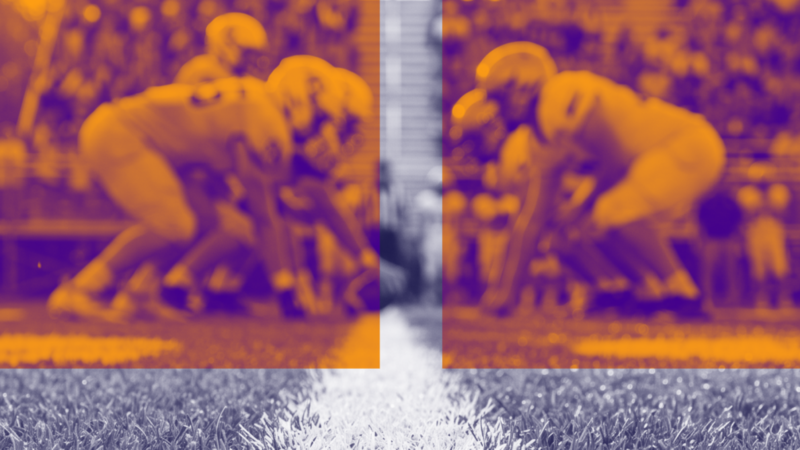
Football season brings excitement and celebration across the nation. But our columnist has been dwelling on the human toll. (Illustration by Eric Thomas for Kansas)
In a column four years ago, I wrote about my moral confusion with football.
On one hand, America swoons for the sport more than ever.
Witness the tailgate tables in Lawrence this weekend: the Jayhawk tablecloths, the ornate crimson-and-blue cupcakes, and novelty KU cocktails. In Topeka, the state of Kansas doles out tax breaks to the Kansas City Chiefs, desperate for them to move across the state line to build their domed stadium.
As Kansas State head coach Collin Klein said at a Wildcats media day, channeling the mood of many Kansans, football is “the greatest sport in the world.”
On the other hand, I wrote, fans often feel icky because of the spectre of football head injuries.
Witness the wide receiver slicing across the secondary. Oblivious to safety in his blind spot, he catches and turns just in time to see the opponent’s helmet filling his field of view. We wince and shush one another in the bleachers. The reverence for a big hit and a concussed kid. The medical staff sprints out before he fully slumps to the turf.
In that column, I wondered: How can we watch football with a clear conscience?
Looking back, my confused hand-wringing about being a fan completely missed the point. How self-absorbed to care about my comfort rather than the safety of the players on the field.
And so we arrive in September: the launch of a new football season paired with gloomy football news. This year, a new study of former NFL players further demonstrates how hundreds of American men are dying, plagued by life-changing neurological injuries caused by football’s cumulative violence to their heads.
Published by The BMJ, the study delivers dark news about the prevalence of brain injuries among professional players who died between 2016 and 2021. The most optimistic analysis of the data suggests that one in four former NFL players suffers from CTE, chronic traumatic encephalopathy, which is a progressive neurological disease.
The most dire possibility? That more than 90 percent of the brains of former pros show signs of such disease.
The study also documents a strong association between severe CTE and dementia. NFL players whose brains showed the most advanced CTE — labeled stage IV — were radically more likely to be clinically diagnosed with dementia.
Data like this sends me toward catastrophizing about football.
As someone ready to lambast the sport on even the flimsiest of evidence, I knew I needed an expert to help me analyze the study. I found one on the University of Kansas campus, where I also teach.
Thayne Munce started as an associate professor in the Department of Health, Sport, Exercise Sciences last year while also directing the Jayhawk Athletic Performance Laboratory.
“The majority of our research is applied sports science research, where we’re taking measurements of athletes in the field, monitoring them while they’re performing, and trying to generate insights and make observations related to their performance,” Munce said.
That means outfitting athletes with all kinds of wearable devices. In recent years, for sports associated with head injury risk (such as football, rodeo and soccer), Munce said that researchers used helmets outfitted with electronic monitors. The data they collected described rapid decelerations and accelerations that accompany hard hits.
“But now the accelerometers are in mouth guards,” Munce said. “That allows the work to expand beyond helmeted sports and beyond football.”
I asked him to put the new study into context: does it reveal something new or confirm something that we already knew?
“I think when you see the headline or even the summary of a study like this, saying that at least one in four — at least 25% of NFL players have CTE — that’s that’s alarming,” Munce said.
However, that summary omits context, Munce said. First, because these players died recently, their average age was much higher, meaning they were likely to have played in the 1960s and 1970s. The head injury data might be worse or better for current players because the playing atmosphere has changed during the last 50 years. (Conducting a widespread study of CTE in current players is impossible because players must be deceased to allow for an inspection of the brain tissue.)
Munce cautions that the study also does not address the prevalence of CTE among players who played youth, middle school, high school and college football during any era. His current research does show that “the impact severities” in youth football are “nearly identical to what others have reported for high school players.”
“We don’t know what that is compared to the NFL because those studies haven’t been publicly shared or publicly released,” Munce said. “But at least from the youth and middle school, up through college, the median impact severities are very similar.”
Munce’s context doesn’t change the basic conclusion: Between 25% and 95% of professional football players walk away from the sport with degenerative brain injuries. College players are the next most likely to have similar CTE rates because their careers involve more seasons and more impacts.
For the sake of the players, I’d like to think football in 2026 is a kinder game than it was for players during the 60s and 70s, in regards to head injuries. That’s Munce’s point of view. He points out the long list of football reforms: “better surveillance, management, care of brain injuries and concussion in particular, for football players of all ages.”
“In the past, concussions weren’t often recognized or talked about, and it’s very likely that players played through their concussions,” Munce said. “Players are better educated on recognizing the signs and symptoms of a concussion.”
Munce listed other reforms: rule changes (targeting restrictions and new kickoff formats), improved helmets and coaching on safer tackling.
For the sake of players, I’d like to believe, as Munce does, that football is safer now than it has ever been, but I don’t think so.
Football seasons are longer today, with more games and more practices in both the NFL and college football. Today’s five-star recruit at nose tackle is likely faster and stronger than generations past as football training, diet and coaching have improved. I imagine today’s 300-pound lineman is just as likely to inflict damage on his opponent’s brain — and more likely to receive it too — as his own strength creates forceful collisions that rebound to him.
The professionalization of America’s favorite sport means more football and more ferocity in football, which means more damage to players’ brains. If years of cumulative violent hits create CTE, today’s game seems just as brutal or nearly so, even with reforms.
There’s more in The BMJ study, such as an explanation of how rare CTE is in the general population (as low as .6%). However, it’s difficult to imagine the study changing this year’s football season.
The concern about head injuries comes and goes as studies emerge or catastrophes unfold. Even at the high points of CTE coverage, it seldom rivals the coverage of one player, such as Chiefs quarterback Patrick Mahomes. (Munce suggested that the COVID-19 pandemic distracted the public’s concern about football head injuries in 2020 by taking control of the safety conversations surrounding sports.)
I reviewed every press conference this fall from the three biggest football teams in the region. Listen to the coaches — Andy Reid of the Chiefs, Lance Leipold of KU and Klein from Kansas State — talk to the news media. No mention of head injuries l that I could find. No talk of helmets, concussions, head injuries and certainly not CTE.
Along with sports gambling, it’s the biggest story in the sport.
And no one is asking about it.
Journalists treat head injuries in football as a news story, not a sports story. (Let the science reporter handle it.)
We treat it as a story for the preseason, not game day. (Listen in vain for a mention of CTE during an NFL broadcast or college pregame show.)
Sweeping away the talk of head injuries has been the magnificent, Machiavellian project of the NFL and college football conferences.
The NFL’s playbook? Create a polished arm of the league titled, “Player Health & Safety” that stresses innovations like “the Digital Athlete” and “Helmet Laboratory Testing.” Enact a few reforms to dial back the shocking hits that disrupt games. Publicize flag football for kids.
At least one NFL player, New York Giants running back Cam Skattebo, believes that the brain condition is fake news.
Say it with me: “The NFL has made important progress in an effort to make football safer – and we remain committed to sharing that progress.”
Yet, the elemental, rumbling threat to player safety remains: the repeated, destructive collisions between players all over the field.
Football’s marketing and our insistent love for the game has convinced America that we fixed football.
The scientific research suggests differentl
Eric Thomas teaches visual journalism and photojournalism at the William Allen White School of Journalism and Mass Communication at the University of Kansas in Lawrence. Through its opinion section, Kansas Reflector works to amplify the voices of people who are affected by public policies or excluded from public debate. Find information, including how to submit your own commentary, here.

Topeka, KS