Missouri voters will decide limits on lawmakers rewriting ballot measures
Sep 03, 2026 | 7:04 pm ET
Description
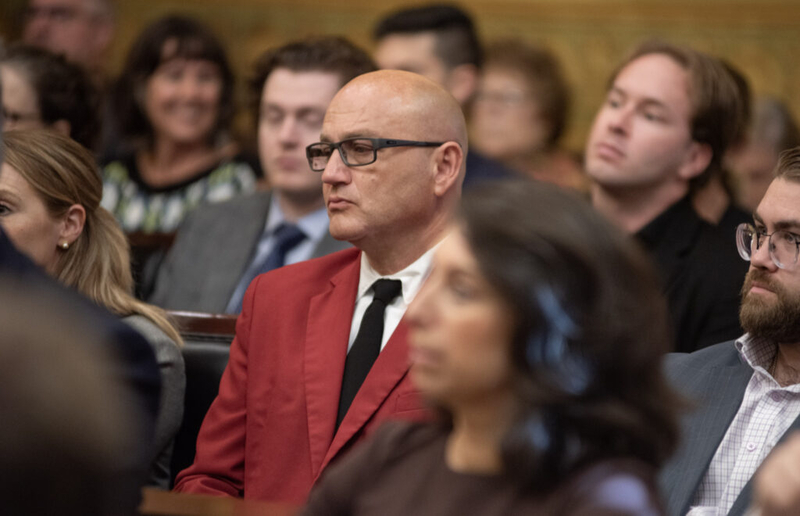
Missouri Secretary of State Denny Hoskins listens to three cases during Missouri Supreme Court arguments Wednesday (Annelise Hanshaw/Missouri Independent).
An effort to restrict the legislature’s ability to rewrite laws and constitutional amendments approved by voters through the initiative process will be on the Nov. 3 ballot, the Missouri Supreme Court ruled Thursday.
In a unanimous decision overturning Cole County Circuit Judge Daniel Green, the court ruled Secretary of State Denny Hoskins improperly declared the proposed Amendment 6 insufficient. The judges also rejected the constitutional objections Hoskins relied on to keep it off the ballot. .
Hoskins on Aug. 4 issued a “certificate of insufficiency” and based it on constitutional violations identified in an opinion letter from Attorney General Catherine Hanaway. Attaching that letter and adopting its findings as his own by reference was not the way it should have been done, Judge Ginger Gooch wrote for the court.
“Because his certificate fails to identify any reason the petition is insufficient under the
Missouri Constitution, it does not comply with (Missouri statutes) and preserves nothing for this
court’s review,” Gooch wrote. “Even if the secretary had preserved his claims, nearly all assert constitutional violations that may or will occur if the petition is approved. These hypothetical claims are not ripe for review. The two pre-election claims-violation of the single-article and single-subject requirements…lack merit.”
A political action committee called Respect MO Voters circulated petitions and obtained more than 350,000 signatures to put Amendment 6 on the ballot. It comes on the heels of voter rejection in the primary of Amendment 4, which would have made it more difficult to amend the Missouri Constitution by initiative petition.
Immediately after the ruling, Respect MO Voters announced it would immediately begin its advertising campaign to pass it.
“For more than 118 years, Missourians have had the power to put issues directly before the voters,” said Eric Bronner, co-founder of Veterans for All Voters, a supporter of Amendment 6, in a news release. “Amendment 6 is about protecting that right and making sure that when Missourians vote for something, politicians can’t simply undo their decision after the election.”
Amendment 6, if passed, would put heavy restrictions on the ability of lawmakers to alter state laws and constitutional amendments proposed by initiative and approved by voters. Any changes would have to receive 80% support in the General Assembly and be ratified in a statewide vote.
Currently, there are no restrictions on lawmakers altering or repealing laws passed by initiative. That happened in 2025, when Republicans forced through a bill that repealed paid sick leave for Missouri workers and inflation adjustments to the minimum wage.
A majority of lawmakers in both chambers can propose changes in constitutional amendments but those changes must also pass statewide.
That happened in 2020, when voters approved changes to the terms of a legislative redistricting proposal passed by initiative in 2018. Amendment 3 on the Nov. 3 ballot seeks to overturn the abortion rights measure approved in 2024.
The proposal would apply not only to measures approved in the future but also to laws and constitutional amendments previously enacted through the initiative process.
For example, lawmakers left the $15 per hour minimum wage approved in 2024 in place when they passed the bill repealing sick leave. If Amendment 6 is ultimately approved by voters, any attempt in the General Assembly to change that minimum wage would require an 80% vote from lawmakers and statewide voter approval.
To achieve that majority, a bill would have to have broad bipartisan support. Republicans won 111 of 163 seats in the Missouri House in 2024 and hold 24 of 34 seats in the state Senate. An 80% majority would require 131 votes in the Missouri House and 28 in the state Senate.
Jefferson City, MO