‘You’re On Your Own’: Rural Parts Of Big Island Reckon With Lala
Sep 03, 2026 | 6:01 am ET
Description
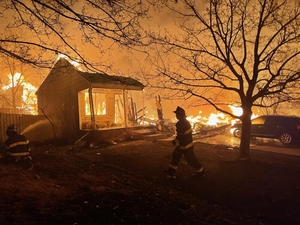
Photo courtesy of Honolulu Civil Beat
Nearly three weeks after Hurricane Lala drenched Hawaiʻi island, many people are still in recovery mode. And while the majority of the attention, resources and support has gone to Nāʻālehu, Wai‘ōhinu and Pāhala — the places hit hardest by mudslides and flooding — there are a number of other vulnerable communities on the Big Island where residents have spent lengthy periods of time without power or water and had their homes cut off due to downed trees.
In those places, just like in Nāʻālehu and Pāhala, people have stepped up to support one another — missing work, volunteering time and using their own personal equipment to clear roads and trees. But remote communities from Ocean View to ʻĀhualoa have also been asking: Why has government support been so slow to arrive? And should so much of the immediate response fall on the communities themselves?
On a broader level, the recovery effort is moving forward. According to an update Monday, the state brought in manpower and equipment from the military, Southern California Edison, one of the country's biggest electric utilities, and Hawaiian Electric Co. to accelerate power grid restoration. Last week, President Donald Trump approved federal disaster assistance to pay for 75% of the cost of recovery — a number that Gov. Josh Green has estimated is $81 million and rising. However, HECO is still working to address what it called pocket outages in several communities.
Staffing issues at the county, where a significant number of positions across multiple departments haven’t been filled in recent months, are also playing a role. There are currently 75 vacancies in the fire department and 105 vacancies in the police department. Employees in the Human Resources Department, which itself has nine vacancies, were stepping in to support the effort last week.
But the most significant factor may be the large and mainly rural island’s geography — and the fact that loss of power and cell service prevented so many people from communicating with the outside world for days.
Darryl Oliveira, acting administrator for the Hawaiʻi County Civil Defense Agency, told Civil Beat that his department is tracking the hubs that have been established around the island, even if it’s often a silent relationship. “They may not have heard about it, but we’re aware of it,” he said.
The county is relying heavily on local nonprofits and grassroots groups, he said, to form hubs in emergencies.
“It's a grassroots effort where we communicate to the hubs, and we're hoping that they have a telephone tree or a door-to-door system of going out,” he said “And short of us hearing, ‘We have major damage,' we're trusting that the community groups are addressing the needs of the community, and we just wait to hear from them what resources are needed.”
A Vulnerable Community Put To The Test
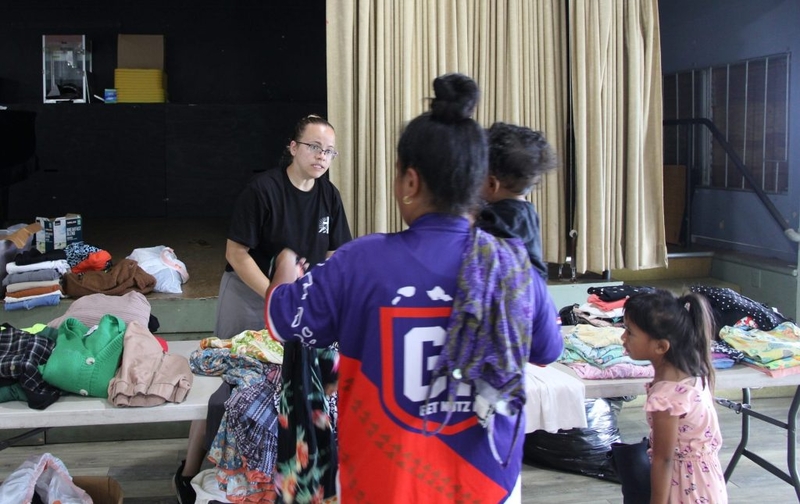
In Ocean View – a sizable yet remote community that spans a grid of 10,000 lots spread across jagged a‘a lava fields on the south side of Mauna Loa – a team of local volunteers worked nonstop for the first week, driving up and down the mountain assessing damage, getting folks water and identifying stranded kūpuna. They threw together a resource hub at the Ocean View Community Center, a sturdy building that serves dozens of purposes, within the first few days. Together they began collecting donations, making supply runs up the hill, and supporting families who were sleeping in cars or had lost entire refrigerators' worth of food.

“We were unloading some boxes, and someone said it was day eight, and I remember feeling my jaw literally drop,” said Alexis Kerver, one of a few dozen Ocean View residents who took the week off work to help and spent the time in a blur of activity.
The community, where an estimated 25% live below the state’s poverty line and there has been a large influx of Marshallese residents in recent years, is no stranger to self-reliance. “We're such an isolated population that it's hard to identify where the needs and the challenges are,” Kerver said.
Images of disaster in other parts of Kaʻū have been widely shared online, and Ocean View residents have watched as massive quantities of supplies have been delivered to the communities just a few miles down the road.
Zed Kaʻapana Aki, a local farmer, was driving 90 miles round trip to Kona almost daily, filling his vehicle with water, generators and other supplies. “We already have transportation disparities,” Aki said. “The disparities are just greater now.”
He added that community members made a request to bring in members of the National Guard to do sweeps of the upper-elevation parts of the neighborhood and they didn’t receive a response. Instead, Ocean View residents saw hundreds of support vehicles pass them by on their way south.
“We haven't seen the county, we haven't seen the state, and we haven't seen the feds,” Ocean View Community Center director Marilynn Rose said last week. “This did not surprise anybody.”
Rose acknowledged that “Pāhala and Nāʻālehu suffered damage that will be nightmares for people for generations,” but the contrast in Ocean View has been especially stark.
Vibrant Hawaiʻi, a nonprofit that helps connect vulnerable people to existing support networks, has had one person on the ground and others collecting data about residents’ needs — 1,800 from Ocean View alone. The Red Cross showed up 10 days after Lala to hand out first-aid kits, tarps and other supplies. At that point, around half of the census-designated area of 4,400 still had no power, and a plan was in place to set up tents on the property for people whose homes were still uninhabitable.

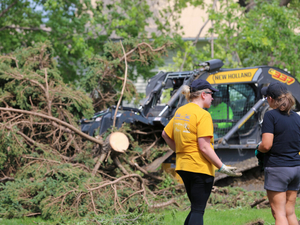
Team Rubicon, a group of 20 humanitarian workers, mostly from the mainland, set up shop in the community center with chainsaws for 10 days. They are still clearing trees off of houses and out of driveways.
The majority of people in Ocean View rely on SNAP benefits, Kerver said, and they lost all their perishable food. On day 11, a table full of canned goods and other non-perishables went in less than an hour. A group of people waited for over an hour in the parking lot for another truck full of supplies to arrive.
The Ocean View Community Association played a pivotal role in supporting the area’s most vulnerable families early in the Covid pandemic. It used that momentum to expand its operations and network of volunteers that came together and was able to then step back into action this month. The challenge comes, Kerver said, when outside groups show up late and want to dictate very specific terms of engagement while taking credit for the work that’s already being done.
When the Red Cross did arrive, for example, they required residents to show Hawaiʻi state driver's licenses to receive first-aid and cleanup kits. Then they placed a shipping container full of supplies on the community center property but didn’t grant the volunteers access. They wanted access to the spreadsheet that Kerver and others had created to keep track of the most vulnerable kūpuna in the community.
“We have a system in place,” Kerver said. “Rather than coming in and trying to impose your ways onto our operations, work with us.”
Shannon Carley, regional communications director for the American Red Cross, said the group typically tries to field all requests for assistance that come to the organization.
“We work with state and county partners to share information and make a plan together on where we should go and optimize our resources,” Carley said. She added that the Red Cross was in Ocean View in partnership with Vibrant Hawaiʻi.
According to Carley, the international nonprofit had worked with their own group of volunteers to set up and staff three evacuation shelters on the Big Island, including one in Nāʻālehu. She said the organization prefers to work with local volunteers because they’re already in the community when disaster hits.
Amber Franks, who lives in Ocean View and works for Vibrant Hawaiʻi, said the area is important to the organization, and it’s just not an easy place to help people.
“We've been called the Wild Wild West, and it’s true that sometimes the resources that you can find in Hilo, Kona and other places are just not as readily available here,” Franks said.
Vibrant Hawaiʻi has been providing $250 Visa cards to the most impacted community members. It’s enough to replace some food, but she acknowledged that for many Ocean View residents, especially those who struggled to find housing before the storm, that financial support will only go so far.
Trapped Behind Trees
In Kaloko Mauka, a high-elevation, heavily forested neighborhood on the side of Hualalai mountain that extends up to 5,000 feet in elevation, downed trees created an obstacle course for many trying to get in and out of the neighborhood during the first week after the storm.
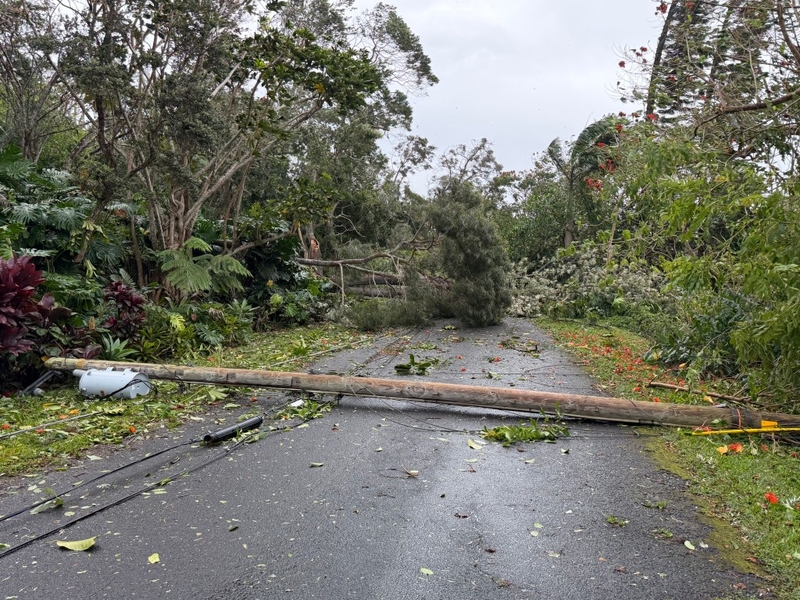
Karen Breier and her neighbors were trapped in their homes for 10 days, as massive fallen trees and power lines blocked off their road. Breier, 76, had chosen to weather the storm with an out-of-town friend and they ended up spending a week together, catching rainwater in buckets.
“In the last three months I've gone to the hospital in an ambulance twice. So it was scary to be trapped here,” Breier said. She lost 22 trees on her property and had several fall on her neighbors’ property. “It was like dominoes all the way down,” she said. On Day 11, several trucks from Hawaiian Telcom and Spectrum were in the neighborhood working to restore the internet.
Just down the road, Frank Sayre was navigating the loss of several massive 'ōhi'a trees, including one that he estimated to be 400-500 years old, on the lot full of native trees he has been stewarding for decades.
Kaloko resident and mushroom farmer Robbie Brown said he and a group of friends with chainsaws spent a few days literally cutting their way through the trees lying across Kaloko Drive, the main thoroughfare that winds up the mountain. “At least then there was a path right to get through,” he recalled. “You had to drive over down power lines or underneath them or underneath trees that were halfway leaning. It was pretty wild.”
“A lot of people brought their own machines up there and did their own stuff, and the county didn't show up until we got power back in the lower part of the subdivision,” he said. That was six days after the storm.

The Unlucky Few
Some communities on the Hāmākua Coast were without power for nearly two weeks. In ‘Āhualoa, Kelly McEnroe was making the 20-minute drive to Waimea and Honokaʻa often for ice to keep her food from spoiling and to access cell service. At home she relies on WiFi to connect her to the world. By the middle of last week she hadn’t heard anything from the county or from Hawaiian Electric officials beyond press releases.
“I keep going to (Hawaiian Electric’s) website, but it's very vague,” she said last week as she prepared for another day without power. “It says 95% in this region will be restored by a date but it doesn't say, well, you are in that 5% or in the 95%.”
The days without power felt like camping, McEnroe said. But she wasn’t prepared for it. “You look at life differently, like, what are luxury items?” she said.
Ken Slauson was in Alaska when Lala hit, and his home was without power when he returned nearly two weeks later. The storm and a lack of communication from the county and utilities reinforced his understanding that communities need to get prepared to go without government help.
“I think we're going to have to get more structured, more organized and more focused in our community associations,” Slauson said.
He’s a part of the ‘Āhualoa Community Association and while he doesn’t like to call himself a doomsday prepper, Slauson has fitted his house with solar panels and a battery, has training in community emergency response and has an amateur radio license.
“Some of the resiliency efforts up and down the Hāmākua Coast are going to get increasingly noteworthy,” he said. “The government is not going to come save us, and so you need to figure you're on your own for two weeks.”
Some resilience efforts got a test run during Lala. In Paʻauilo, the community association tried out a radio network they set up earlier this year. With handheld high-frequency radios, community members were able to stay in touch and look after each other when both cell service and the power were out.
Oliveira recognizes that much could be done to improve communication with harder-to-reach places when power and cell service goes out. He said he has been working with New West Broadcasting Corp., the company behind multiple radio stations, including KWXX 94.7 FM in Hilo and KAOY 101.5 in Kona, to expand the commercial radio coverage on Hawai‘i island, and with others on the west side of Maui where the stations reach the Hāmākua Coast.
“I think there's an opportunity to continue to build on that,” he said. “For the areas that our local system does not cover, how do we partner with the system that does provide that outreach and coverage?”
Hawaiian Electric is tracking the remaining power outages on this map. The Ka‘ū Police Station’s phone system is also still out due to Lala’s impacts on the area’s fiber optic network, officials announced Wednesday. Meanwhile, three more storms are making their way across the Pacific.
Civil Beat reporter Taylor Nāhulukeaokalani Cozloff contributed to this story.
Honolulu, HI