Idaho officials request raise for disability caregivers and restoring cuts to mental health services
Nov 19, 2026 | 6:15 am ET
Description
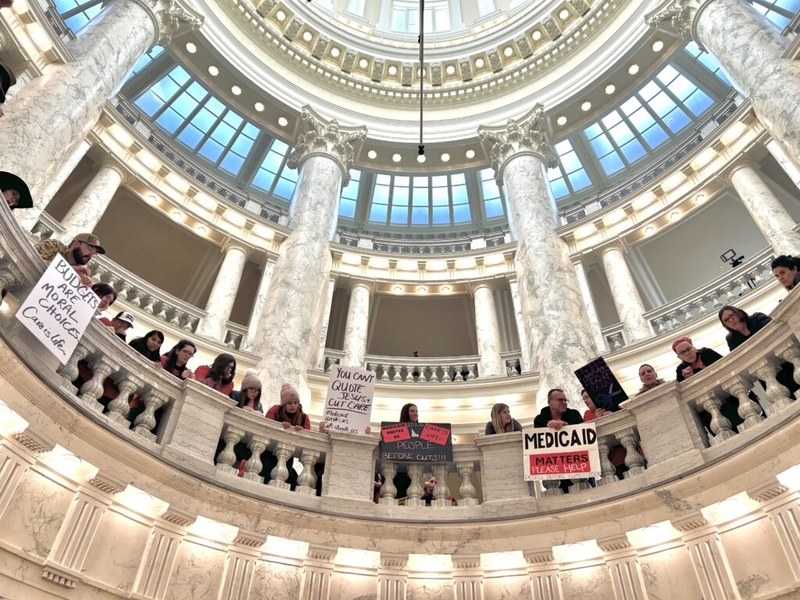
Hundreds of Idahoans gathered in the rotunda of the Idaho Capitol on Jan. 12, 2026, to protest budget cuts to the state's Medicaid program. The protest, organized by Idaho Voices for Children, took place before the governor's State of the State Address. (Photo by Christina Lords/Idaho Capital Sun)
Idaho health officials are hoping to increase the pay rate for disability caregivers by 13% next year.
The raise request — detailed in the Idaho Department of Health and Welfare’s budget proposal submitted to the Idaho governor in September — would bring the pay for personal care service workers up to $27.64 per hour. That’s up from Idaho’s current hourly pay rate of $24.44.
That could bring the state out of its status as the lowest paying state for the industry in the Northwest for the first time in years. Idaho has, for years, had a shortage of disability caregivers, who often work in low-paid, demanding jobs.
On the heels of the 2026 legislative session’s deep budget cuts across state government, the request to increase the pay of disability caregivers represents a rare departure from the governor’s office’s instructions for state agencies to continue submitting barebones budgets.
The Idaho Department of Health and Welfare is calling for the pay increase after recently learning that few caregiving agencies can take new patients, Medicaid Administrator Sasha O’Connell said in an interview last month. Through the research, required by federal regulators as part of the state’s recent cuts to doctor pay rates, the state found — by hiring a secret shopper — that only three personal care service agencies, out of 152 across the state, could take children. Less than a third said they could take new adult Medicaid clients.
“What we found is very concerning,” O’Connell said.
The budget request is only one of the first stops for a change in the state’s budget.
Gov. Brad Little will next lay out his priorities for state agencies and the state budget during January’s State of the State Address. But it is ultimately up to the Idaho Legislature to set the state budget and weigh which individual requests make the cut.
Across the board, the raises for disability caregivers would cost the state roughly $3.9 million, and the federal government about $8.1 million. That represents a small chunk of the Idaho Department of Health and Welfare’s overall $6.58 billion budget for next fiscal year, which starts in June. The total budget could see about a 2% increase from what lawmakers approved this fiscal year.
State health officials aren’t expecting to need to ask the Legislature for more money to fund Medicaid for this fiscal year. But they are hoping to ask the Legislature for permission to tap into a recently created rainy day fund, the Medicaid Stabilization Fund, in case costs come in higher.
But in a year where state agencies were instructed to once again submit barebones budgets, the Department of Health and Welfare had a few new spending areas.
After Legislature restored mental health budget cuts, agency requests permanent funding
Early this year, within months after a Medicaid contractor cut a set of mental health programs, four patients died. The contractor, Magellan, had had its pay rate cut by the state as part of an early round of budget cuts by Little.
In the final weeks of the legislative session, state lawmakers had secured temporary funding — through legal settlements with tobacco and opioid manufacturers — to restore the two programs, which included a mobile treatment program for people with severe mental illness, called Assertive Community Treatment, as well as peer support services, which help people navigate mental health treatment.
Heading into the next legislative session, the Department of Health and Welfare requested ongoing state funding to keep providing the programs.
The state’s estimates for how to maintain those services are tough to break apart. The costs for people on those programs who are on Medicaid are baked into a bigger budget area; this year, it cost the state $8 million to run the program, and it cost the feds $20 million. The costs next year to fund non-Medicaid members of those programs is $2.15 million from the state’s general fund.
Without the program, state officials acknowledged that more patients could die.
Without sustainable funding for these services, “Idaho may see higher utilization of crisis services, hospitalizations, death, and incarceration among individuals with serious mental illness,” state officials wrote in the budget proposal.
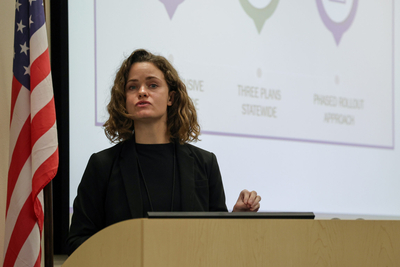
O’Connell said health officials were instructed to bring back programs restored temporarily last year into ongoing funding, through the state’s general fund, the pool of taxpayer funding that lawmakers can freely allocate to different areas.
But she acknowledged that lawmakers could decide to keep tapping temporary funding for the programs.
“It’s completely up to the Legislature, should they choose to use ongoing funding sources to fill that need or one-time, like they did last year,” O’Connell said.
And she stressed that this programs’ inclusion isn’t a sign that they are safe from cuts for good. In budget shortfalls, she said state health officials would still have a similarly small list of options of what they could cut.
“Those are not decisions that we would have made if it weren’t for budget reductions that were necessary,” O’Connell said. “But we also live in an environment where we need to plan according to a state budget. And if we were in a similar position … we would be faced with a similar set of options, where Assertive Community Treatment, adult peer support services, and very few other services would be on the list of things that could be eliminated if we were told that we needed to eliminate services or change our budget to get in line with expectations, given our limited resources.”
Other new programs: Patients pay more for Medicaid care, and a scorecard for Medicaid contractors that manage health benefits
More parts of big Medicaid changes from a cost-cutting state law in 2025 are rolling out.
One of the next pieces will essentially be more patient copays, or costs people have to pay per doctor’s visit or treatment session.
The law allowed those payments, called cost-sharing, to be “at least to the levels developed by other states and up to the maximum charged by other states.”
In researching that part of the law, Health and Welfare found that the cap would be about $4 for most services, and $8 for prescription drugs that are not on the state’s preferred drug list. The state asked federal regulators for permission to make those changes.
Part of implementing this change, the agency says, is developing a tool to ensure that the cost-sharing amounts aren’t more than 5% of the household income. The agency is requesting permission to transfer $1.78 million in mostly federal funds to set up that system from program benefits costs. Long term, the state expects the policy to save money.
As part of the state’s shift to private companies managing Medicaid benefits spurred by the same state law, the state is also preparing to roll out a new federally required tool to monitor those contractors. The model of private companies running Medicaid is called managed care.
The tool, set to be publicly available by the end of 2028, is expected to include feedback from patients and providers, O’Connell said. In the past, some providers have complained that the two most recent mental health managed care organizations, Magellan and Optum, had delayed payments to providers.
“The goal is really to share that information publicly, so that managed care organizations have that information transparently as providers and members are making selections about who to contract with or who to receive their care from in a future state where we’re moving to comprehensive managed care,” O’Connell said.
To help set up the tool, the state health agency is requesting $550,000, largely from the federal government.
What wasn’t detailed in Health and Welfare’s budget request was an update on its cuts to doctor pay rates. The agency hasn’t yet received approval from federal regulators on its cuts, which it first implemented in late 2025. But Department of Health and Welfare spokesperson AJ McWhorter said the agency has “no reason to expect that we won’t” receive approval.
Ending the cuts to provider pay rates and cut services would cost $34 million in general funds, and nearly $92.3 million in federal funds, according to estimates the agency provided to the Idaho Capital Sun.
Boise, ID