Lack of child care still a key need for WV businesses while state slowrolls lawmakers’ bill
Sep 02, 2026 | 5:57 pm ET
Description
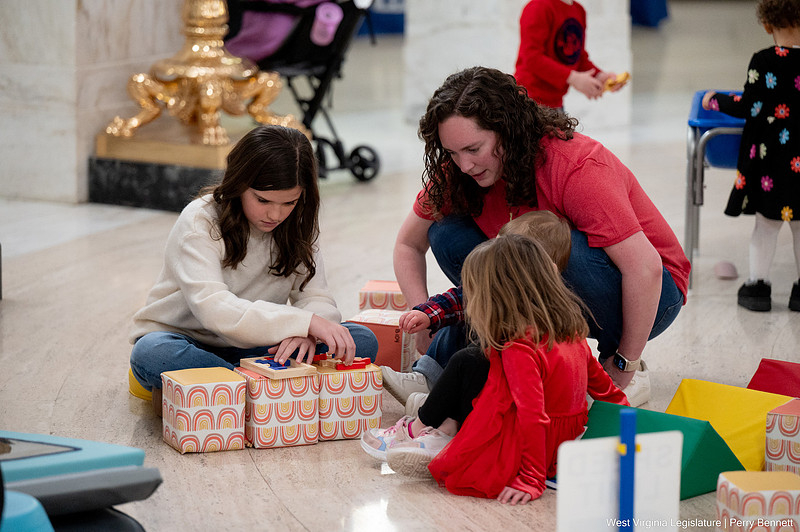
Child care providers and families attended Child Care Day at the West Virginia Capitol Feb. 2, 2026, to advocate for legislation supporting the state’s struggling child care industry. (Photo by Perry Bennett/West Virginia Legislative Photography)
West Virginia’s business leaders continue to beat the drum that the state is woefully short on affordable childcare spots. They say it is one of the reasons the state continues to have the nation’s worst workforce participation of a little more than 50%.
While state-backed efforts are underway to expand childcare, more than 28,000 children currently lack access to care because West Virginia providers don’t have enough available slots.
“Childcare really just isn’t a family issue anymore. It really is a workforce issue. It’s a retention issue. It’s a recruitment issue,” said Leeann Kaminsky, senior vice president and chief human resources officer at WVU Health System.
Along with a lack of childcare spots, affordability is a real concern for job seekers, Kaminsky said. Families on average spend over $10,000 a year on childcare in West Virginia.
“The average median household salary in the state of West Virginia is $61,000 a year. So if you think about that, the cost to put a child in daycare, it’s almost not worth it for someone to work,” Kaminsky said.
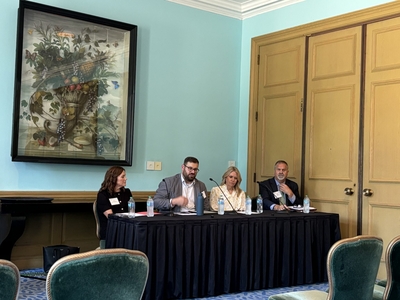
The state’s childcare crisis was highlighted during a panel discussion at the West Virginia Chamber’s annual Business Summit. The meeting is underway this week at The Greenbrier Resort in White Sulphur Springs, W.Va.
“We consistently hear that over three quarters of our members identify child care as one of the main barriers (to) attracting and retaining a workforce in West Virginia,” said Brian Dayton, vice president of policy and advocacy for the West Virginia Chamber of Commerce. “We have a firm belief that addressing childcare is one of the absolute fundamentals if we’re going to go ahead and start raising our workforce participation and being more pro-family in West Virginia.”
State lawmakers passed their first-ever landmark childcare bill earlier this year, hoping to stabilize the struggling child care industry. Child care providers came to the Capitol asking for help dealing with a myriad of complicated issues, including how the state reimburses providers who serve thousands of kids using an assistance program for eligible working parents.
House Finance Chair Clay Riley, R-Harrison, said consistent education on the topic of childcare helped him move the issue to the forefront of the Legislature while they focus on improving the state’s economy.
“You’ve got to consider early childhood education as really kind of an economic infrastructure,” Riley said. “You bring more people back into the workforce. They begin paying taxes. They earn more wages. They have more stability. It gives more opportunity for their kids to be educated and get better educational outcomes.”
The lengthy legislation combined several bills to expand the state’s childcare tax credit for businesses and codified that the state — regardless of fluctuating federal guidance — reimburse childcare providers who serve kids using the state’s childcare subsidy by the total child enrollment rather than daily attendance in an effort to stabilize finances.
The West Virginia Department of Human Services hasn’t implemented the bulk of the bill despite a July 1 deadline. Gov. Patrick Morrisey declined to sign the measure, and it became law without his public support.
The governor’s office told West Virginia Watch last month that the stalled implementation is because lawmakers didn’t provide necessary funding to make the required technology upgrades.
Sarah Bolyard, president & CEO of the YMCA of Kanawha Valley, said that DoHS this week implemented a key part of the bill that changed how the state calculates the length of afterschool childcare for purposes of providers’ billing. The previous policy made it difficult to hit the state’s reimbursement threshold due to the time between when school lets out and typical parent pickup times.
“The way that the policy was written was that in order for us to be reimbursed for a full day for a child in after-school, which is $14, the child would have to stay with us for four hours,” Bolyard explained. “That’s not possible with parent work schedules when most parents get off at 4, 4:30, 5 o’clock, and so that’s why this legislation was so important for us.”
‘We are still operating at a loss’
Thousands of West Virginia families use the childcare assistance program, making it integral to childcare providers’ finances.
Providers are still struggling to stay open and keep care affordable for families. Two-hundred and fifty childcare providers in West Virginia have closed in the last two years due to affordability issues.
“We want to provide a fair, movable wage to our staff. Operating costs are through the roof, just like everybody else’s utility bills are raising, ours are raising as well,” Bolyard said. “We are still operating at a loss. Our center in Cross Lanes, in the last seven months, has lost $87,000 over last year, and we have not changed the way that we operate. We’ve actually decreased how many staff we’ve had, and we’ve made those necessary cuts.”
In May, Morrisey signaled that the state could see changes to the childcare subsidy program due to a looming shortfall in federal Temporary Assistance for Needy Family dollars that pay for the program. The state has decreased its own funding into childcare since 2018 by 40%; it’s now around $8.8 million.
Wonderschool, a tech company, is hoping to address the affordability issue by expanding its tri-share model in all 55 counties after lawmakers allocated $5 million to the program.
Marcus Keech, who works in government relations and tri-share partnerships for Wonderschool, announced the statewide launch on Thursday after piloting it in eight counties.
The tri-share model splits the cost of childcare three ways – between employers, employees and the state. The family pays the remaining difference.
“There’s no additional bureaucracy. The family keeps the provider they currently have and that they trust,” Keech said.
“We look forward to partnering with [Department of Education] and others in taking this across the state. We’re really excited,” he continued. “To my knowledge, it is the largest tri-share program funded of all states that have been real pioneers of this program. So that’s something that’s really welcome.”
Keech noted that the tri-share model addresses affordability but doesn’t address the state’s capacity issue.
Charleston, WV