Prayer, dynamite and leadership: 60 years of West Virginia water worries
Sep 02, 2026 | 5:55 am ET
Description
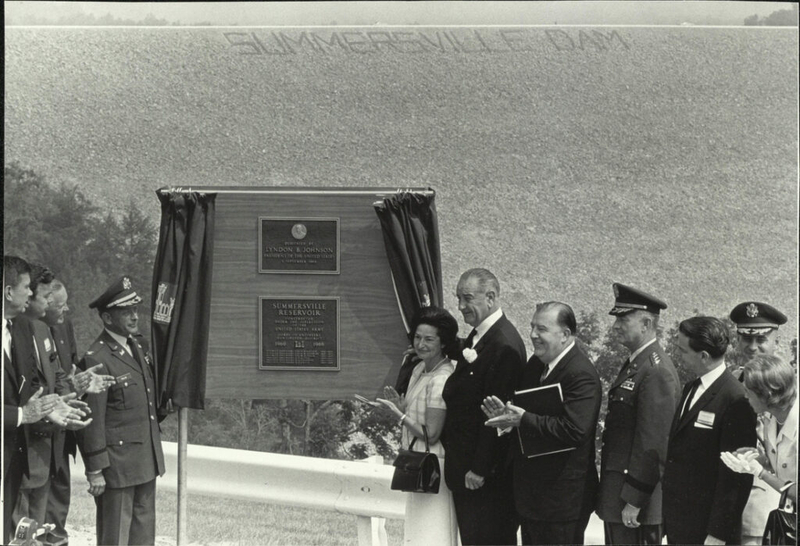
President Lyndon B. Johnson and his wife, Lady Bird, attend the dedication of the Summersville Dam in Summersville, West Virginia, on Sept. 3, 1966. (West Virginia State Division of Culture and History photo)
The sight of a family on the shores of Summersville Lake, adults cooking on a fire while scattered children explore an inlet, is a common and relatable scene for many West Virginians over the last 60 years.
The scene is slightly different and more historical when the observer is Lady Bird Johnson swooshing in via helicopter to mark the newly man-made wonder of West Virginia water.
The then-First Lady was accompanying her husband President Lyndon Baines Johnson to the dedication ceremony of the new Summersville Dam. The first couple were joined by legendary U.S. Sen. Jennings Randolph and up-and-coming politicos like Sen. Robert C. Byrd and Congressmen Ken Hechler, John Slack, Harley Staggers, James Kee and a young Arch Moore, Jr. among others participating in the presidential festivities. Sept. 3, 1966, saw thousands gather at Charleston to greet the Convair version of Air Force One and thousands more anywhere they could fit around the 390 foot high and nearly half-mile long earth fill dedicated to keeping the Gauley River specifically and Kanawha River basin generally at bay.
Lady Bird’s personal audio diary for the day noted several things about her brief trip to West Virginia. She found the scars of strip mining viewed from the air ghastly, noting “It is just as though some heedless child had been turned loose with a giant crayon on an enormous mural of forested hillsides and soft green valleys with creeks — the broad ugly scars of the strip mining laid bare to the hillsides, crawling around the mountains and on and on into the distance — ugly, brutal, dramatic.”
She preserved into the official record the long-running joke locally of the naming of the lake, dam, and the speech LBJ was to give dedicating it all under the nomenclature of “Summersville,” despite the post office town of Gad having been relegated to the depths by eminent domain and the greater good. The wisdom of not naming such a feat of engineering the “Gad Dam, West Virginia” was as amusing to the First Lady then as it has been to locals ever since. And she noted the family in the inlet on the blanket ignoring the pomp, politics and policy to just enjoy the time on the water.
For his part, LBJ delivered a speech that, after the usual acknowledgements of present persons of note, was an impressive mix of history and forethought. The president used his remarks to trace water as a constant challenge of mankind throughout history. Notorious for editing and “flavoring” his speeches from prepared text, Johnson put quite a bit of himself and impressive perspective into what could have easily been a low effort appearance. He talked of frustration at seeing flooding as president from aircraft and the devastation wrought, and touted the dam behind him — where workers had spelled out a nearly 400 foot long “Summersville Dam” into the earthwork itself as background — for its potential flood control abilities.
The president related to being from the arid parts of Texas where water was scarce and valuable. The long-time congressman and U.S. senator before becoming vice president and then president touted his legislative pushes throughout his career across the country. He spoke of pollution control while still fueling industries and protecting water quality
Then the president zoomed out. He talked of the entire world, and how no water meant no peace. He listed seven points his administration was looking to work towards. He announced a forthcoming international conference on the subject. He talked about the entire history of humans being a struggle to get, use and keep water, and his desire “to get people to think of this most important subject before it is too late.” He punctuated his remarks with a quote from Texan historian Walter Prescott Webb on how humans had “resorted to every expedient from prayer to dynamite” to win the war for water. Webb concluded, “The story of their efforts is, on the whole, one of pathos and tragedy, of a few successes and many failures.”
President Johnson added his own piece to the quote, motioning to the dam he was dedicating behind him and to the already recognized elected officials standing beside him. “You not only have the prayer and the dynamite, you have the leadership of men in the Congress. You have the leadership of the great Corps of Engineers who participated. You have leadership in the state level with your great governor — to build projects like this that millions in years to come will enjoy, and millions today will thank you for.”
Sixty years after that visit to Summersville Dam finds West Virginians still waging wars over water.
The long hot summer of 2026 has brought flood after flood to the state. Over the last 60 years, hundreds of West Virginians have died and untold thousands more affected by various floods, from the industrial massacre of Buffalo Creek to the Election Day floods in 1985 to the “thousand year” flooding of 2016. A renewed political debate over water policy, the kind of water for drinking and using for things, have renewed cries from the affected to “do something” to the political leaders. Leaders who have to solve the old problem of too many needs and not enough money and political will to tend them all but needing to show activity to keep their positions regardless of the issue at hand being solvable.
In the gaps where dynamite and engineering cannot or will not be used, prayer is substituted. Thoughts and prayers to mourn the dead. Crying out for relief when the building block of all life doesn’t come out of the tap clean and usable. Forlorn hoping a loving God can overcome bureaucratic limitations and infrastructure realities. The “thoughts and prayers” phrasing can also turn into cynical prayer-coded condescending buzzwords from more privileged outsiders aimed at their perceived lessers who they think should not be so. Unlike engineering and dynamite, the results of prayers answered and otherwise are more nuanced and hard to define as successful or not.
By any measurement Summersville Lake and Dam has been a great success. During the already historically deadly 2016 flooding the US Army Corps of Engineers estimated the massive earth fill dam on the Gauley shouldered 42 feet of floodwater that otherwise would have caused Biblical destruction to downstream areas, including Charleston.
Tourism has been a hallmark of the area, since impounding the mighty Gauley River for summer leisure on the lake also means world class white water in the fall when winter pool drain means rising river rapids. Rafters put in for the Gauley run right below where LBJ spoke that day 60 years ago, even as a hydroelectric plant made the outflow less visually stunning but more useful to the area. More recently Summersville Lake State Park formalized what many already knew, that this particular corner of the wild and wonderful was worthy of specific attention.
All that success is because of leadership seeing through plans dating back to the 1930s to control water in West Virginia. Whether for power, for recreating, for preventing death and destruction, for 60 years Summersville Lake and Dam harnessing water has shown what can be done. The ability to dynamite and engineer such things is well established. The hopes and prayers of the citizens for better in the future are constants.
The variable is leadership.
While Lady Bird Johnson was visually processing the mining scars across the West Virginia hillsides she felt so deeply, she asked the governor of West Virginia’s wife Mrs. Smith if there was any sort of legislation requiring the mines to do something about what they had created. “Yes” she noted in her audio diary the reply. “That’s the business on the agenda. It involves mostly some sort of terracing because they are an erosion problem.”
Quite the summation in Lady Bird Johnson’s September sojourn to Summersville in 1966. She sees a massive, ugly, glaring problem on the way in and gets only a vague answer in return. Enjoys a ceremony set up with maximum pomp and circumstance to mark a real achievement that will make an everyday, mundane, under-appreciated difference. Flying over a family oblivious to it all because their focus is enjoying family time along a lake that months before didn’t even exist but would become one of thousands of stories. Pretty good West Virginia experience as highly choreographed official visits go.
Meanwhile, the fight for and over water in West Virginia continues, with three fewer congressional districts. We still have the dynamite to get things done and prayers to see us through. Have a bit of a leadership issue, though. It mostly involves some sort of terracing because there is an erosion problem.
Charleston, WV