The ‘show-your-papers’ measure failed to reach the ballot. That’s good for Michigan’s newest voters
Sep 02, 2026 | 5:39 am ET
Description
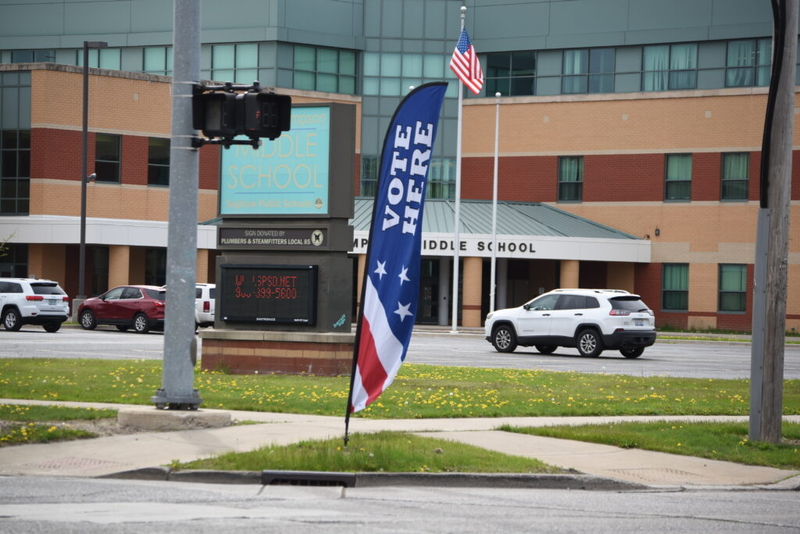
A sign welcoming voters outside Thompson Middle School in Saginaw, Mich. May 5, 2026. | Photo by Katherine Dailey/Michigan Advance.
At a time when media is reporting on Gen Z’s lack of political engagement (prompting unfair accusations of apathy), many colleges and universities, along with nonprofit partners, such as the Fair Elections Center’s Campus Vote Project, are working to instill feelings of civic agency and lifelong voting habits in our nation’s newest voters. After all, the future health of our democracy depends on the constant generational renewal of civically engaged citizens.
But in Michigan, anti-voting operatives are trying to advance policies that would silence young voters before they’ve even had a chance to find their political voices. After a “show your papers” bill requiring documentary proof of citizenship (DPOC) for voter registration stalled twice in the Michigan legislature, anti-voter groups responded by trying to gather enough signatures to have the question of whether DPOC should be required included as a ballot initiative in the upcoming 2026 elections.
The State Board of Canvassers deadlocked on whether the signatures met the state’s legal requirements, meaning the measure is not currently on the ballot. If it remains off, that would be a win for voters.
Board of State Canvassers deadlocks on citizens-only voting measure, setting up court fight
But the anti-voter forces behind the bill have vowed to turn to the courts to break the tie and force the issue to the ballot. If ultimately voted on and passed, this bad-faith anti-voter policy, rooted in demonstrably false narratives of noncitizen voting, would silence the voices of thousands of eligible Michigan voters—not just young people—and needs to be stopped in its tracks.
The problem? Many eligible Michigan voters, like thousands of eligible voters across the U.S., do not have or cannot access the required documents—such as a passport or birth certificate. Many more who have changed their names do not have documentation that matches their birth names (a category that includes millions of married women).
For students, the barriers that DPOC requirements would impose are clear. According to a recent Institute for Responsive Government study, 24% of 18–29-year-olds reported lacking the necessary documents. In several of the states covered by the study, voters in this age group were two to three times more likely to have trouble accessing proof-of-citizenship documents than those aged over 30.
The solution is not as simple as obtaining the necessary documents—for many, getting a passport or tracking down a birth certificate can be prohibitively costly and time-consuming, often taking weeks or months.
Students who live on campus are particularly vulnerable to being stopped from voting by these laws. Even those who have obtained a passport or a birth certificate often do not keep those sensitive documents on campus with them in dorms or group houses. As a result, requiring students to show documents to register severely hampers on-campus voter registration opportunities. These critical student engagement efforts cannot operate effectively when potential voters have to show paper documents to sign up.
Arizona provides a real-world example of whom DPOC requirements will disenfranchise. According to a 2024 Votebeat analysis, of the roughly 32,000 people excluded from voting in state elections in Arizona because they lacked DPOC, a disproportionate number were geographically concentrated in areas that included college campuses, most of them likely young voters: 18–24-year-olds in the state were nearly three times more likely to be excluded from voting in state elections because they lacked proof of citizenship.
The red tape that DPOC requirements force on voters is entirely unnecessary and will stop thousands of eligible citizens from voting for absolutely no good reason. Existing law already safeguards our elections to ensure that any instances of a noncitizen casting a ballot are extremely rare and usually a mistake. Noncitizen voting is already illegal under state and federal law, and state-level reviews of Michigan’s 2024 election cycle found that just .00028% of the more than 5.7 million ballots were cast by non-citizens.
Voting is habit forming: Michigan should continue to increase opportunities to start a life-long voting habit, not set up red tape that makes it harder to become an engaged citizen. We must work to ensure every eligible voter, no matter their age or background, can participate fully and fairly. Failure (so far) of the 2026 DPOC initiative is a win for voters that protects our elections and strengthens our democracy.
Lansing, MI