Wendell Berry asked: What do we owe to the place that sustains us?
Sep 02, 2026 | 5:30 am ET
Description
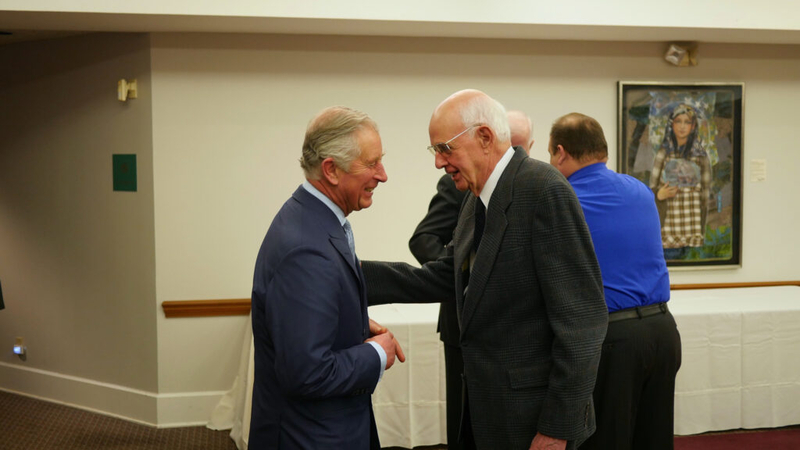
Wendell Berry and the now King Charles met at the Cathedral of the Assumption on the day of Prince Charles' visit in 2015. (Photo by John Nation)
Some Kentuckians become so rooted in this place that it is difficult to think of one without the other. Wendell Berry was such a Kentuckian. He died Monday at age 92 at his beloved Lane’s Landing Farm in Port Royal, Ky.
Poet, novelist, essayist, teacher, farmer, conservationist, and dissenter, he spent a lifetime asking: What do we owe to the place that sustains us?
It is an old question in Kentucky, a state blessed — and sometimes burdened — by the abundance of its earth. Limestone and timber, coal and tobacco, fertile fields and flowing rivers have brought prosperity. Yet too often we mistake possession for stewardship, taking what the land yields without asking what must be returned or preserved for those who follow.
Berry answered from Henry County, along the Kentucky River, where generations of his family had lived. He came home, farmed with horses, walked the fields, knew his neighbors, watched the seasons turn and wrote from that attentive life.
He understood that anyone who speaks for the land ought first to know one place intimately — its creeks and hollows, good ground and poor, abundance and limits. From that small piece of Kentucky came a vision that reached far beyond it.
He opposed war, strip mining, industrial agriculture and heedless consumption, challenging the notion that whatever can be done profitably ought to be done. His criticism of Kentucky came from affection, not contempt. He loved the place too much to flatter it. When mountains were torn apart for coal and small farms disappeared, he warned that something more precious than efficiency was being lost. When modern life assured us that progress was inevitable, Berry asked: Progress toward what?
Such questions did not always make him popular. They made him necessary.
Wendell Berry said that to inherit land was not simply to own it; it was to accept its care.
He gave that idea human form in Port William, his fictional Kentucky community, where people are joined by memory, necessity, affection, obligation and forgiveness. They share work and sorrow, bury their dead and remember those who came before. Belonging there is more than geography; it is a covenant with the land, neighbors, the dead and those not yet born.
That idea traveled far. When Charles, then Prince of Wales, came to Louisville in 2015, Berry introduced him at the Cathedral of the Assumption. The prince called Berry “a very special son of Kentucky” and said he had “long been a hero of mine.” One man was born to inherit a kingdom; the other chose to tend a Kentucky hillside. Yet both understood that inheritance is not merely what we receive, but what is placed in our care.
That understanding ran through Wendell Berry’s life. In an age that celebrated mobility, he celebrated staying. Against enormous institutions, he defended the farm, town, household, and neighbor. And when information was mistaken for wisdom, he reminded us that wisdom begins with attention—to a field after rain, a river’s bend, a wounded mountainside, an old man’s memory, a country churchyard’s silence.
Someday today’s arguments will seem distant. Institutions will change, fortunes disappear, and much we mistake for permanence will be gone.
But the Kentucky River will still turn through Henry County. Rain will fall on the fields. Someone will plant in spring, hope for a harvest and walk toward evening beneath a tree planted long ago by hands he never knew.
Perhaps that person will understand that the ground beneath his feet was never entirely his. Others walked there before him; others will follow.
For a little while, it was entrusted to his care.
Wendell Berry understood that. He spent a lifetime teaching Kentucky the same.
That may be the finest definition of stewardship we have.

Frankfort