Mainers tell advisory council they’re concerned about data centers — and the risk of missing out
Sep 02, 2026 | 4:18 am ET
Description
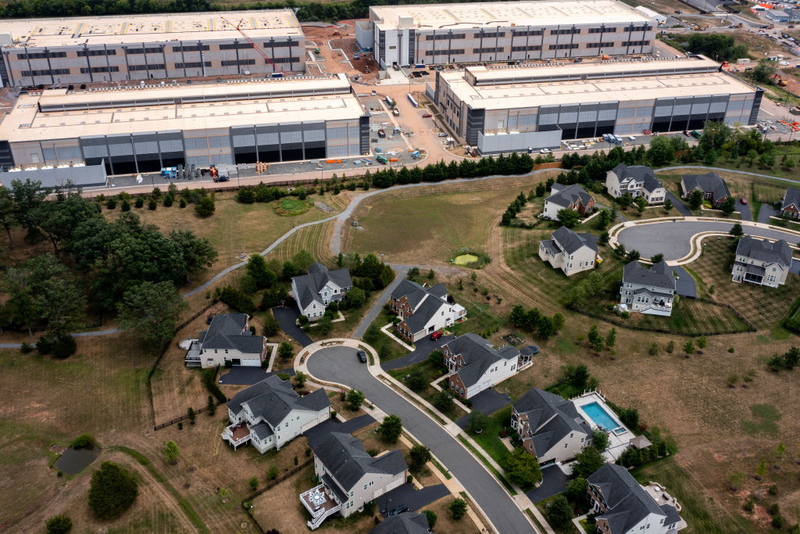
An Amazon Web Services data center is shown situated near single-family homes. (Photo by Nathan Howard/Getty Images)
At two listening sessions with the Maine Data Center Advisory Council, residents from across the state voiced concerns about data center development — but also the risks of opting out of the industry boom.
The council is tasked with evaluating issues related to large-scale data centers and providing strategic input on policies to address the potential benefits and drawbacks.
As part of that process, the council held two virtual listening sessions to hear from the public about their concerns as well as possible recommendations. The council is tasked with presenting a final report to lawmakers in January.
The vast majority of speakers said they had many concerns about data centers, but there were some speakers who also pointed out the potential benefits of the development. Much of the discussion mirrored earlier debates on the issue in the state Legislature, including concerns about the impacts on Maine’s water and environment, as well as energy use and noise pollution.
At the first session last week, Jackie Elliott said those complex factors led her to support a moratorium on data centers, until the issue can be better understood.
“We’ve got to know what we’re doing here, and I don’t think we really do,” she said.
Elliott said most of the information on artificial intelligence and data centers is still speculative, and that she feels the industry is a bubble that is going to burst.
“And that, in this old lady’s mind, raises a question about who’s going to be paying the cost of what gets broken along the way,” she said. “And I am of the strong opinion that whoever breaks the stuff needs to pay for it, and we need solid agreements on the front end of all of this — costs cannot be shifted onto the public pocketbook.”
Jay data center on hold indefinitely as company backs out, despite veto of statewide ban
Other speakers, including Maura McDermott, echoed concerns about the state being left responsible if the industry collapses.
“I am afraid they’re going to come in, sweep in, overtake us, and do whatever they want, and then we’re left holding the bag, like all these PFAS chemicals,” she said, referring to the widespread contamination of so-called forever chemicals.
She said that Maine is a recreation-focused state, and the outdoor environment is a key part of that identity.
“Everything that the data centers bring and talk about is in opposition to what we know and love in Maine,” McDermott said. “That’s who we are. We are outdoors people. We’re strong. We’re resilient. So I want us to think about this, and let’s make some demands.”
At the second session Tuesday, Karen Raye, an Eastport city councilor, asked the advisory council to consider the costs that a small municipality can accrue just to assess a data center project. The Federal Energy Regulatory Commission is considering an application for an underwater data center in Passamaquoddy Bay.
“In our case, before equipment ever enters the water, the community begins paying a price,” Raye said. “In fact, before the developer’s FERC application was even accepted, we’ve been forced to spend very scarce taxpayer dollars.”
She said the town has already had to review ordinances, attend hearings, consult attorneys and navigate the overlapping jurisdictions of state and federal government.
“Eastport has a very small tax base,” Raye said. “We do not have scientists, engineers or attorneys on staff. Yet we must evaluate this project’s impacts on fisheries, navigation, water quality, the electrical grid, emergency response and our working waterfront.”
Sen. Stacy Brenner (D-Cumberland) echoed the need to support local officials.
“Many of Maine’s small towns simply don’t have the planning capacity or technical expertise to evaluate developments of this scale and the impacts may extend well beyond municipal boundaries,” Brenner said.
Brenner, who is also the president of Maine Farmland Trust, urged the council to protect the state’s farmland. She compared the data center boom to the development push for large solar developments in recent years. Brenner said the council should consider farmland protections like those the Legislature passed in 2023 that protected farmland from solar developments.
“Data centers are different from renewable energy projects, and they bring their own questions around land, water, infrastructure, energy and community impacts,” she said. “But Maine does not need to start from scratch.”
Rep. Melanie Sachs (D-Freeport), who sponsored a bill vetoed by Gov. Janet Mills that would have created a moratorium on large scale data centers, said she has been closely following the council’s work.
Like other speakers, Sachs said that Maine can’t rely on federal regulations to protect the state from data centers. And that any environmental review needs to be thorough and required of developers.
“I would urge not providing any exemptions to the environmental review of any data center, regardless of megawatt size or square footage,” Sachs said.
There were a range of opinions on how much of the regulations should be handled at the state or local level.
Brett Brockway, who said he works in housing construction in central Maine, urged the council to ensure that local municipalities get the final say — and said that it shouldn’t be impossible for the towns that want the development to get it.
“So, my recommendation is actually very simple: don’t create another layer of bureaucracy,” he said. “Set clear statewide guardrails for the things that genuinely require statewide oversight, and do it quickly. Protect the ratepayers, protect the grid, enforce our environmental laws and then let the towns decide.”
Brockway is also a founder of Maine Vision 2040, an initiative that encourages responsible artificial intelligence infrastructure to prepare the state for economic opportunity. He said that banning data centers could have a serious economic impact on areas already struggling after losing a major employer, such as a paper mill.
“There are communities in Maine that have the luxury of asking whether they want more growth,” he said. “There are other communities that have spent 40 years wondering where the growth went.”
But at the earlier session, Amy Davidoff said that a data center is never going to impact only one community, and there should be a mechanism for the surrounding area to play some sort of role in local considerations.
“This isn’t a one-town deal,” she said. “It’s many of us, and I don’t know how to create such a mechanism, and maybe that’s why it needs to be at the state level.”
Kat Taylor said she is concerned that the state’s unorganized territories will be targeted for data centers, because they don’t have the same home rule rights as other towns and cities.
Taylor said she is “agnostic” about data centers but added, “I don’t think that data centers are a bad idea if handled correctly.”
Remick French, a retired technology executive and a founder of Maine Vision 2040, also emphasized the economic opportunity data centers could bring to Maine.
“The goal should not be to approve every data center or reject them as a category,” French said. “It should be to create a framework that allows Maine to say yes to the right projects and no to the wrong ones, based on clear standards, public interest and evidence.”
He said the state should prioritize creating a predictable pathway for projects.
“Maine should not wait for individual proposals and then improvise,” he said. “The state should identify where these facilities make the most sense, especially locations with suitable infrastructure, community support and opportunities to reuse formal industrial sites.”
The council will review all written and verbal comments at its next meeting, scheduled for Wednesday, Sept. 9.
Augusta, ME