Same-day events underscore strategic differences in Maine’s pivotal US Senate race
Sep 01, 2026 | 10:48 pm ET

Description
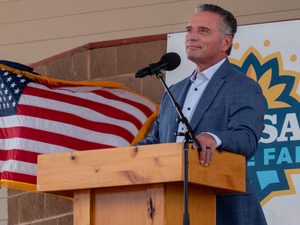
Democratic nominee for U.S. Senate Troy Jackson speaks to voters at his first town hall in Lewiston on Sept. 1, 2026. (Photo by Emma Davis/ Maine Morning Star)
Troy Jackson fielded questions Tuesday night during his first U.S. Senate campaign town hall from voters who have grown skeptical of the Democratic Party and who feel he is not critical enough of his opponent, U.S. Sen. Susan Collins.
“This is what representative government is supposed to be,” Jackson said, standing next to an empty chair he said he saved for Collins at the Franco Center in Lewiston.
Hours earlier, the incumbent Republican greeted workers during the morning shift change at Bath Iron Works, the Navy shipbuilder she has supported with billions of dollars of defense funding during her tenure.
“We’ve seen promises made during election season that are forgotten by the time the next contract fight rolls around. That’s not you,” a group of 100 BIW workers wrote in a letter that shipbuilders Glenn Chateauvert and Ray Gauthier gave to Collins Tuesday morning. “You’ve been showing up for us since before most of these young guys on the line were even hired on.”
The rivals’ contrasting campaign events on Tuesday underscored their differing approaches to winning over voters, as well as the tensions at play 63 days out from the Nov. 3 election.
Troy Jackson secured third-most donations of Senate candidates through ActBlue in July
Jackson, former state Senate president and logger from Allagash, has been meeting with voters at union halls and on picket lines. The Lewiston town hall is the start of a series of open forums he is packing into his condensed campaign timeline.
Town halls had similarly been a staple of former Democratic nominee Graham Platner, who held more than 80 before dropping out in July after an accusation of sexual assault, and were also used by some of Collins’ earlier challengers. They all criticized the five-term senator for not hosting a town hall in over two decades, a common critique among Democrats in recent campaign cycles.
Collins’ staff told Maine Morning Star that she meets with thousands of Mainers every year and prefers individual and small group gatherings. This election cycle, the senator, who is known for her constituent services, is sticking to the tactic she’s used for all of her campaigns: a bus tour throughout the state, stopping at community events and highlighting projects she helped fund.
That approach feeds into her overall pitch to voters that she delivers for Maine as chair of the Senate Appropriations Committee. It continues to resonate with some BIW workers, but it did not with Jackson supporters Tuesday night. Several said they want to see the Democrat focus more on chipping away at that aspect of Collins’ persona, which has led her to defy polls and get reelected in the past.
“Why have you been so soft on Susan Collins?” an attendee named Fred asked.
After Collins proposed a TV debate series to start the week of Sept. 6, Jackson invited the senator to join his town halls, the first of which she did not attend. Jackson said he wants at least two debates to be town hall-style with questions from attendees.
There are also six declared write-in candidates in the race, though they will not likely be included in debates, which typically require candidates to poll at a certain level.
Parallels to Platner
In many ways, Jackson’s town hall was similar to Platner’s, starting with music, a series of speakers and a stump speech from Jackson before opening up to questions. While questions were often yelled out from the crowd during Platner events, Jackson’s campaign gave people raffle tickets as they entered and then randomly selected numbers to decide who got to ask questions.
When asked what he’d do first if elected, Jackson responded that he’d push for Medicare for All.
In response to a question about who he’d work with, Jackson said, “anyone that’s going to be willing to do whatever I think is good, whatever we think is good, for the people in the state of Maine and the people in this country.”
For example, he said he’d work with Republicans on property tax cuts.
“I think Democrats have a lot of work to bring working class people back into the fold,” he said when asked how he’d convert swing or Republican voters.
Jackson’s stump speech drew several direct parallels to Platner’s. He said he is not afraid to stand up to Trump and Republicans, but that he is also not afraid to stand up to people in his own party.
Some in the audience came skeptical of Jackson, including Tori Leigh of Auburn, an independent, who said she is horrified by MAGA but also “disillusioned by the patronizing and ineffectual lip service of the establishment left.”
“I’ve seen your ads, and I notice that you keep referring to ‘our ‘movement that ‘we built.’ Honestly, it feels disingenuous,” Leigh told Jackson when her raffle was picked. “Because the movement that was building was built by someone else. You weren’t nominated by votes. Why should frustrated Mainers like me trust you as a person to take over leadership of that movement?”
Jackson responded with something Platner had often repeated, that the campaign is not about him or any one candidate.
“This isn’t about Troy Jackson, but I don’t even think it’s about Graham,” Jackson said. “I think it’s about people across this state that know there’s something fundamentally wrong with the way things are going.”
Leigh told Maine Morning Star she was satisfied with his response. “It seemed authentic and it seemed humble,” she said.
As other attendees came up to her after the town hall and thanked her for asking that question, Leigh explained that she’d attended the event to see whether Jackson actually listened to what voters had to say, which was a key reason she’d previously liked Platner. She said she felt he did, but added, “You should never stan a politician. Your vote should be strategic.”
Dueling records
Pointing to Jackon’s decades in Augusta, including six years as president of the Maine Senate, Collins’ spokesperson Blake Kernen said, “He’s running around the state telling Mainers that the status quo isn’t working. Well, he was the status quo.”
When Platner was still in the running, many liked the fact that he was an outsider, a political newcomer. Though Jackson shares many of the same progressive policy stances, he is well known as an experienced insider. Some who attended his first town hall see that as a plus.
“He has been in the trenches and had to work with different kinds of people,” said Chris Bean, a lifelong Democrat who had not supported Platner and will be voting for Jackson.
With focus on fraud and ‘socialism,’ Vance returns to Maine to rally for Republican candidates
Jackson and his supporters spoke to some of his legislative work Tuesday night, such as the bill he sponsored that created universal free school meals. But Jackson also acknowledged shortcomings.
“I am upset, frustrated, mad a lot, and that’s why I got into state government,” Jackson said. “And a lot of what I tried to do, we weren’t able to change.”
A card carrying union member, Jackson has earned endorsements from more than 20 labor unions, including the national union representing most of the people employed by BIW, the International Association of Machinists. The local chapter has not weighed in, but previously endorsed him during his recent unsuccessful bid for governor.
The disconnect between the national union’s endorsement of Jackson and some of the workers’ support for Collins highlights the tension between populist union labor and the establishment appropriations industries rely on.
“The rank and file workers know that I have worked with them over the years and I have delivered for Bath Iron Works, and many of them told me as they went through that I had their vote,” Collins told NEWS CENTER Maine during her visit Tuesday morning. “They are independent people and they make their own decision.”
Jackson argued during his speech Tuesday night that Collins’ appropriations wins mask a broader record that hurts Mainers. He and other speakers also emphasized his first-hand experience with the challenges of t working-class Mainers — “ He knows what it looks like from the bottom,” as Western Maine Labor Council President Linda Dean put it.
“You are part of a new union tonight,” Portland Mayor Mark Dion said before Jackson took the stage. “The union of Troy Jackson.”
- September 2, 202610:16 amEditor's note: This story was updated to clarify that town hall attendees were not required to write down questions in advance.

Augusta, ME