‘Unbearable’ heat in uncooled Alabama prisons
Aug 30, 2026 | 8:01 am ET
Description
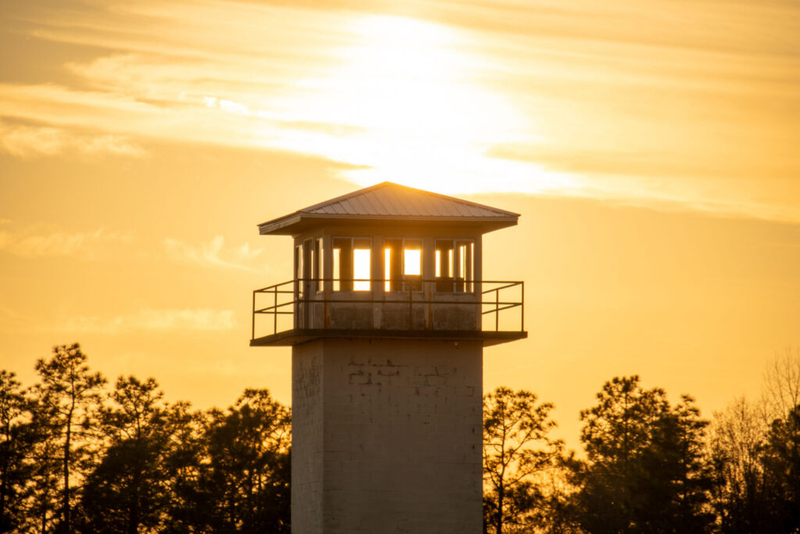
At least one dorm at the Holman Correctional Facility in Atmore, located in south Alabama, is uncooled. (Lee Hedgepeth/Inside Climate News)
This article originally appeared on Inside Climate News, a nonprofit, non-partisan news organization that covers climate, energy and the environment. Sign up for their newsletter here.
ELMORE — Tiffany Montellano can’t sleep.
Instead, she lies awake, worried about her husband Andrew, 31, who is incarcerated at Elmore Correctional Facility just north of Montgomery.
She worries because a few days ago, she received a call during her lunch break from Andrew, who had missed their usual call the night before.
He told her he had become dizzy the previous day because of the overwhelming heat inside the un-air-conditioned, 200-person dorm where he’s housed.
“He said the room wouldn’t stop spinning, and they had to hook him up to an IV,” Montellano said.
Montellano is among many Alabamians whose loved ones inside state prisons are describing intolerable conditions because of the ongoing and more frequently record-breaking heat.
Of the state’s 14 major correctional facilities, none have universal air conditioning, according to Eddie Burkhalter, a researcher for the Alabama Appleseed Center for Law and Justice, a nonpartisan nonprofit that works to reform the state’s justice system.
“Housing humans like this in the extreme heat in Alabama and across the South: It’s torture for people,” Burkhalter said.
The Alabama Department of Corrections did not respond to questions for this story.
In 2022, the U.S. Department of Justice deemed the conditions in Alabama prisons, which operate at around 160 percent of their stated capacity, unconstitutional. Federal courts have so far agreed, repeatedly ordering the state to improve staffing, mental health services and other aspects of its prison operations.
Still, even as the state uses COVID relief funds to help fund construction of a new mega-prison, the 4,000-bed Governor Kay Ivey Correctional Complex, many of the 27,000 currently incarcerated Alabamians continue to suffer in the heat.
The impact of heat in prisons can be pronounced, research shows.
A 2023 study that analyzed data from public and private prisons across the U.S. from 2001 to 2019 showed that extreme heat events led to increases in overall deaths, cardiac-related deaths and suicides.
“These findings suggest that warm temperatures are associated with increased mortality in prisons, yet this vulnerable population’s risk has largely been overlooked,” the study concluded.
Montellano said the state has an obligation to treat those it imprisons fairly. What she hears every day from her husband, she said, doesn’t reflect any commitment to humane treatment.
“They have to go in the shower and dip their towels in water and wrap it around their bodies because it’s so hot,” she said.
Exhaust fans meant to remove hot air from the building are often broken, he told her.
“Everybody takes the sheets off their bed because they’re so drenched in sweat,” she said. “So they either lay on the cold metal bed frame or lay on the floor.”
Christopher Fritz spent two years in St. Clair Correctional Facility, just northeast of Birmingham. He said that every summer, he’s reminded of his time behind bars and worries about the people still suffering in the heat.
“When the heat index was over 100, they would give us a six-ounce cup of Gatorade twice a day,” Fritz said. “That was their idea of dealing with the heat, but it was unbearable.”
While he was incarcerated, Fritz said he witnessed many men faint from the heat. Elderly residents were particularly impacted, he said.
“Some of them couldn’t even get out of the bed because of the heat,” he said.
Matthew Gray Bush has been a pen pal for several incarcerated Alabamians for years. He recently received a message from a friend incarcerated in Limestone Correctional Facility near Huntsville about the consequences of the heat on a 60-year-old dorm-mate.
“I’m a little worried this morning because he has been taken to healthcare three times, and they keep sending him back to the dorm,” the message, reviewed by Inside Climate News, said in part. “He needs to go to the free world hospital.”
Later, the contact said the man had been told by prison medical staff that he’d suffered heat stroke, a severe, life-threatening medical condition.
Burkhalter said he often hears from family members who describe similar incidents and conditions.
“We just don’t treat them like human beings,” he said. “And they are human beings. They have mothers and fathers and children to go home to.”
The overwhelming majority of those currently incarcerated in the state will be released at some point, he said, so it’s critical that society thinks about what that individual is like when they return to the community.
“Do we want them to return shell-shocked? More addicted to drugs? With serious medical conditions? Do we want them to be wracked with PTSD and anxiety and depression?” he asked. “Because that’s what happens when you torture people.”
Despite the impact of the heat, limited data exists about the nature or extent of heat injuries inside Alabama prisons. That’s partly because even among the general population, deaths related to heat in Alabama and across the nation are systematically undercounted, with cause of death often solely attributed to cardiac or other issues, which are often caused or exacerbated by excessive heat.
Burkhalter has worked for years to collect data on deaths in Alabama prisons. As he scrolled through the records of summer months on a hot August day, he scoffed. He began reading causes of death aloud:
“Hypertensive cardiovascular disease. Chronic obstructive pulmonary disease. Pulmonary embolism due to probably deep vein thrombosis. Their deaths are being deemed natural by the state of Alabama,” he said. “But it’s not natural to keep somebody in the heat like that.”
And Burkhalter said he’s not surprised to hear that loved ones like Montellano—those who committed no crime and face no sentence—are filled with anxiety.
“Can you imagine if your loved one—if your spouse or your child was locked away in a place like this,” Burkhalter asked. “Would you be able to sleep at night?”
As the climate continues to warm as a result of greenhouse gas emissions, the impact of heat on Alabamians, both inside and outside prison walls, will likely rise.
As part of its 2022 State Climate Summaries, NOAA, the National Oceanic and Atmospheric Administration, wrote that while Alabama had so far escaped the near-universal increase in net temperatures, the future includes near-certain record-breaking heat.
“Temperatures in Alabama have not risen since the beginning of the 20th century, one of the few areas globally to experience no net warming. However, recent years have been very warm and the warmest consecutive five-year interval was the most recent, 2016 to 2020,” the report said. “Under a higher emissions pathway, historically unprecedented warming is projected during this century.”

Montgomery