Republicans won Arkansas by nationalizing campaigns. Could that strategy backfire?
Aug 30, 2026 | 6:00 am ET
Description
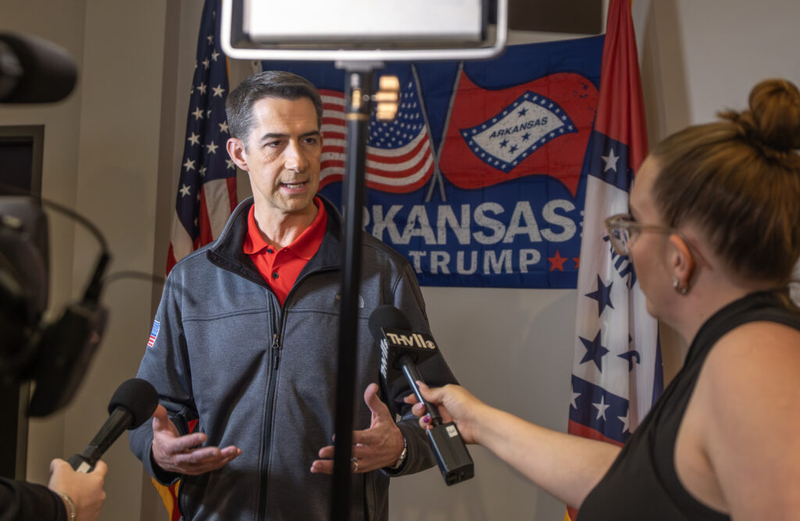
Arkansas Sen. Tom Cotton takes a few questions from media at Republican Party headquarters in downtown Little Rock on Tuesday, March 3, 2026 after winning his primary. (Photo by John Sykes/Arkansas Advocate)
Arkansas Republicans began their takeover of the state’s politics 16 years ago by successfully tying Democrats at every level to a president who was deeply unpopular in the state.
It didn’t matter whether you were running for Congress or local office, invoking President Barack Obama and his policies was the key for Republicans chipping away at the last blue state in the South.
But this year’s election could test whether there’s a downside to nationalizing campaigns for Arkansas Republicans, as they contend with a president whose falling approval numbers offer Democrats hope even in the reddest of states.
Recent polling by Talk Business & Politics and Hendrix College indicated surprisingly tight races for the U.S. Senate and central Arkansas’ 2nd Congressional District, with Democrats holding slim leads that are within the margin of error.
It’s dangerous for Democrats to read too much into a single poll a little over two months before the election. Republicans have been quick to question the polling, and Democrats have been given false hope before about their chances in the 2nd District.
But it’s just as dangerous for Republicans to ignore warning signs that President Donald Trump could be a drag in a state where he won nearly two-thirds of the vote just two years ago.
Fifty-three percent of likely voters responding to the Talk Business poll strongly or somewhat disapproved of Trump’s performance as president. The poll, which had a margin of error of plus or minus 4.7 percentage points, showed similar numbers regarding Trump’s handling of the economy and the war in Iran.
Those numbers pose a challenge for Republicans, especially as the state’s voters grapple with gas prices and tariffs.
Republicans became the majority in Arkansas by telling voters the president’s party should be accountable for what happens in Washington. But that lesson might be theirs to learn this time.
Democrats’ struggles in distancing themselves from the national party show the challenge Republicans may face if Trump’s approval remains this low. Former Sens. Blanche Lincoln and Mark Pryor both lost their reelection bids after facing an onslaught of ads and mailers linking them to Obama and his signature healthcare law.
Gov. Mike Beebe was the aberration. He won all 75 of Arkansas’ counties the same year Lincoln lost, relying on the goodwill he’d built over decades to avoid being compared with national Democratic figures.
Following that example may be difficult for Republicans in Arkansas who have tied their fortunes to Trump and his policies. Gov. Sarah Huckabee Sanders, who was Trump’s press secretary, launched her 2022 campaign with a video featuring images of Trump and bragged about nationalizing the race.
Sen. Tom Cotton, who is being challenged by Democratic nominee Hallie Shoffner, has been one of Trump’s most vocal defenders — especially on immigration policy.
How GOP candidates maneuver the coming weeks may say more about the state of Arkansas’ midterms than any poll.
Republicans have already shown a willingness to split with Trump on some issues, with Cotton and U.S. Rep. French Hill pushing back on the president’s plan to pause tariffs on beef imports.
And Sanders’ TV ads so far have mostly shied away from Trump, focusing instead on homegrown issues like tax cuts and healthcare.
There’s still plenty of reasons to be skeptical about Democrats’ chances in Arkansas, even in a challenging midterm election season for Republicans.
The campaign cash Cotton, Sanders and Hill have amassed easily dwarfs those of their Democratic rivals, plus they have the help of outside groups spending big on the state.
Republicans are still banking on nationalizing the state’s races, as evidenced by their glee over former Vice President Kamala Harris endorsing Chris Jones’ bid against Hill.
Republicans can still try to tie Democrats to other national figures they hope voters will find more unpopular than Trump. And some Democratic candidates may be wary of focusing too much on Trump as they hope to win over independent voters who supported the president but are unhappy with his policies.
There’s no guarantee that nationalizing Arkansas’ campaigns will benefit Democrats the same way it has Republicans. But the midterm environment offers Democrats a rare opening to turn Republicans’ strategy against them.
Little Rock