In Dolly Parton’s ebullient existence, lessons in life and love and devotion to what really matters
Aug 29, 2026 | 4:33 am ET
Description
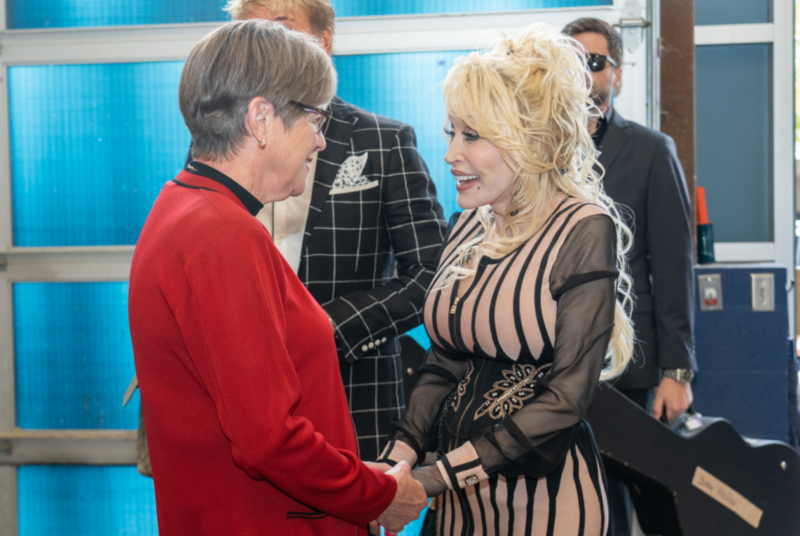
Gov. Laura Kelly joined singer and child literacy advocate Dolly Parton to an event marking statewide expansion in Kansas of a program donating a book each month to children 0-5. (Photo by Kansas Governor's Office)
The queen is dead. Long live the queen.
That queen, of course, would be legendary country entertainer Dolly Parton, who slipped the surly bonds of Earth on Aug. 25 at the age of 80. A Tennessee native, she nonetheless visited Kansas three years ago to celebrate the expansion of her Imagination Library literacy program.
The preternaturally talented Parton had much to teach those of us in the Sunflower State — and every other state besides, if we bother to pay attention.
Notably, she remained in the region where she was born, raised and achieved international fame. She invested in the people and places that she came from, even though those people and places might not always have agreed with how she presented herself or how she chose to live her life as a fiercely independent entertainer.
In mid-August, I marked five years at Kansas Reflector as opinion editor. I too, have chosen to live in my home state. In my inaugural column, I wrote about how important it was that good people, caring people, keep pushing for positive change.
Parton proved that could be done. For real, and for the long term.
For those of us who are LGBTQ+, politically progressive or just a little bit quirky, the fact that Parton stayed and earned not just the respect and love of those in Tennessee but those across the nation proves that the traditional red vs. blue dynamics of this country do not explain the wonder and kindness of its people.
Parton was famous for saying that it cost a lot of money to look as cheap as she did, but the truth of the matter was, she never looked cheap. Flamboyant yes. Extravagant even. But aside from a handful of bouts with overzealous makeup artists, she never looked like anything other than what she was — an enthusiastic musician, humanitarian, and creative adventurer.
She wrote thousands of songs, recorded dozens of albums, appeared on film and TV, donated millions to charity and ran a theme park that transformed her poverty-stricken community. She stayed true to herself and helped others along the way.
A fading past
Few others share Parton’s cultural importance and dedication to do good. Some try. Rock stars Bruce Springsteen and Elton John have spoken up for admirable civic causes and raised money for charity, but both have reached their late 70s.
As our society’s common cultural touchpoints recede, so too does our shared sense of civic understanding.
Both the Democratic Socialists of America and President Donald Trump paid tribute to Parton. She was warmly remembered on social media by both rapper Eminem and the Nashville musicians’ union. Millions felt touched by her spirit and warmth.
Parton made a conscious decision in her later decades to be an unproblematic celebrity. Her public statements about social issues were carefully calibrated to support liberal fans while not offending conservative ones. She turned down the Presidential Medal of Freedom when offered by both Donald Trump and Joe Biden.
She understood, with the keen intelligence that followed her career as a performer and businesswoman, that she had become a common cultural cause. She likely sacrificed her own freedom of expression to do so.
I don’t know who can fill Parton’s tiny, high-heeled shoes today. Modern entertainers cultivate devoted, narrow fandoms. Musicians and writers and actors and standup comics work harder than ever to reach fewer and fewer people. If another Dolly Parton set out from Locust Ridge, Tennessee, today, would she have the same opportunities to become internationally beloved?
Let’s not think about that. For now, at least.
Family and friends
Throughout her eight decades, Parton proved that core values of humanity — love, family, friendship — matter no matter what you look like or where you live.
As one of 12 children, she tended to an enormous extended family, recording albums and writing cookbooks with them. She featured her parents and siblings on a TV broadcast from 1976. You can see how the presence of the family delighted her (and the musical talents of her mother, Avie Lee.
Monday Night Variety
She was married to her husband, Carl Dean, for almost 60 years. Although the couple did not have children, they helped raise several of Parton’s younger siblings and stayed in close touch with the extended family.
Dean stayed out of the spotlight, telling his effervescent wife that he had no use for publicity. He still listened to her albums, watched her movies and visited Dollywood to keep an eye on things. When he died last year at age 82, Parton issued a heartbreaking yet optimistic song, “If You Hadn’t Been There.”
As different as those of us living in Kansas can be — liberal or conservative, Republican or Democrat, Christian or Muslim or Jewish, man or woman, black or white or every race in between, gay or straight, transgender or cisgender, married or single, introvert or extrovert — we all share similar desires.
We love our spouses and significant others. We care about our friends. We watch over our families. Like Parton, let us all try to do our best.
As she sang in her 1991 song “Family”:
When it’s family, you forgive them
For they know not what they do
When it’s family, you accept them
‘Cause you have no choice but to
When it’s family, they’re a mirror
Of the worst and best in you
And they always put you to the test
And you always try to do your best
And just pray for God to do the rest
When it’s family
For they know not what they do
When it’s family, you accept them
‘Cause you have no choice but to
When it’s family, they’re a mirror
Of the worst and best in you
And they always put you to the test
And you always try to do your best
And just pray for God to do the rest
When it’s family
Clay Wirestone is Kansas Reflector opinion editor. His first book, “Opinionated: Kansas Journalists Who Proved Why Commentary Matters — Then and Now,” comes out Sept. 29 from the University Press of Kansas. Through its opinion section, Kansas Reflector works to amplify the voices of people who are affected by public policies or excluded from public debate. Find information, including how to submit your own commentary, here.

Topeka, KS