Alaska Supreme Court affirms state’s election ballot measure language, with one change
Aug 28, 2026 | 4:44 pm ET
Description
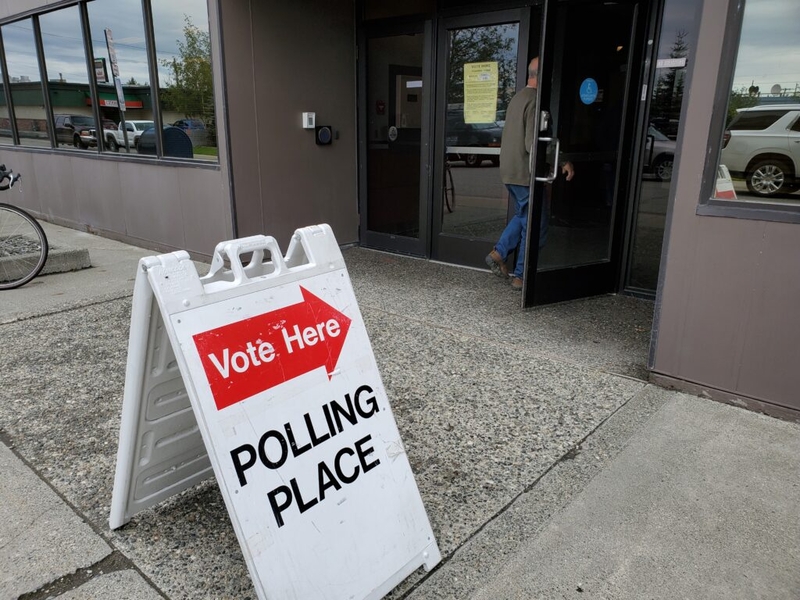
A voter joins a line of voters waiting to cast their ballots on Aug. 15, 2022, at the state Division of Elections office in Anchorage. (Photo by Yereth Rosen/Alaska Beacon)
The Alaska Supreme Court issued a fast-tracked ruling on Thursday, affirming a lower court’s decision that the Alaska Division of Elections’ language for an elections overhaul ballot measure is “true and impartial,” but ordered the division to make one additional change.
The Court issued the ruling days after hearing oral arguments from two groups of plaintiffs on opposing sides of the current ranked-choice voting system. The groups appealed a lower court’s ruling issued in June, challenging the language of Ballot Measure 2 as unclear, politically partisan and containing omissions they sought to change.
Ballot Measure 2, which will appear on the ballot as 24ESEG, would repeal the state’s current ranked choice voting and open primary systems, as well as repeal campaign disclosure rules enacted by voters in 2020.
The Supreme Court ruling Thursday affirmed a Superior Court’s finding that the Alaska Division of Elections’ fulfilled its legal duty in preparing the ballot measure title and summary in a “true and impartial” manner.
But the justices identified one omission: the division must add language that explains if the measure is approved, and nonpartisan, open primaries are eliminated, candidates for Governor and Lieutenant Governor would run for election separately.
Currently, candidates for Governor and Lieutenant Governor run together on a combined ticket in the primary election. The top-four vote getters in the open primary advance to the ranked choice general election.
A spokesperson for the Alaska Department of Law, which defended the division and its ballot measure language in court, said by email Friday they welcomed the ruling and would make the change.
“We are pleased that the Alaska Supreme Court rejected nearly all the challenges to the lieutenant governor’s true and impartial ballot summary,” said Sam Curtis, an information officer. He called the court’s directive a small change.
“The State had considered this a minor detail that did not need to be in a ballot summary, but the Court disagreed,” he said. “The Office of the Lieutenant Governor will issue a revised summary soon.”
The revised language is expected to be published by the division before a ballot printing deadline of Sep. 2.
Both groups of plaintiffs that filed appeals in court expressed mixed reactions, saying they were “disappointed” but “appreciated” the court’s decision.
One group of plaintiffs that also sponsored the ballot measure, called the “Repeal Now” campaign, filed a lawsuit challenging the language in court. Among a series of language changes requested, they had argued for language to explain the governor and lieutenant governor would run separately. Their attorney Julie Pack said by email Thursday they maintained concerns.
“We’re disappointed that the summary will continue to incorrectly state that open primaries would end with Ballot Measure 2,” Pack wrote. “Primaries would remain defaulted at open following Ballot Measure 2’s passage, just like they previously were.”
The group argued, in part, that if approved Alaskans would still vote in “open primaries.”
But the ballot measure language states “the act would get rid of open party primaries.” That’s because if voters approve the measure, the elections system would revert to a “closed,” partisan primary system where voters would only be able to vote for a candidate in the party they’re registered with.
Voters would no longer be able to vote for candidates of any party running for statewide and federal offices, as they currently do.
The issue is of particular concern to another group of plaintiffs that filed suit in court, represented by attorney Scott Kendall, who was one of the primary sponsors of the 2020 ballot implementing the current ranked-choice voting system.
He argued the current language on the ballot measure related to how the primaries would change is incomplete.
“Our specific request was that it be made more clear that each political party will have the power to not only close their primaries, but to close them and make it unlawful for undeclareds and nonpartisans to vote,” Kendall said in an interview Friday. “There’s some language in the ballot measure that gestures at that, but I don’t think it really makes it clear.”
Overall Kendall said the group is grateful to the court and division for rejecting language proposed by Repeal Now he called “radical changes.”
“We’re very, very grateful that the court correctly rejected those baseless edits,” he said.
Kendall said the Supreme Court’s added change is “a good one.”
“It wasn’t so much about what’s good policy, bad policy. It was when a voter steps into the booth and picks up the pen, are they equipped with full knowledge of what their yes or no vote means?”
Juneau