Don’t confuse lower Medicaid utilization with success
Aug 28, 2026 | 1:19 pm ET
Description
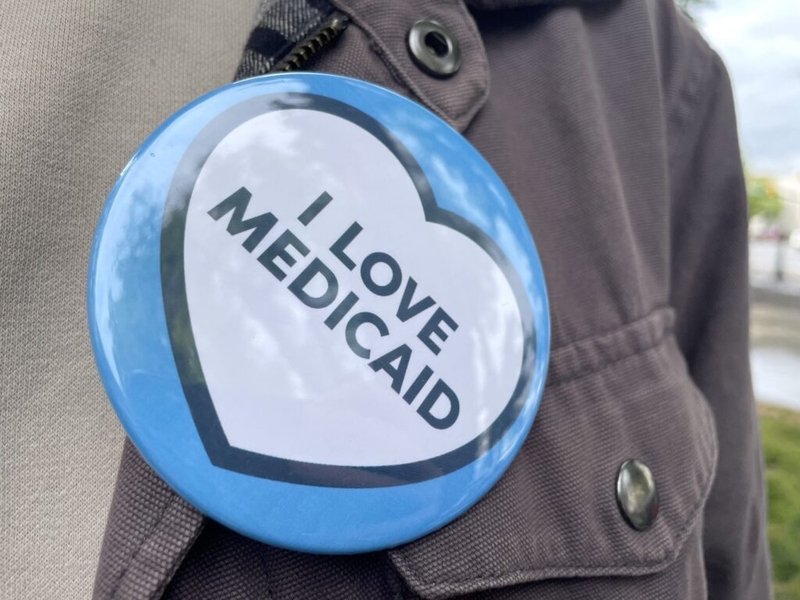
An attendee wears an “I love Medicaid” button during a news conference at Pioneer Park in Salt Lake City on May 6, 2025. (Katie McKellar/Utah News Dispatch)
Healthcare is not a luxury, but a necessity.
At a time when costs are rising in seemingly all sectors of life, it would be tragic for the access to care we all need to become something that can only be afforded by individuals with high incomes and those who are more financially stable while all others must go without.
People working hard for low wages should not have to choose between seeing a doctor and the essentials required to survive day-to-day. Healthcare might not feel as immediate a need on some days as food or shelter, but there’s a clock ticking on all of us and the day is always coming when our need for a doctor is so real that it will supersede all others. Income should not be a determining factor in access to basic care, but for far too many that is reality.
This is not hard for most people to comprehend, so when South Dakotans had the chance in 2022 to vote to expand Medicaid to folks who earned too much to qualify for traditional Medicaid but not enough to afford private insurance, it was a clear decision. The health and prosperity of South Dakota has improved a great deal because of Medicaid expansion, with nearly 30,000 more enrolled in the program, gaining access to comprehensive, quality care.
States face tight timeline as feds unveil new Medicaid work requirement rules
As a breast cancer survivor, I can attest to the crucial nature of healthcare and not just when you are not feeling well. Regular visits to a doctor saved my life. My cancer was detected on an annual mammogram and I cannot say I would have been so diligent with screenings were I not fortunate enough to have health benefits as part of my employment. My cancer was caught early, when it was treatable, and I am doing well and have had the gift of many years of fun family times with my husband, children and friends.
This should be a story anybody can tell.
Everyone should be able to go to the doctor, not just those who can afford it. That remains the greatest challenge of Medicaid expansion — making sure those who are eligible for coverage actually get that coverage. In recent weeks, Medicaid usage has been in the news following Gov. Larry Rhoden’s announcement of a budget surplus, due in part to lower utilization of Medicaid funds than anticipated.
We should not confuse low utilization with success. Stewards of Medicaid access must make sure those who need it can access coverage and can navigate the system to use it for screenings, treatments and preventive care. People who do not know they are eligible or who can’t access the coverage might skip important screenings and never go to the doctor until a treatable condition becomes truly dangerous, requiring more extensive treatment or a hospital stay. This is the very thing Medicaid expansion seeks to avoid.
The need to get and keep people covered will face another challenge in 2027 when federal work reporting requirements kick in, requiring those enrolled in Medicaid expansion to report 80 monthly hours of “eligible activity.”
The vast majority of South Dakota enrollees meet these standards and will continue to do so. These hardworking people’s ability to report and have that activity accurately assessed by a state staff that has enough on their plates already is the problem — and those who are unable to work due to a medical condition, such as a cancer patient undergoing treatment, will trigger a separate tangle of bureaucratic red tape to prove they are exempt.
There is simply no possibility that all eligible people who need coverage will remain on the rolls when this requirement is implemented, but simply a matter of how many will be erroneously kicked off and the potentially deadly consequences when they need care but cannot afford it.
Only half of South Dakotans are insured through their jobs. That means the other half needs to gain coverage some other way and, for those working in low-wage jobs, Medicaid is a lifeline. It helps South Dakotans stay healthy, remain in the workforce and avoid suffocating medical debt. It keeps local care providers from the financial struggles that hit when serving a population with a high number of uninsured people.
Lawmakers and South Dakota Department of Social Services leadership can do a lot to help keep people covered in the coming months. They can minimize barriers to enrollment, offer robust and easily accessible educational information on the process and communicate clearly on changes coming so folks don’t get caught unaware. Most people lose care because of technicalities, not because they are ineligible. If the changes are implemented in a way that minimizes bureaucracy and maximizes ease of navigation, the financial hit on South Dakotans and the state’s care infrastructure can be minimized, though certainly not eliminated.
These regulations are going to be painful in many ways. Lawmakers and state staff have a huge challenge ahead and must rise to the moment before them.
Quite simply, lives will be lost if they do not.

Pierre, SD