Ohio politicians welcomed unregulated data centers by the hundreds. Ohio citizens are fighting back.
Aug 28, 2026 | 3:30 am ET
Description
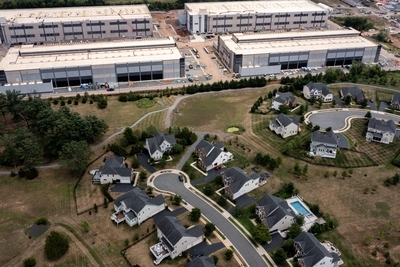
An Amazon Web Services data center is shown situated near single-family homes. (Photo by Nathan Howard/Getty Images)
Everybody across all lines seems to not really want these things in their local community.
Along a stretch of road in a rural, northeast Ohio township just southwest of Sandusky, multiple yard signs appeared unexpectedly. One after the other.
At first, I thought they were premature campaign signs planted in early August. But every successive lawn display in screamed the same message: “Protect our community: No data center.”
What I had stumbled on in Erie County’s Oxford Township, population 1,185, was a microcosm of the ballooning revolt spreading across the state against the race to build more sprawling data centers in Ohio than anywhere else.
It took a beat for Ohioans to get wise to the financial and environmental burden of these massive facilities sold as an economic boon. Pure AI snake oil. Google the AI bubble.
Risky AI infrastructure buildout, (that relies on massive debt and unproven future revenues) also faces severe physical bottlenecks with power and water shortages — and now angry communities are blocking new data center construction.
Tech companies thought they could get away with ignoring the silent stakeholders in the data center boom — citizens who live and work where AI factories locate.
They are the ones who bear the direct consequences of these resource-depleting data centers. They cover the costs to bring data centers online but often have no say—or even prior knowledge — about giant AI warehouses breaking ground in their neighborhoods.
Folks in Oxford Township saw what happened in nearby Perkins Township where residents were left in the dark about a massive hyperscale data center campus. It’s being constructed on an old manufacturing site a stone’s throw from Sandusky High School.
The first building alone, (about the size of three football fields) will use up to 96 megawatts (MW) of electricity — enough to power 75,000-100,000 homes or more than the entire city of Sandusky.
When word trickled out about another hyperscale, 250-megawatt data center proposed in Oxford Township on a 146-acre campus near the EHOVE Career Center, residents were ready.
Hundreds attended a meeting hosted by data center developers that quickly became heated as many in the audience shouted objections and heckled the tech company presenters.
People were not in the mood for slick sales talk. They came prepared with questions about surging electricity bills, power grid stress, water usage, constant noise, and air pollution.
Wenzinger, a Bowling Green State University graduate with a degree in environmental policy and analysis, has seen emotions run high as communities come together “at this scale” with deep foreboding about data center development with no rules or public safeguards.
The response to this common, remarkably unifying issue has evolved into something “existential” that is “bigger than all of us and is really immediate and present,” she said.
The 27-year-old was herself drawn to the untold story of AI digital infrastructure when the Perkins Township data center moved, without notice, into her hometown.
She became a volunteer petitioner with Conserve Ohio, a grassroots organization gathering signatures for a constitutional amendment that would ban all large-scale data centers in Ohio.
Wenzinger has also been meeting with Ohioans around the state to raise awareness about the short-and long-term impacts of hyperscale data centers and how communities can protect their interests apart from corporate ones.
She is regularly astounded by how many people show up to learn what Big Tech doesn’t tell them about the 200-plus data centers in Ohio.
Wenzinger flipped through slides of her presentation in a packed local church in Oxford Township.
She told the standing-room-only crowd how new generation data centers consume huge amounts of local electricity and water, how they drive up utility bills for residents, how they create loud, non-stop noise and air emissions from backup diesel generators, how they offer very few permanent jobs after construction, and how they still get enormous public hand-outs at an enormous loss to state revenue.
Under former Republican Gov. John Kasich, Ohio committed at least $2.3 billion in sales tax exemptions to tech giants like Amazon, Meta, and Google.
The quiet deals promised 100% sales tax breaks for up to 40 years if companies met certain goals.
That blank check to Big Tech cost Ohio more than $1.5 billion in 2025, almost 12 times the state’s $136 million forecast.
After losing that much revenue in data center subsidies, Gov. Mike DeWine — who supported the costly giveaways for some of the richest corporations in the world — paused consideration of new data center tax breaks in May to figure out what went so wrong.
What went wrong with Ohio’s build-now-ask-questions-later data center boom?
Ask the farmer and the family and the retired couple and young people whose quality of life is in jeopardy today because the state’s Republican leadership gave short shrift to how communities would fare while greasing the wheels for Silicon Valley.
Politicians welcomed unregulated, massive computing facilities that run 24 hours a day and deplete energy equivalent to that of a whole city to power servers and cooling systems.
They kept the highly speculative transactions with Big Tech secret, without public input or rigorous debate, because they didn’t want people to know.
But Ohioans know now and are fighting back. The proposed data center in Oxford Township has been tabled.
“We have carefully considered the concerns expressed by residents,” said a statement from township trustees, and determined “it is not in the best interest” of our community. The data center developer plans to revisit after the midterms.
Columbus, OH