Vaccination protections ‘teetering’ as state declares measles outbreaks in 3 counties
Aug 27, 2026 | 5:50 am ET
Description
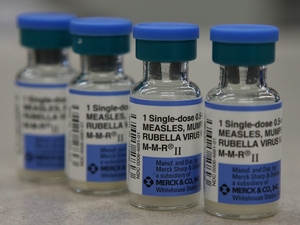
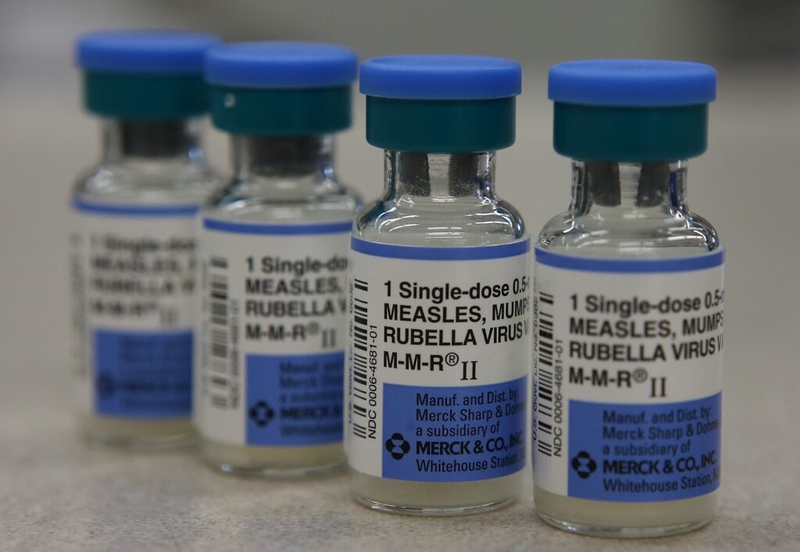
Vials of measles, mumps and rubella vaccine are displayed on a counter at a Walgreens Pharmacy in Mill Valley, California, in a 2015 file photo. (Photo illustration by Justin Sullivan/Getty Images)
Despite Maryland’s relatively high measles vaccination rate statewide, those rates are slipping and varying coverage by county can leave community members exposed to potentially severe or deadly infection.
That’s the concern for public health experts and data analysts amid the recently announced measles outbreaks in three counties that have lower vaccination coverage than other counties.
The Maryland Department of Health this week declared measles outbreaks in Cecil, Carroll and St. Mary’s counties and reported dozens of new cases detected since mid-July among unvaccinated individuals.
State officials and others urge Marylanders to check their immunization status and get vaccinated if they are not protected – or else risk the health of vulnerable populations and young children.
“Measles is super contagious,” said Dr. Esther Liu, chair of pediatrics at the University of Maryland Baltimore Washington Medical Center. “As a pediatrician, I am very concerned, especially as we are seeing our vaccine rates dropping…. Children under 5 are one of the high-risk groups for complications from measles.”
The measles outbreaks announced Monday in the three counties was the newest development in what’s already an active measles season this year. But state health officials say that there is “currently no evidence of widespread community transmission” and that most cases identified so far occurred among household contacts.
That said, the health department reports 31 confirmed measles cases in Maryland, with 27 of those cases identified since July 15. Those 27 cases were among unvaccinated residents.
It’s a steep jump from the total of three cases identified in Maryland all of last year.
Approximately 96% of Marylanders have lifelong protection from measles because they were vaccinated, above the national average of 93%, according to data from the Centers for Disease Control and Prevention. Other Marylanders who have already been sick with measles are also considered immune.
Epidemiologists and health experts said that Maryland’s high vaccination rate previously kept measles contained as residents traveled out-of-state or internationally to areas with ongoing measles outbreaks.
The recommend vaccination coverage rate considered necessary to protect a community from measles is 96%, which means Maryland is “teetering” on the edge of the recommended coverage, Liu said. More importantly, it is not consistent across the state.
“If we’re dropping below the immunity threshold, we’re going to see a significant increase in cases only because it is so contagious,” she said. “Statistically, nine out of 10 exposed people who are unvaccinated or immunocompromised will contract measles from an exposure. It is a high, high infection rate.”
In communities and counties where a higher percentage of families do not get measles vaccinations, there is a greater opportunity for the respiratory virus to creep in, especially as outbreaks pop up in nearby states.
A common metric public health officials and analysts use to determine vaccine coverage in an area is the number of nonmedical exemptions granted from kindergarten vaccination requirements.
In the 2025-2026 school year, about 2.1% of Maryland families asked for a religious exemption for their kindergartener to opt out of required vaccinations, which includes the MMR vaccine that covers mumps, measles and rubella. That represents more than 1,300 of the 65,500 kindergartners enrolled last school year.
While the percentage of nonmedical exemptions are growing, the statewide vaccine coverage still falls within the recommended 96% threshold. That picture gets more complicated at the county level.
There are 12 counties where the rates of nonmedical exemptions are higher than the statewide average, including the three counties where there are current measles outbreaks.
In the 2025-2026 school year, St. Mary’s County reported that 3.5% of kindergarteners were opted out of required vaccines through religious exemptions, or about 43 kids out of 1,237 enrolled in kindergarten. That’s more than twice the nonmedical exemption rate of 1.5% of St. Mary’s kids in the previous academic year.
St. Mary’s is also the county with the highest number case detected so far this year at 13.
Cecil County had roughly 40 kids with religious exemptions out of 1,116 kindergarteners enrolled the 2025-2026 academic year. That’s about 3.6% of kindergarteners who were opted out of vaccination requirements, up from 2.84% the previous year.
And in Carroll County, the third outbreak county, 46 of 1,774 kindergarteners were exempt — roughly 2.6% of kindergarteners, keeping steady with the previous year.
That said, there are several other counties with higher vaccination exemptions that do not have current measles outbreaks, or even a single measles case detected this year. Worcester and Allegany counties both have nonmedical exemptions over 4%, but have not reported any confirmed measles cases – yet.
The variation in vaccine coverage by county worries public health researchers and data analysts for the future of the current Maryland outbreaks.
“Honestly, we have to wait and see,” said Farzin Ahmadi, an associate professor with Towson University who tracks measles cases at a county level.
Along with the reported outbreaks, the Maryland Department of Health broke out each county where measles cases were identified, a specificity that’s new for communications about measles cases this year.
Analysts like Ahmadi say that more granular information about where the measles cases were found is a “good development” that can help track the growing number of cases.
“The virus is circulating … in neighboring states. It shouldn’t be surprising that we’re seeing more cases,” he said. “Because measles is having more activity in this state, it’s better to have more granular data.”
Pennsylvania reports nation’s first confirmed measles-related deaths in 2026
Liu said that while people who are vaccinated against measles or have already been infected and recovered are protected, those who catch it can have serious complications from the virus, including pneumonia, which can be fatal.
“When we tell families that we are concerned about measles, obviously we are concerned about the virus itself and the acute illness – high fevers up to 105 degrees, inflammation of the eyes,” she said. “And then long-term complications that we don’t really understand very well related to brain swelling and inflammation that could happen years after the infection.”
Just over the Maryland border, the Pennsylvania Department of Health reported the nation’s first measles-related deaths this year in two Lancaster County residents, both of whom were unvaccinated.
“I would really love for people to understand that measles is not just a cold,” Liu said. “It can be a quite severe illness in-and-of-itself and the complications from measles can be quite significant.”
Annapolis, MD