Indiana’s SNAP program soon to be at a crossroads
Aug 27, 2026 | 5:00 am ET
Description
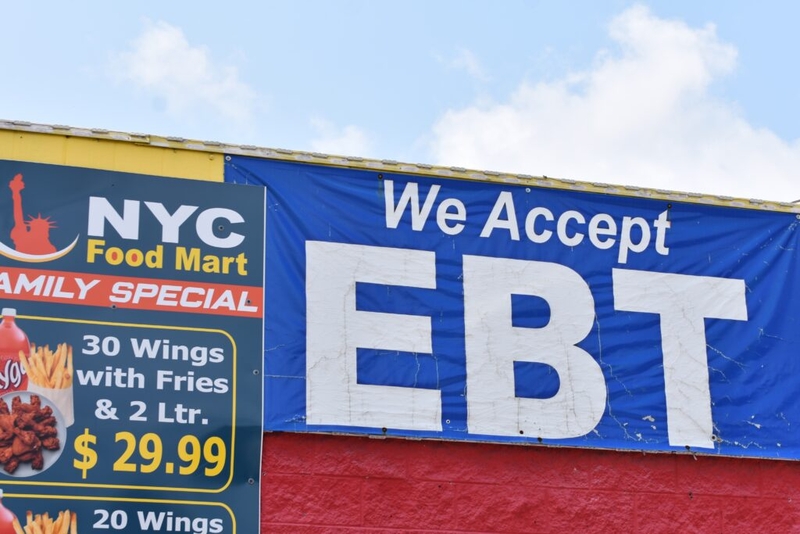
A store in Indianapolis advertises electronic benefits acceptance for SNAP purchases in July 2026. (Photo by Jack Forrest/Indiana Capital Chronicle)
Indiana’s budget surplus is impressive, but Congress has determined that our costs are about to go up. The One Big Beautiful Bill Act of 2025 changed how states and the federal government pay for food assistance, and for the first time in the history of the Supplemental Nutrition Assistance Program, or SNAP, Indiana state taxpayers are on the hook.
Starting on October 1 of this year, Indiana’s portion of the administrative costs for the state is increasing from 50% to 75%. The Family and Social Services Administration estimates that this will be an additional $47 million dollars in annual expenses to the state budget. Furthermore, beginning in October 2027, Indiana state taxpayers may be required to shoulder a 5%, 10%, or 15% burden of the benefits themselves based on how high our payment error rate is. That could be an additional cost of $71.5 million, $143.0 million, or $214.4 million, depending on the error rate.
SNAP’s payment error rates are the sum of the percentage of overpayments and the percentage of underpayments. Our error rate in Indiana for federal fiscal year 2024 was 9.52, and in federal fiscal year 2025, it was 9.77. While this is better than the national average in both years (10.93 and 10.62, respectively), it means that if things continue how they have been, Indiana will be stuck in the 10% cost-sharing bucket ($143.0 million).
Lawmakers will be in an unenviable position when they meet next January to start hashing out the biennial state budget. Do they raise Hoosier taxes to absorb the increased costs for SNAP that Congress has passed on? Do they maintain SNAP and slash other vital services, like education, public safety, or road/highway maintenance? Do they cut SNAP, or, God forbid, eliminate it entirely?
This is an avoidable choice. The legislation provides some options. For starters, states with an error rate of less than 6.00 don’t have to cost-share at all. According to the latest data from the USDA, only nine states/territories (Idaho, Iowa, Kentucky, Nebraska, South Dakota, Utah, Vermont, the Virgin Islands, and Wisconsin) have an error rate under this limit.
Ironically, the law also provides respite if our error rate were to get much worse. States with an error rate of 13.34 or greater qualify for a delay of cost-sharing until as late as October 2029. Six states plus DC (Alaska, Delaware, DC, Georgia, Illinois, New Mexico, and Oregon) met this requirement in federal fiscal year 2025, which means they don’t have to participate in the cost sharing until at least the autumn of 2028 (and potentially later).
Despite the fact our error rate is better than the national average, yet because it is “only” 9.77, Indiana state taxpayers are being punished for having a bad error rate while states with higher error rates get a pass. To top it off, over 20% of our error rate (2.04 of the 9.77) is because of underpayments. Congress is going to punish state taxpayers to the tune of $143 million because the state government failed to provide enough food assistance to vulnerable Hoosiers in the first place.
The short of the issue is, without action from federal lawmakers, it appears that the Indiana state budget will need to increase to the tune of somewhere between $47 million and $261 million starting in 2027. Given the Braun administration’s reluctance to engage with SUN Bucks in the summers of 2025, 2026, and 2027 — a very similar federally-funded food assistance program —due to balking at a projected cost of between around $15 million, it does not bode well for SNAP in Indiana as a whole.
We have recently seen huge reductions in SNAP recipients in Indiana already. Since President Trump signed the One Big Beautiful Bill Act into law in July 2025, the number of Indiana SNAP recipients has decreased 15%, from 577,054 to 487,920. The law made older adults 55–64 newly subject to work requirements, set up abrupt benefit cliffs for single parents of teenagers, deemed immigrants without permanent resident status completely ineligible, and created new work reporting requirements for veterans, homeless individuals, and former foster youth — despite their known irregular employment circumstances.
Food insecurity is not going away in Indiana, but food assistance is becoming more difficult to obtain. Increasingly, it seems that Hoosier taxpayers are going to need to foot more of the bill on our own, or state lawmakers are going to have to make tough decisions on who will get food assistance and who will go hungry.
Indianapolis, IN