SC legislators approve $350M in earmarks, agree to changes next year
Aug 26, 2026 | 8:00 am ET
Description
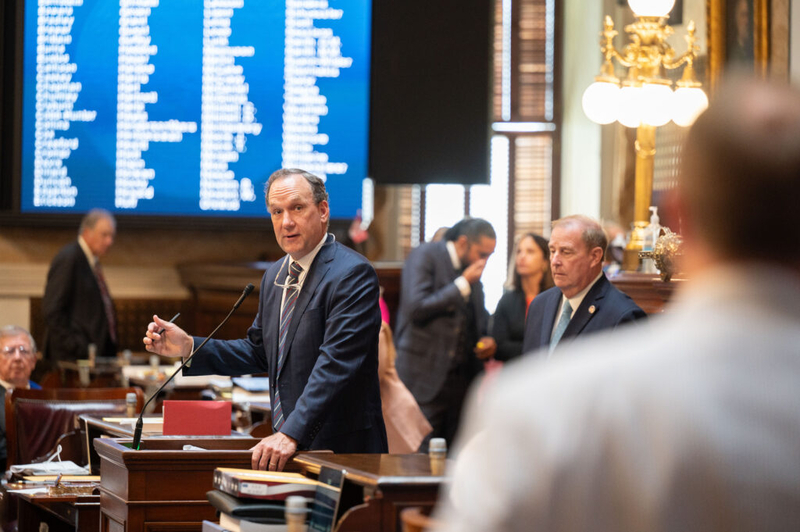
House Ways and Means Chairman Bruce Bannister, R-Greenville, takes a question from Rep. Jordan Pace, R-Goose Creek, in House chambers on Tuesday, Aug. 11, 2026, when the Legislature sent a budget compromise to the governor. (Courtesy of the SC House photographer's office/photo by Sam Holland)
COLUMBIA — The General Assembly passed a deal Tuesday spending $350 million on a long list of legislator-sponsored spending that includes parks, building renovations, water and sewer upgrades, and equipment for first responders.
The votes came two weeks after negotiations over the local spending blew up publicly. The $15 billion budget included no earmarks, and legislators left believing their communities wouldn’t get the funding this year. Earmarks, or what legislators call community investments, designate state taxpayers’ money to local projects at legislators’ request.
Tuesday’s deal came with an understanding that legislators would revamp the earmark approval process next year, as some called for a reevaluation of where the money is going and more transparency in general.
The Senate passed the bill 30-6. The House voted 96-15 to send it to the governor’s desk, after dispatching efforts by the hardline Freedom Caucus to kill it.
“This is a good faith agreement,” said Senate Finance Chairman Harvey Peeler, R-Gaffney. “We worked on it and worked it out.”
SC legislators to return to vote on $350M agreement on local spending
Future spending should be more equal between the House and Senate, said Sen. Tom Davis, a member of the Senate’s budget negotiating committee. The House’s budget included more than double what the Senate spent on earmarks, which senators decried as unfair.
In the deal negotiators worked out, the Senate kept all $131 million of its proposed projects. The House shaved $100 million off its spending, bringing the chamber’s total down to $220 million.
Any money going to first responders, including local fire and police departments, remained untouched. As did anything receiving less than $300,000.
Legislative delegations had the final say in what to cut and what to leave in place, allowing them to pick which projects were most important to their counties, House Ways and Means Chairman Bruce Bannister said previously.
Legislators also removed about a dozen projects Gov. Henry McMaster’s office said he would veto. In past years, McMaster has sliced spending for nonprofits without much of a history and projects with little documentation of where the money would go.
Future spending
Earmarks tend to be a contentious part of the budgeting process.
After several years of spending hundreds of millions of dollars, the lead budget writers for each chamber announced last year they wouldn’t fund the projects at all. This year, the projects became a sticking point in negotiations that led to a spending plan passed six weeks after the budget year began.
Legislators have come a long way since the days of hiding local spending in agency budgets. But the process still needed to change, some said Tuesday.
In coming years, the House agreed to start adding its earmarks earlier in the budget process, giving senators more time and wiggle room to negotiate on the final numbers, said Davis, a Beaufort Republican. As is, negotiators have to make an all-or-nothing decision about each project.
Both chambers agreed not to send money directly to nonprofits. In the future, any money going to a nonprofit must be sponsored by a local government, which senators said will provide more oversight of the spending.
And the two chambers will spend roughly the same amount. While there are more House members than senators — 124 to 46 — each chamber collectively represents the same people, Davis said.
“Mathematical certainty isn’t the goal here,” Davis said. “The goal here is a recognition that the House represents all the people of South Carolina, and the Senate represents all the people of South Carolina.”
Both chambers agreed to pass stopgap funding legislation as a contingency plan earlier in the session. Called a continuing resolution, it keeps state government operating at the prior year’s levels if no budget is in place by the start of the fiscal year.
They’re normally not needed. But this year, the government would have shut down July 1 without it. In the past, at least one of the chambers withheld approval of the just-in-case resolution until the last days — or hours — of the regular session as a negotiating tactic in a legislative game of chicken. This year’s resolution passed the Senate in January. But the House waited until the next-to-last week of session to give unanimous approval, and the chambers’ leaders didn’t sign off on sending it to the governor’s desk until the next-to-last day.
“I think that’s extraordinarily important,” Davis said of the resolution’s early passage. “It’s difficult to have meaningful and constructive negotiations when one side has a gun to the head, saying, ‘Well, if we don’t do something, or if you don’t do what we’re requesting here, we’ll simply let government shut down.’”
Although the agreement puts legislators in a better position to negotiate the budget next year, it “is in no way the end of the discussion in regard to earmarks,” Davis said.
“I think we have to put work into a better framework regarding earmarks,” he said.
To his point, legislators brought up other changes Tuesday they wanted to see during the next budget process.
Money for transportation projects, in particular, rankled Senate Majority Leader Shane Massey, who questioned whether legislators were the right people to decide which projects should take priority.
The state Department of Transportation relies on engineering data to rank and prioritize which roads and bridges most need fixing, the Edgefield Republican said.
The agency is doing what the Legislature required in restructuring laws passed in 2007, then revamped following an audit a decade later, which were meant to ensure projects were based on need, not legislators’ influence. Critics complained the state’s limited road funding was being wasted on pet projects.
Legislators telling the agency to repair certain roads their constituents complain about bypasses that priority process and reverts to funding based on politics, Massey said.
“My concern here is that we have created a scenario where individual legislators are going to start jumping to the front of the line unless we say ‘no’ to this,” he said.
Other changes could include setting a ceiling for the amount legislators can spend on earmarks or changing what projects can receive money, Davis said. For the most part, legislators don’t want to do away with the spending completely, but they do want to make sure the state is making the best use of taxpayer dollars, he said.
“There’s a place for earmarks, because state agencies don’t always understand everything that local legislators understand at that local level,” Davis said. “But to the extent that they grow too large, or to the extent that they start to infringe upon statewide priorities, like roads, I think we should put some constraints on them.”
To spend or not to spend
Some discussion over earmarks focused less on how the money should be spent and more on whether it should be spent at all.
In the House, the ultra-conservative Freedom Caucus tried to kill the proposal using procedural motions but succeeded only in stalling the vote.
But with the bill certain to pass, Freedom Caucus member Rep. April Cromer changed her tune, asking for $1 million in earmarks for police and fire in Anderson County. She submitted the projects before the deadline, but they didn’t make the cut, she said.
She proposed pulling money from the Arts Commission, which the Freedom Caucus regularly tries to defund, to pay for the projects.
Although the Freedom Caucus opposes all state spending that its members consider extraneous, they would prefer to see money go toward public safety than other uses, said caucus Chairman Jordan Pace.
Still, the caucus would ultimately prefer the state use the money for tax cuts, he said.
“We’d rather get the money back to the taxpayer,” said Pace, R-Goose Creek. “That would be the best way to spend it.”
Earmarks are helpful for poor, rural areas that don’t have the tax base to fund major projects, legislators said. That was what spurred conversations to continue after legislators left two weeks ago without earmarks in the spending plan, Bannister said.
“We recognized that a lot of people in our districts, represented by both House and Senate members, had things that they needed help with,” Bannister said.
Columbia