Federal judge dismisses Trump administration lawsuit against Washtenaw County’s sanctuary policies
Aug 26, 2026 | 5:38 am ET

Description
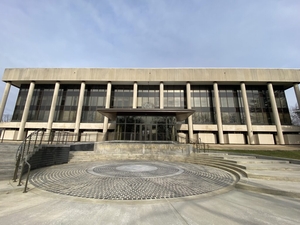
Washtenaw County Courthouse (Photo by Jon King/Michigan Advance)
A federal judge in the Eastern District of Michigan on Friday dismissed a lawsuit alleging that Washtenaw County’s “sanctuary policies” were illegal.
In her opinion, Judge F. Kay Behm stated that “neither the federal government nor the President may conscript local officials to enforce their will,” adding that “the government cannot otherwise compel localities to enforce the President’s priorities in the manner it wishes.”
She wrote that the federal government cannot compel states or local governments to enact or administer a federal program, and cannot “conscript state or local officers directly.”
Three county policies were at issue in the lawsuit, Behm laid out in her decision. First, the county prosecutor’s office directed prosecutors to consider immigration consequences when making charging decisions, as well as not to share information with U.S. Immigration and Customs Enforcement beyond what would be required by federal law. Second, the county sheriff’s office instructed officers not to ask about immigration status and determined that the office would not detain individuals for ICE without a judicial warrant or court order. Finally, the county’s Board of Commissioners decided not to allow federal immigration officers onto county property if they did not have a judicial warrant or court order.
The federal government’s initial complaint alleged that the county “insists on obstructing federal immigration enforcement operations and shielding criminal offenders from apprehension by federal law enforcement. Washtenaw County’s policies aim to obstruct federal law enforcement and celebrate thwarting the constitutional obligation of the President of the United States to take care that federal immigration law be faithfully executed.”
The supremacy clause of the U.S. Constitution has complicated local and state level responses to federal immigration enforcement for communities around the country that do not want ICE to have a presence.
One aspect of that legal doctrine is ‘obstacle preemption,” when state law serves as an obstacle to the purposes and objectives embodied in a federal law. The federal government argued Washtenaw County’s policies fit that definition. However, a high threshold must be met to prove that preemption.
Behm wrote that a refusal to cooperate with immigration enforcement “does not constitute discrimination against the federal government,” and therefore is not constitutionally prohibited.
Quoting from another court ruling, Behm added that a “healthy balance of power between the States and the Federal Government [reduces] the risk of tyranny and abuse from either front,” concluding that Washtenaw County had done nothing more than “exercise its constitutional authority under the Tenth Amendment.”
Lansing, MI