Judge expresses concerns, delays ruling in challenge to redistricting amendment
Aug 26, 2026 | 2:38 am ET
Description
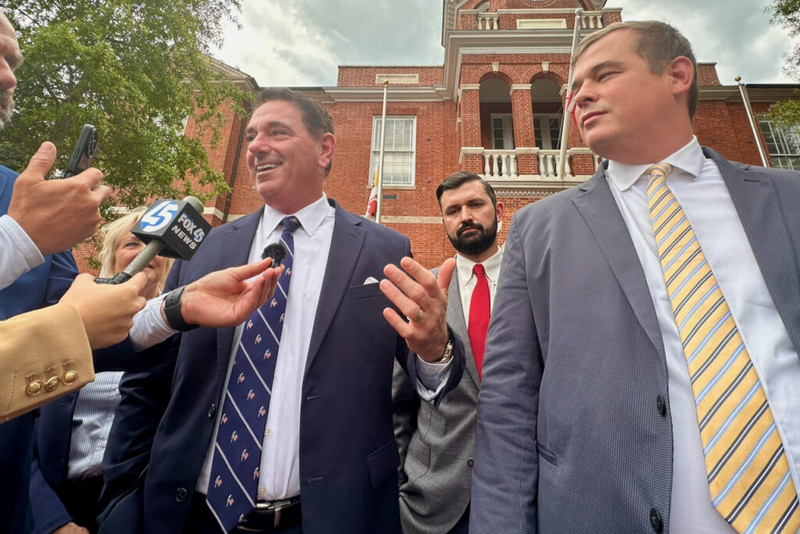
Del. Matt Morgan (R-St. Mary's) (left) and other Republicans expressed optimism at the end of a day-long hearing challenging a proposed amendment to the Maryland Constitution setting standards on congressional redistricting. Morgan, chair of the Maryland Freedom Caucus, is a plaintiff in the lawsuit along with Del. Ryan Nawrocki (R-Baltimore County) and Mike Howell (right), president of the conservative Oversight Project. (Photo Bryan P. Sears Maryland Matters)
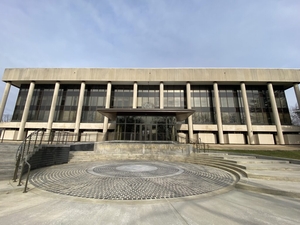
The Anne Arundel County Circuit Court judge overseeing a legal challenge to a proposed constitutional amendment on redistricting said Tuesday there are a “couple things that trouble me about this case.”
The comments by Circuit Judge Robert J. Thompson came at the end of a daylong hearing of a Republican lawsuit challenging the amendment, passed earlier this month in a special legislative session and slated to go to voters in November. Thompson said he originally planned to have a ruling by Tuesday, but instead said he would rule by Wednesday afternoon.
“There are a couple things that trouble me about this case,” Thompson said before adjourning for the day. “In particular, when all of this lawmaking authority, at least statutory lawmaking authority, rests in one branch of the government, and that branch of the government wants to do something that its own laws that it enacted don’t allow or don’t make easy to do, you can just say, ‘Well, you know, we won’t follow those laws.’
“That doesn’t seem right to me because I know that the legislature, that branch of government that has that authority, also has the ability to repeal laws, amend laws, carve out exceptions in laws,” he said.
The comments left Republicans hopeful and Democrats characterizing his ruling as a jump ball at this point.
Thompson was appointed to the bench by Republican former Gov. Larry Hogan in 2018. Prior to the hearing, he disclosed in open court he had “an association” with two of the plaintiffs in the case — Dels. Brian Chisholm (R-Anne Arundel) and Kathy Szeliga (R-Baltimore County), saying he had spoken with both after Hogan appointed him to the bench.
Judge rejects request to move redistricting lawsuit from Dorchester County
“I don’t believe it creates a conflict,” Thompson said as he opened the hearing, and attorneys for both sides declined to raise concerns about the disclosure in open court.
The case filed in Anne Arundel County Circuit Court is one of two legal challenges to House Bill 2100, a proposed amendment to the Maryland Constitution that could go to voters in November.
A second lawsuit, filed in Dorchester County, has yet to be scheduled for a hearing.
Both cases are expected to head to the Supreme Court of Maryland. Election officials are staring at a deadline of Aug. 31 to certify the roughly 1,200 ballot variations that will be presented to voters across the state Nov. 3.
Maryland State Election Administrator Jared DeMarinis welcomed what he saw as Thompson “understanding the urgency” for a ruling so the appeals process can begin.
“We just want some clarity … so that we can meet all the certification deadlines and make sure that the mail-in ballots go out in a timely fashion,” DeMarinis said. “In the end, voters have to be informed and vote.”
DeMarinis declined to speculate on how Thompson might rule.
“I’ll let the lawyers and the other prognosticators take that one there,” he said. “My job is to create the ballot and make sure that the voters have choices, and that’s what I’m going to do.”
The proposed amendment at the center of the case would nullify a 2022 ruling by Judge Lynne Battaglia that struck down a proposed 2021 congressional map.
Battaglia applied a portion of the state constitution that requires districts be compact, contiguous and mindful of jurisdictional and geographic boundaries — language that had always been applied to legislative districts, not congressional districts.
When all of this lawmaking authority ... rests in one branch of the government, and that branch of the government wants to do something that its own laws that it enacted don't allow or don't make easy to do, you can just say, 'Well, you know, we won't follow those laws.' That doesn't seem right to me.
It was considered a novel ruling. And while not considered a binding legal precedent, the ruling was not appealed. Instead, lawmakers compromised on a revised map that favors Democrats in seven of the state’s eight congressional districts, instead of in all eight as the original plan would have done.
The proposed constitutional amendment would ask voters to approve a change that would make clear that compact and contiguous requirements apply only to state legislative districts.
Republicans see the change as the first step in a process that could result in new maps as early as next year. That map would eliminate the last Maryland Republican member of Congress, Rep. Andy Harris (R-1st), as Democrats seek to join in a flurry of hyperpartisan midcycle redistricting, sparked by President Donald Trump, as states jockey to retain control of Congress in the midterm elections.
The challenge heard by Thompson — mounted by members of the ultraconservative Maryland Freedom Caucus and leaders of the Senate Republican Caucus — primarily focuses on a law passed last year that sets a July 1 deadline for ballot questions to be presented to voters with public comment. The bill passed in special session skirts that deadline.
“All of our constituents’ due process rights were violated,” Del. Ryan Nawrocki (R-Baltimore County), a plaintiff in the case, said outside the courthouse Tuesday afternoon. “All of Marylanders’ due process rights were violated in this process. The legislature can’t make rules for thee and not apply them to me, and that is what this case is fundamentally about. And we are all cautiously optimistic that that is what the judge is going to decide tomorrow.”
Maryland Republicans were joined by Oversight Project President Mike Howell, another plaintiff in the case. Jeffrey B. Clark, a former Trump White House official, served as lead attorney Tuesday, arguing the case before Thompson.
“The governor of Maryland and the General Assembly are well within their rights to make mistakes and terrible policy all day long,” Howell told reporters outside the courthouse. “But what they can’t do is just run roughshod over the very rules that they lay out just not too long ago. That’s what this case comes down to: Are there rules, and does the General Assembly have to obey them?”
Clark, who is now vice president of litigation for the Oversight Project, was indicted in connection to Donald Trump’s attempts to overturn the election results in Georgia in 2020. Trump pardoned Clark last year. The case in Georgia was later dropped.
“You have the former acting attorney general of the United States, one of the nation’s leading legal experts, standing up for the rights of Marylanders,” Howell of Clark. “He’s exactly where he needs to be. We have an embarrassment of riches at the Oversight Project with our legal team, and you know, standing behind me are many more lawyers that assisted on this, along with you know my fellow plaintiffs in the Maryland legislature and Senate. And so Jeff Clark makes the case all that much more clear.”
Del. Kris Fair (D-Frederick), a House leader in the effort to pass the amendment, criticized Republicans for bringing Clark in on the lawsuit. He called Clark “infamous” for trying to “overturn a lawful election” in Georgia.
“He’s then coming here to Maryland to try to block the right of Maryland voters just to be able to vote on the issue themselves,” Fair said.
The bill — which included a mandated question for the ballot —passed with the support of Democratic lawmakers who hold supermajorities in both chambers and included a “notwithstanding” amendment supporters said allowed them to bypass those requirements.
Thompson also seemed to express concerns about how the supermajority wields power in the legislature.
“These are the same people who want to set the law aside, who are constantly telling us how we’re a nation of laws. We need to follow the law. We all need to have this fidelity to the law,” Thompson said. “And then when they want something they can’t get in the ordinary way, they want to toss the law out. Doesn’t make a lot of sense to me.”
Republican and Democratic lawmakers in the packed courtroom attempted to read between the lines of Thompson’s closing remarks.
“I’m cautiously optimistic that he saw things the way we saw things as legislators,” said Senate Minority Leader Sen. Stephen S. Hershey Jr. (R-Upper Shore), a plaintiff in the case.
Fair said he was neither “hopeful or forlorn” as the day ended without a decision from Thompson.
“Obviously, he had some concerns, so I think it’s going to be an interesting ruling tomorrow (Wednesday),” Fair said. “I’m not sure which way it’s going to go.”
When asked if he thought the decision was still a “jump ball,” Fair said “that’s a safe assumption, to think that it could be a toss-up.”
Fair criticized Republicans for attempting to prevent the matter from going to voters.
“Why are the Republicans this scared of the voters of the state of Maryland? Why are they that nervous to bring this issue forward and allow the voters of the state of Maryland to tell us instead of lecturing them?” Fair told reporters.
Del. Matt Morgan (R-St. Mary’s), chair of the Maryland Freedom Caucus and a plaintiff in the case, had a response for Fair.
“They (Democrats) could have avoided this whole situation by following the process that they set up,” Morgan told reporters. “Instead, they come out with this amendment a half-hour before the committee hearing, and it’s supposed to exempt them from all the laws. The General Assembly has to abide by the law. That’s what we’re just asking for.”
Annapolis, MD