Active court order still blocking Trump effort to restrict vote-by-mail
Aug 25, 2026 | 4:11 pm ET
Description
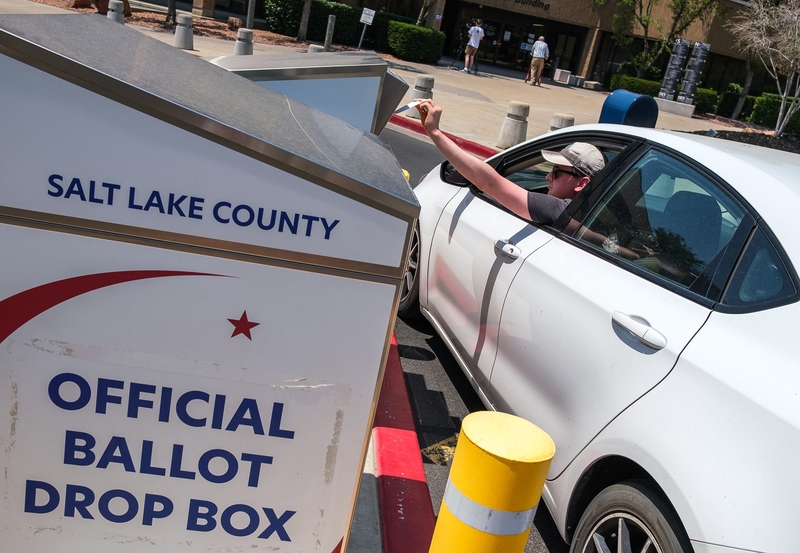
A voter drops off a ballot on primary Election Day at the Salt Lake County Government Center on Tuesday, June 23, 2026. (Photo by Marco Lozzi for Utah News Dispatch)
WASHINGTON — The U.S. Supreme Court on Monday handed a procedural victory to President Donald Trump on an executive order to curb mail-in voting, but the administration is still fighting a separate ruling that limits a portion of the order and remains in effect — complicating the administration’s temporary win.
In light of the ruling in the nation’s highest court, the administration late Monday asked U.S. District Judge Indira Talwani in Massachusetts to vacate her decision from earlier in August that blocks the U.S. Postal Service from carrying out aspects of Trump’s executive order, while the voting rights groups that brought that challenge argued Tuesday the block should remain in place.
Monday’s decision from the Supreme Court also drew the ire of Democrats, who argued that Trump’s executive order ran afoul of the Constitution and threatens democracy.
Under the Constitution, states are responsible for administering elections. Many Democrats have said Trump’s order seeks to unlawfully grab that power for the executive branch.
The Supreme Court’s ruling halted a June decision from Talwani in a case brought by more than 20 Democratic-led states and Washington, D.C.
But that ruling does not apply in a separate case, filed in the same Massachusetts federal court, by the League of Women Voters of Massachusetts and several other voting rights groups challenging Trump’s executive order.
In its emergency motion in the voting rights groups case, the administration wrote that “the Supreme Court’s order leaves no room for any further dispute: this Court lacked jurisdiction to issue the preliminary-injunction in this case, just as it lacked jurisdiction to enter summary judgment in the (states’) case, because there is no justiciable controversy over a proposed rule until it is actually finalized by an agency.”
Final rule published
Further complicating the matter, the U.S. Postal Service on Friday issued a final rule that details how the agency would execute Trump’s order.
The voting rights groups on Saturday asked Talwani to enforce her August order as a result of the Postal Service issuing the regulation.
Regarding that request, Talwani on Tuesday afternoon said the rule violated her order because she specifically said the administration could not take steps to implement the executive order. However, she declined to take action “other than identifying the violation.”
The groups redoubled their request earlier Tuesday, writing that the Supreme Court’s decision was based on the lack of a USPS final rule.
“That decision addressed a materially different record and did not consider the critical development that occurred last Friday: The USPS Defendants promulgated a Final Rule, transforming the posture of this case and supplying a final agency action that was not before the Supreme Court,” they wrote.
Talwani’s order on the administration's request was still pending Tuesday afternoon.
Democratic blowback
Meanwhile, Democrats were quick to blast the Supreme Court’s decision, including the top Democrats in the U.S. Senate and House.
Senate Minority Leader Chuck Schumer said it’s “a disgrace that the highest court in the nation is allowing Trump to put a dagger into the heart of our democracy,” in a Monday statement.
The New York Democrat noted that “Trump’s effort to turn the Postal Service into a voter suppression machine is blatantly unconstitutional – yet his MAGA Supreme Court is refusing to stop it from going forward,” while adding that “Senate Democrats will fight every attempt to hijack mail-in voting and rig the rules before voters have their say this November.”
House Minority Leader Hakeem Jeffries also blasted the decision and vowed to continue fighting, saying “the sycophantic Supreme Court majority’s decision in the vote-by-mail case is sowing chaos in service to Donald Trump’s effort to undermine our free and fair elections.”
Jeffries, also of New York, added that “the Trump-aligned justices on the Supreme Court did not and cannot give the President the power to decide how states run elections or who gets to vote by mail.”
The respective heads of the Democratic National Committee, Democratic Congressional Campaign Committee, Democratic Senatorial Campaign Committee and Democratic Governors Association also pushed back against Trump’s executive order.
“This is the latest attempt from Trump to rig the midterms because Republicans know their corrupt, cost-hiking policies are deeply unpopular and hurting people every day,” DNC Chair Ken Martin, DCCC Chair Suzan DelBene, DSCC Chair Kirsten Gillibrand, and DGA Chair Andy Beshear said in a statement.
“Democrats will not let them get away with it, and we are confident the American people will reject these Republican schemes in November,” they wrote. “We're going to fight every day until Trump's illegal executive order, and all of his other attempts to undermine our free and fair elections, are completely thrown out.”
A spokesperson for the National Republican Congressional Committee, the party’s U.S. House campaign arm, did not return a message Tuesday.
All States Newsroom content is free to republish. Read our republishing policy for more information.