Pritzker, Bailey offer different visions for Illinois education
Aug 25, 2026 | 12:30 pm ET
Description
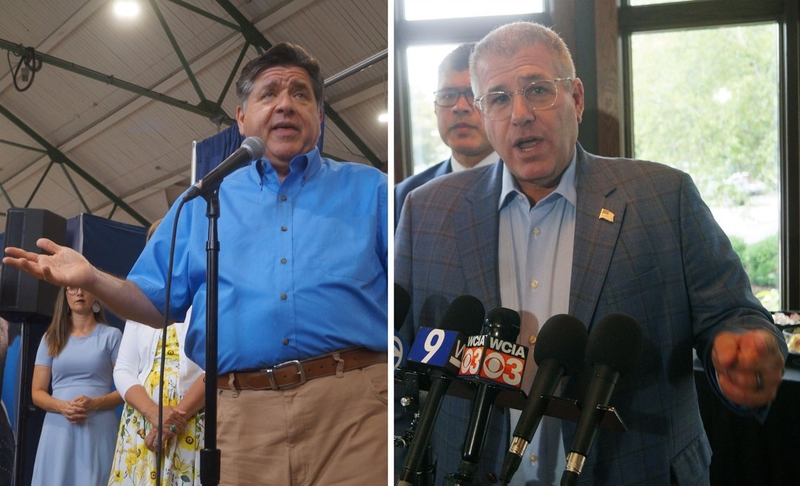
Gov. JB Pritzker and challenger Darren Bailey. (Capitol News Illinois photos by Peter Hancock)
SPRINGFIELD – Gov. JB Pritzker said during Illinois State Fair festivities this month that he agrees public schools need more funding.
But he also boasted about the additional funding his administration has already provided, and he said that has led to improved performance in reading and math, even though by the state’s own measure, most schools in Illinois remain underfunded.
“We lifted eighth grade reading and math scores to a new high,” Pritzker told a cheering crowd at the Illinois Democratic County Chairs’ Association brunch on Wednesday, Aug. 19. “We got a fifth-in-the-nation ranking for Illinois’ K-12 education. We expanded preschool and we notched the highest high school graduation rate in Illinois history.”
His Republican challenger Darren Bailey, meanwhile, said he believes the way to improve education in Illinois is through less government interference, not more funding.
“Let local communities, let parents decide how they want their children educated,” he told reporters outside a Republican State Central Committee meeting Thursday. “Get the government out.”
Those were just some of the comments the two candidates for governor made during political events surrounding the State Fair, an event that traditionally marks the unofficial start of the general election campaign.
The issue of school funding
The state fiscal year that began July 1 marks the 10th year of funding public schools under the Evidence-Based Funding model. Lawmakers enacted that system in 2017 to improve adequacy and equity in Illinois school finance, and it was signed into law by then-Gov. Bruce Rauner, a Republican.
That law established a goal of bringing all districts up to adequate levels of funding by this fiscal year. And in the years since it passed, annual state funding for K-12 education has increased more than $3 billion, with the bulk of that money being directed to the most underfunded districts in the state.
Still, the most recent figures from the Illinois State Board of Education show that more than two-thirds of the state’s elementary, high school and unit school districts will be underfunded this year. And the overall “adequacy gap” — the difference between the funding districts and their adequacy target under the law — now stands at $6.8 billion and growing.
Open interactive chart in a new tab
In addition, Capitol News Illinois reported in July that while the state has made progress in narrowing the wealth-based disparities in the distribution of school funding, significant disparities still exist in the property tax rates people pay to fund the local share of education costs. Research showed homeowners in the poorest districts paid tax rates that were twice as high as those in the wealthiest districts.
Pritzker responds
Asked about those trends while speaking with reporters at the fairgrounds, Pritzker said he agreed the state needs to continue increasing education funding, saying “adequacy is always a challenge.”
But then he quickly pivoted to certain performance measurements showing Illinois students improving on several metrics.
“We have a higher graduation rate than we’ve ever had in the history of record keeping in the state of Illinois,” he said. “We have a higher graduation rate overall. We also have a higher graduation rate for Latino students in high school. We have a higher graduation rate for Black students in high school, and the fact that we have a better student-teacher ratio now is another reason why we’re getting better results.”
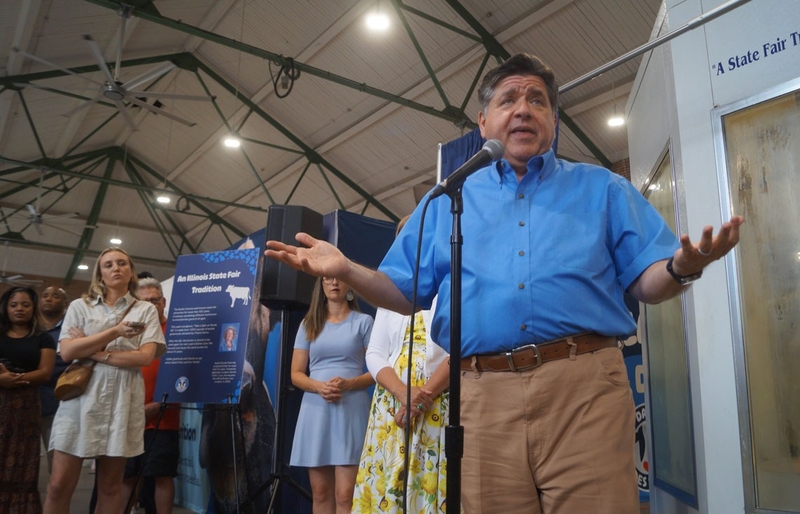
That’s a message Pritzker has been pushing both from the governor’s office and on the campaign trail. On Aug. 17, his office issued a news release touting the state’s rankings according to various surveys of educational quality.
That same day, his campaign issued a statement highlighting his administration’s record in education while announcing he had received the endorsement of the Illinois Education Association, the state’s largest teacher’s union.
Bailey responds
Bailey, meanwhile, has been delivering an entirely different message about education, pointing — sometimes inaccurately — to the number of students who score below proficiency on standardized state assessments.
“When 70% of our children across the state cannot read and write and do math at grade level, that’s a problem and everyone knows it,” Bailey told reporters. “And Chicago Public Schools system, my heart breaks for them, 90% of the children up there. —Go to Illinois State Board of Education’s website. Read it. That’s not my numbers. That’s the state’s numbers.”
In fact, according to the state’s 2025 Report Card, only 47.6% of Illinois students scored below proficiency in English Language Arts while 61.6% scored below proficiency in math.
At Chicago Public Schools, the 2025 Report Card showed 58% of students scored below proficiency in English language arts while 73% did so in math.
Those, however, were the first tests administered under a new scoring system in which the cut scores for determining proficiency were lowered. ISBE officials said that was done to reflect student performance more accurately.
Bailey also brushed aside the suggestion that low scores could be the result of inadequate funding and that most of the students in Illinois attend schools that are underfunded.
“Funding is not the issue,” he said. “Why is money always the always the answer to every problem that we have? Money is not the answer to every problem that we have.”
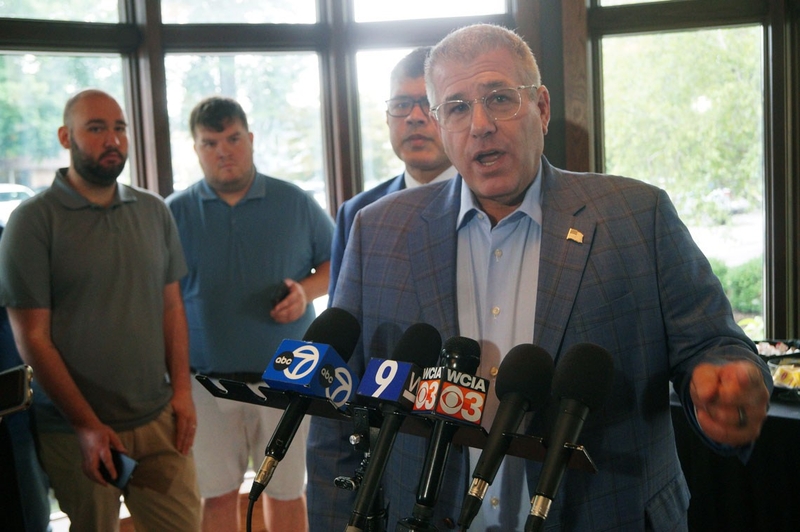
When asked to explain how he proposes to improve education in the state, Bailey said: “Get the government out of it. Less government, and let the people, let the school districts control themselves.”
“Government doesn’t need to mandate and regulate it,” Bailey said. “Let local communities, let parents decide what how they want their children educated.”
Aaron Del Mar, Bailey’s running mate, echoed Bailey’s call for less direct state involvement in school funding and suggested instead that Illinois should opt in to a new federal program backed by the Trump administration that provides tax credits for contribution to private school scholarship funds.
That is similar to Illinois’ former tax credit program called Invest in Kids, which lawmakers allowed to expire in 2023.
“Why don’t you ask JB Pritzker why he doesn’t opt into the federal program that would bring federal dollars and resources to Illinois,” Del Mar said. “Thirty-two states have already opted in … but JB Pritzker wants to put his political ambitions for the 2028 Democratic (presidential) primary in front of educating Illinois students. When JB Pritzker opts into the federal program, we can start talking more about education.”
Evolution controversy
Also during the fair, the Pritzker campaign tried to revive criticism of Bailey’s involvement in founding a private religious school in southern Illinois in 2016, Full Armor Christian Academy, that teaches a biblically based curriculum that includes the teaching of creationism in science classes.
Bailey stepped down from his role in running the church shortly before launching his 2022 gubernatorial campaign. The Pritzker campaign ran ads at that time criticizing the school for using textbooks published by Bob Jones University Press that suggested humans and dinosaurs once roamed the earth at the same time.
This year, Pritzker’s campaign placed inflatable dinosaurs outside a Republican Day gathering on the fairgrounds to mock Bailey.
The stunt infuriated Bailey, especially when asked by reporters to comment on it. Bailey did not directly respond to the criticism or state a position on evolution, telling a Chicago reporter he “wasn’t there.” He also accused Pritzker of using the issue to deflect attention away from the state’s problems while focusing on running for president in 2028.
Then Monday, Bailey issued a statement saying the school had received a “threatening message” and he accused Pritzker of putting children in danger with by using “reckless” campaign rhetoric.
“Pritzker is free to attack Darren Bailey,” the statement said. “He can spend his billions slinging all the political mud he wants at another candidate. But a governor who not only drags students, teachers, and families into the political gutter but also endangers them with his reckless rhetoric has lost any claim to moral leadership.”
A spokesperson for Illinois State Police said in an email Monday that it is assisting the Clay County Sheriff’s Office in investigating a threat made to the school but offered no additional comment.
Capitol News Illinois is a nonprofit, nonpartisan news service that distributes state government coverage to hundreds of news outlets statewide. It is funded primarily by the Illinois Press Foundation and the Robert R. McCormick Foundation.
Springfield, IL