Walks like a duck: The real reasons Marsha Blackburn won’t debate her opponents
Aug 24, 2026 | 5:59 am ET
Description
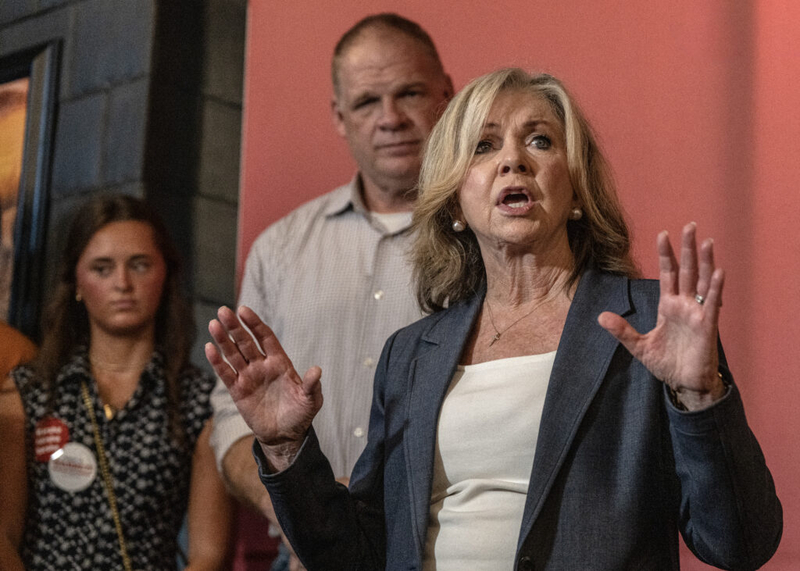
Why won't U.S. Sen. Marsha Blackburn debate? The stock answer is that there's no need, but there may be more to the issue. (Photo: John Partipilo/Tennessee Lookout)
Why was U.S. Sen. Marsha Blackburn unwilling to share a debate stage with her Republican primary opponents for governor, and why will she continue to duck debates with general election opponent Democrat Jerri Green this fall?
The stock answer is that there’s no need. Why engage with opponents, campaign consultants will insist, when a front-runner can choose instead to ignore them, sticking with friendly audiences and tribally sympatico interviewers?
As strategic advice for which consultants are paid handsomely this is hard to dispute. Unlike flyover states that have assumed various shades of electoral purple (North Carolina, Georgia, Arizona), or turned assorted shades of potentially interesting (Iowa, Ohio, Alaska, Kansas), Tennessee exhibits few markers of blueward political shift, much less conversion.
But even granting the sad-for-democracy reality that debate avoidance can be tactically sensible, Blackburn’s bashfulness takes political poltroonery to new heights. She is famously unwilling to engage with voters in unscripted settings, with detractors, including Green, claiming she hasn’t held an in-person town hall fielding unscreened questions in a decade.
Moving beyond the patronizing arrogance of “I’m ahead so why bother,” I have a couple of theories about why Blackburn didn’t debate her primary opponents and won’t debate Green or either of the potentially interesting independents (David Hatley and Lauren Pinkston) this fall.
One theory is that Blackburn and her handlers aren’t merely making tactical choices rooted in conventional wisdom about avoiding giving underdog opponents a platform; they are guarding against potential calamity.
Blackburn has never cultivated a reputation as — how shall I put this? — the sharpest rhetorical knife in the drawer. But she did passably in debates with former Democratic Gov. Phil Bredesen in her first U.S. Senate run in 2018, going more on the offensive and drawing sharper contrasts than the passively articulate (and perhaps out-of-practice) Philbot.
Blackburn benefitted from standing alongside the older Bredesen, a reluctant warrior framed at the time by historian Jon Meacham as a man who is “74 and happily retired … beseeched to get back in the arena to run.”
With gerontocracy on the outs, now it’s Blackburn at 74 who might strike debate watchers as short on political agility, standing alongside the more youthful and articulate Green. Well-known conservative Steve Gill surmised recently on Fox 17’s political gabfest Nashville in Focus that Blackburn “is fearful and her team is fearful that she will have a Joe Biden moment in a debate that could collapse her campaign, if she gets off kilter, if she is not as articulate and glib as she might have been … when she debated Bredesen.”
Watch a few minutes of Blackburn in the 2018 debate with Bredesen at Cumberland University and then watch a few minutes of a recent interview with Scott Jennings, and you’ll see why Gill and other Republicans might worry.
My second theory about Blackburn’s reluctance to debate has to do with the policy substance of her campaign, which is remarkably flimsy and at times just weird.

Both Blackburn and Green have what seem at first glance like extensive platforms on their campaign websites. But click beyond the topic headings and we find Blackburn on issue after issue offering simpleminded and at times nonsensical platitudes, while Green goes deep on policy.
Take K-12 education for instance. The sum total of Blackburn’s plans involves more vouchers (which we already have lots of), taking away kids’ cell phones (already disallowed in classrooms) and making sure woke teachers aren’t indoctrinating kids into hating America (they aren’t). Green in contrast has much to say about school funding, teacher pay and incentives, universal pre-K,mental health services, GED testing, investments in after-school and summer care and students with disabilities.
Or take technology and A.I., a big issue in 2026 politics. Green’s medley of proposals covers electricity and water use by data centers, the role of A.I. in education, housing, criminal justice, employment, and medical care and the effects of AI on jobs.
Blackburn as senator has been involved in A.I. regulation conversations at the national level, but says little about what a governor can do. Her website does position her adventurously in favor of reliable internet service, and she thinks crypto is whizzo because it helps “preserve our conservative values,” whatever that means.
On health care Green discusses Medicaid expansion, health equity, mental health services, addiction and prescription drug costs. On her government website Blackburn brags about the various rural healthcare bills she has sponsored as a senator, none of which have made it out of committee. Her overarching view is that “the issues facing our health care sector will not be solved in Washington, D.C., but in Tennessee,” Ok, so now you’re running for governor and you can tell us how — yet she overlooks health care entirely as an issue on her campaign website.
Blackburn’s agenda veers from flimsy to bizarre when she reaches for soundbites. A few quick examples: Reminding us that she has no grasp of constitutional history she tweeted last week that “Tennessee ought to be the number one Christian conservative state in the nation.” Earlier this month she promised that “as your governor, I’ll deport illegal aliens from Tennessee,” hoping we don’t notice that governors have no power to deport anyone. In a recent interview she pledged to make sure “that every child in our state … has access to a world class education,” while nowhere saying what that looks like or how she would make it happen.
In her primary night victory speech Blackburn said: “The Democrats are just not running on different policies. The Democrats are running to destroy our state and our nation.” Some will dismiss this as a passing example of the all-too-commonplace tenor of polarized political discourse these days, but I’m not buying it. Accusing your opponents of “running to destroy our state and our nation” goes beyond routine hyperbole; it’s morally and mentally unhinged.
Blackburn has shown herself to be a chronically inarticulate and underinformed political sycophant who is running now to lead the state on a vacuous platform of mostly substance-free banalities, devoid of any meaningful governing agenda. As her underwhelming low-40s election result in the primary against two mediocrities attests, even her GOP fellow travelers know she’s weak sauce.
Tennessee voters won’t see the gubernatorial debates they deserve not just because campaign strategy puts Blackburn in a position to win without them. She’ll duck debates for the same reason she steadfastly avoids unvetted audiences: the political pros advising her know inept and unhinged when they see it, and grasp fully the importance of keeping them as hidden from public view as possible.
Nashville, TN