New Orleans’ stormwater strategy must be equitable and inclusive
Aug 24, 2026 | 6:00 am ET
Description
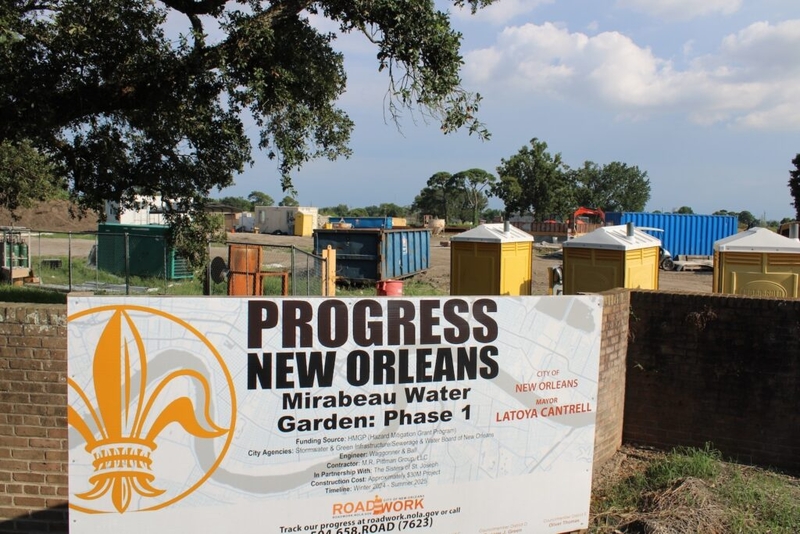
Work continues in August 2025 on the early stages of the Mirabeau Water Gardens, a stormwater retention project planned for the Gentilly neighborhood. (Photo by Greg LaRose/Louisiana Illuminator)
As city leaders and the Sewerage and Water Board of New Orleans grapple with how best to address drainage and other needs, residents must listen closely and ask questions of their elected officials and other city leaders.
How any proposed fee is structured, managed — and, importantly, how clearly it is communicated — will determine whether it succeeds first at the ballot box and then in practice. Public buy-in will not materialize unless the public clearly understands what is put before them.
Imagine a fee that is right-sized and distributed across all properties citywide, with minimal exemptions, one that includes residential and commercial properties, large tax-exempt parcels owned by universities, hospitals and government. Imagine a system where everyone is paying something that is proportionate to the runoff they create, but no one is paying more than they can afford.
Property owners of all sizes and types who have already invested in green infrastructure to manage water where it falls would receive credit for their investments. A portion of revenue collected would be placed in a fund to reduce or eliminate fees assigned to moderate- and low-income homeowners to ensure no one is cost-burdened.
In this scenario, those who want to create space for water to soak in on their properties would be provided a pathway to do so, with programs that subsidize concrete removal and permeable paving, infiltration trenches and rain garden installations. Property owners would be connected with qualified green infrastructure installers and programs providing low to 0% financing to make such improvements time and cost-effective.
With such an approach, the city would finally have an equitable funding stream to make gray and green infrastructure improvements while incentivizing property owners to continue to reduce their own contributions to runoff.
This is not pie in the sky. This is possible. In fact, it’s already happening in other cities.
Stormwater utilities have been successfully implemented across the country for decades. There are approximately 2,000 tested models nationwide to offer guidance on what and what not to do.
More importantly, many of the necessary components for such an approach — a qualified workforce and installation professionals, financing bodies, property owners motivated to make these improvements and nonprofit organizations positioned to help raise awareness — are already in place in New Orleans.
In addition, we have local data showing incentives and credits to encourage property owners to invest in runoff reduction are not optional add-ons; they are proven drivers of participation and support.
The Urban Conservancy’s Front Yard Initiative incentivized property owners for over a decade to replace concrete surfaces with permeable paving, rain gardens and other nature-based solutions that create stormwater storage. Participants report drastic and lasting reductions in flooding, less runoff entering storm drains and improved resilience to heat and drought. Results from our third triennial homeowner survey, published earlier this year, show that effectiveness remains high years after installation.
Consistently, in all three homeowner surveys conducted over the past decade, more than 95% of respondents say financial incentives were essential to their decision to participate. The initiative’s results demonstrate what is possible when residents are given both the technical tools and modest financial encouragement to act. Excluding credits and incentives would ignore evidence and undermine the likelihood of success for any proposed fee.
The stakes could not be higher. Recent research published in Science Advances and Nature Sustainability reinforces what New Orleanians already know: Flood risk remains an existential threat. Nearly all residents face significant exposure under multiple climate scenarios.
A dedicated funding stream for drainage maintenance and upgrades is essential. Unlike sewer and drinking water systems, which are funded primarily through user fees, New Orleans’ drainage system relies entirely on property tax millages, some of which are set to expire soon. This places the burden disproportionately on taxpayers while exempting more than a third of the city’s total real estate value, including large nonprofit, government, and commercial properties that contribute significantly to runoff but are exempt from property taxes.
The result is both a funding shortfall and a system that fails to create a direct link between a property’s impervious surface area and its contribution to maintenance costs. A well-designed fee structure where largest contributors to stormwater runoff pay a proportionate amount to mitigate their impact is possible.
As New Orleans moves forward, decision-makers must incorporate lessons learned locally and elsewhere. Residents should insist on a system reflecting both urgency and inclusion: a stormwater fee that funds essential drainage infrastructure while empowering individuals and institutions to act on their own properties.
That dual approach is not a luxury. It is the strategy most likely to succeed both at the ballot box and beyond.
Baton Rouge, LA