After attacks, Alabama-founded LGBTQ+ history nonprofit moves to North Carolina
Aug 24, 2026 | 6:01 am ET
Description
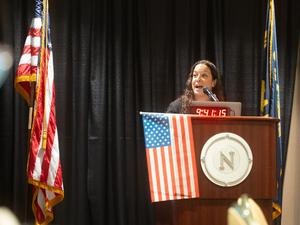
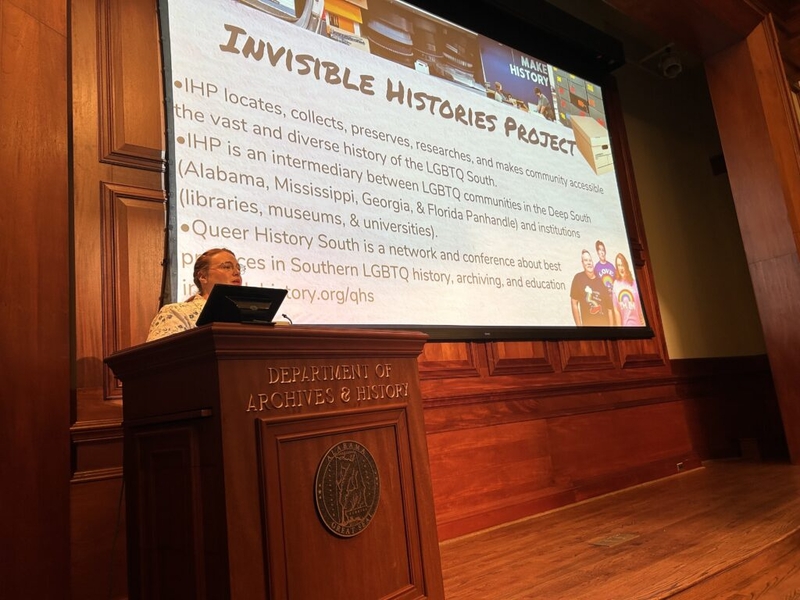
Maigen Sullivan, co-founder of Invisible Histories, speaks at the Department of Archives and History on Thursday, June 15, 2023. In March 2026, the organization moved from Birmingham to Charlotte, North Carolina. (Jemma Stephenson/Alabama Reflector)
Before June 2023, Invisible Histories flew under the radar in Alabama.
The nonprofit organization, which archives and researches southern LGBTQ+ history, began collecting items in 2018, just two years after President Donald Trump was elected for his first term.
“People seemed just kind of quasi-interested, and then 2016 happened,” said Maigen Sullivan, co-founder of the nonprofit, in a recent interview. “People were all of a sudden very interested in the urgent need to preserve at-risk history, and we see that was too much foreshadowing, I think.”
But now Invisible Histories is no longer in Alabama. In March, Sullivan and Joshua Burford, the other co-founder of the organization, decided to relocate from Birmingham to Charlotte, North Carolina. The new facility is set to open to the public in November.
There were several reasons for the move, including funding and a need for space.
“The biggest push was the humanities cuts (to) funding. Running an archive is not sexy and is incredibly expensive. The standards for keeping old things in a box are actually really high and very costly, and so we could not be in one of the poorest states.” Sullivan said.
But another reason for moving, Sullivan said, was a mounting political hostility to Alabama’s LGBTQ+ communities, which Sullivan experienced firsthand after delivering a talk about Alabama’s LGBTQ+ history at the Alabama Department of Archives and History in June 2023.
“(Charlotte) is in a state that also has a lot of problems, but is not quite as actively hostile to LGBTQ things as Alabama particularly is,” she said.
An Archives presentation
Sullivan’s 2023 talk was a part of the department’s Food for Thought series, a year-long series of presentations with a different speaker each month. During the lecture, Sullivan discussed the history of LGBTQ+ people and organizations in Alabama.
Figures mentioned during the speech include singer Gertrude “Ma” Rainey and actress Nell Carter, who would be considered bisexual by today’s standards, and the organization Lambda Inc., which Sullivan described as the state’s first LGBTQ+ resource center.
Following the presentation, Sullivan and Archives and History became the targets of conservative media in the state, which sparked attacks from Republicans in the Alabama Legislature. Legislators made several attempts to defund Archives and filed bills that would overhaul the department’s governing board.
“Intentionally erased:” Invisible Histories Project cofounder speaks on Alabama’s LGBTQ+ history
Sen. Chris Elliott, R-Josephine, who sponsored the defunding bill and several other bills looking to reappoint members of the department’s board, said in a recent interview that Sullivan’s talk made him realize the board was “self-perpetuating” and not being confirmed by the Senate.
“We really just need to update the board’s appointing process. And again, I think as this continues to go on, you have board members that for multiple years now, three plus years, have not been confirmed by the Alabama Senate, and yet they continue to serve,” Elliott said.
None of the bills Elliott have proposed have gone into effect. He said during the interview he will bring another piece of legislation related to the Archives board during the next legislative session.
Sullivan’s speech was not the first time Sullivan or Burford had worked with the Department of Archives and History. Steve Murray, the executive director of the Alabama Department of Archives and History, said Burford in 2022 “gave a talk about (the) Invisible Histories Project and that organization and what they were doing to preserve historical materials related to LGBTQ topics.”
Burford wrote in an email Thursday that he was surprised by the backlash.
“We give talks all the time, and we have never had a Senator ever give any feedback at all,” Burford said. “Some of it was scary, especially being doxxed by a ‘news’ organization but in a lot of ways it wasn’t really that shocking considering this elected official was trying to ride some wave or (anti-LGBTQ+) sentiment for his own reasons. Since the talk was about folks from Alabama who were part of the queer community, there was very little to react to, honestly.”
Murray said when Burford gave his speech in June 2022, there was no pushback from lawmakers on the topic of LGBTQ+ history preservation, nor was there any pushback in the months leading up to Sullivan’s speech.
“Usually, like right after Christmas, we’re sending out the (Food for Thought speaker) list for the next year, and so that’s how that happens every year, and including those two years,” Murray said. “Those were schedules that had been set for about nine months, before the program happened, and we had been promoting it since January, but we didn’t hear any criticisms or questions about any of that until literally the day before the program was supposed to take place.”
One main question Murray said he got from lawmakers was regarding the audience the program was created for. He said when lawmakers called him, he assured them that Sullivan’s lecture wasn’t aimed at children. But because of the backlash, the department has not had a public program centered on LGBTQ+ topics since 2023.
Patricia Todd, a former state representative who chairs Alabama Equality, an organization that advocates for LGBTQ+ rights, called the attacks “disrespectful” and said Republican lawmakers should focus on other issues in an interview Friday.
“It’s ridiculous. I mean, we are not the problem, okay? But they need to pay attention to issues that affect average (people) the price of gas, groceries, lack of healthcare, access to healthcare. That’s what they need to be focusing on,” she said.
Prior work
Murray said Invisible Histories began working with the department years before either co-founder participated in the Food for Thought programs.
“So they had approached us years earlier about what they were trying to do in building those connections, and so we welcomed that as an opportunity to meet potential prospective donors, and so over those several years, they helped us. They introduced people to us as an institution, and facilitated some conversations about is your repository an appropriate place for this person’s collections,” he said.
LGBTQ history program part of recommitment effort, says Archives and History
Some of the items collected by the non-profit had ties to Mardi Gras, the AIDS crisis and marriage equality.
“What started out as the Montgomery AIDS outreach back in the 80s in response to the AIDS crisis, it changed names over time, but still exists and and and serves a broader community today” Murray said. “But so there’s Mardi Gras, marriage equality, and various organizations that were kind of advocating for LGBTQ rights in Alabama, so all of those kind of fit within our larger umbrella of collecting emphases on things that affect public policy or documenting change in Alabama.”
Burford said the decision to not platform LGBTQ+ history is because “institutions will always look out for the interest of their own organizations” and are “risk averse and often back away for fear of reprisal.”
Sullivan said she saw the backlash to her lecture coming.
“I think that people are so afraid of history,” she said. “I mean, the literacy crisis that we’re in did not just happen, right? It is not just about tech. It is about an attack on knowledge and intellect and expertise. There are concentrated efforts to make us the way that we are right now, and I think one of the reasons why history is such a threat to this very alt-right conservative movement that we’re having right now is because it happened, and it is a weapon to show people how you can fight back.”
Sullivan also believes the emphasis being put on science, technology, engineering and math (STEM) careers has taken away from the humanities.
“Now we’re seeing not just the defunding of humanities, but also diversity, LGBTQ work, generally speaking, with some places having prohibitions on funding that,” she said. “Now what we’re starting to see, and again, this has been kind of subtly happening, is a direct erasure. We’re seeing websites being pulled down. We’re seeing things being censored.”
Sullivan mentioned a July hearing from the Subcommittee on Delivering on Government Efficiency involving the committee sharply attacking the Smithsonian Institute for promoting “divisive, inappropriate, and factually inaccurate programming on U.S. history” as an instance of censorship happening in America.
A new start in Charlotte
Prior to the move, Invisible Histories was being lent space from AIDS Alabama, an organization that provides services to those affected by HIV, and were cycling donations they received to universities and libraries.
Todd said Invisible Histories relocating was sad, but due to the lack of public access, she wasn’t sure if it’d make a difference in Alabama.
“I’m sad to see them go, but you know you don’t have access to the archives they have, so it doesn’t matter where they are,” Todd said. “When I gave them the material, the boxes of information, I thought they were going to be for public view, and so they really need to think about that, or people won’t give.”
At the non-profit’s new location in Charlotte, Sullivan said there is far more space for them to maintain their donations and will also be more accessible to the public.
“It (the old space) was down a flight of stairs. It was harder for people with mobility issues or older folks to get up and down (and) the way we were operating then it made it a little bit harder for us to show things,” Sullivan said. “So it was more about preservation. The new space is prioritizing accessibility, getting people in the door, come on in, sit down, feel comfortable. So it is more accessible, more inviting.”
Despite Invisible Histories moving to Charlotte, the organization could still face attacks. Sullivan said she’s not fearful of any potential backlash.
“I do think it will happen. I’m definitely not fearful. I’m a very froggy person, and you will pull this history out of my cold, dead hands,” Sullivan said. “I don’t think this is the time to be afraid. I feel very resilient.”
She said looking at LGBTQ+ activists of the past makes her want to fight to maintain the history more.
“What would it be for me to shrink into the shadows now, when socio-politically it is incredibly terrifying, purely for trans people. But culturally, things have shifted. Culturally, things have changed,” Sullivan said. “And while there is some backsliding, it just feels like if I’m going to be a bearer of this history, then I have to live in the shadow of those people, and I owe it to them to fight back.”
The Key Points box was written by Reporter Andrea Tinker.
Montgomery