Indiana lawmakers looking at license plate cameras amid growing privacy worries
Aug 24, 2026 | 5:00 am ET
Description
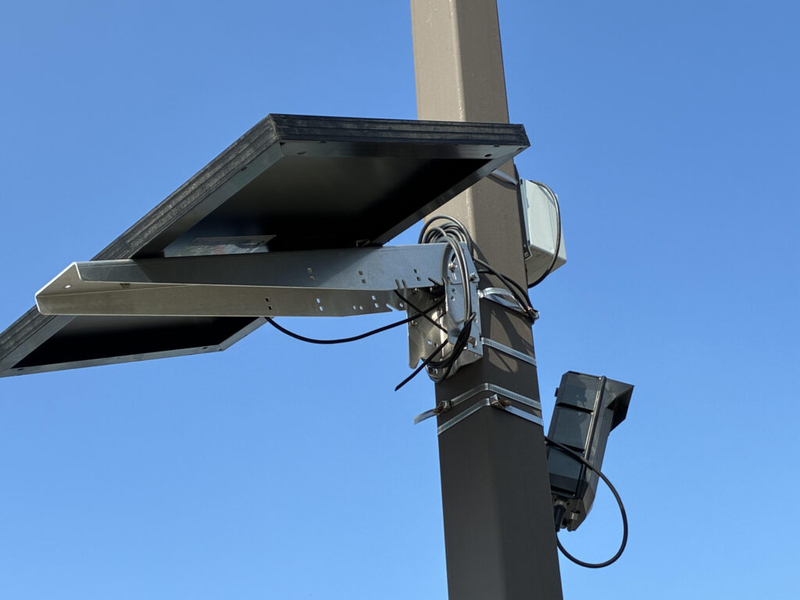
A license plate reader outside Avon, Indiana. (Photo by Mackenzi Klemann/Indiana Capital Chronicle)
A petition to ban automated license plate readers in rural Lawrence County garnered 500 signatures in four days.
The Indianapolis Metropolitan Police Department is investigating one of its officers for reportedly accessing the department’s license plate network for personal use, which the Washington Post reports went undetected until one of its reporters discovered it.
The Bloomington Police Department did not renew its contract with vendor Flock Systems — and other cities across the state are debating whether to do the same.
Public backlash to license plate reader networks is intensifying, but Indiana law says little about how police and commercial entities can use the technology.
The cameras are widely used by law enforcement agencies to capture still images of license plates for criminal investigations.
A state law enacted last year bans homeowners’ associations from deploying the technology to monitor residents and visitors, unless the cameras are operated by law enforcement — the sole restriction to date.
But several lawmakers plan to revisit the subject next year as their constituents express fears of mass surveillance and misuse.
Lawmakers seek ‘guardrails’
“License plate readers have proven to be a very effective tool for law enforcement,” said Rep. Jim Pressel, R-Rolling Prairie. “It’s something that I think we need to preserve the good that it does, while at the same time putting up guardrails to protect Hoosiers from surveillance.”
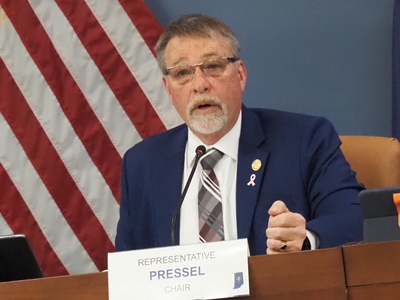
Pressel, chair of the House Roads and Transportation Committee, authored the HOA license plate reader ban as an amendment to House Enrolled Act 1150. He’s now drafting a bill to set a minimum standard for how law enforcement should use the technology.
The bill will likely require law enforcement agencies to perform regular audits of license plate reader searches to identify misuse, with additional yearly audits by Indiana State Police, Pressel said.
Pressel is also considering minimum standards for how long police agencies should be allowed to retain license plate data and when that information can be shared with outside agencies.
Walker Lasbury, a DePauw University student who is a founder of Eyes Off Indiana, wants lawmakers to set a seven-day data retention limit on information about license plates that do not appear on hot lists — a digital database of vehicles of interest to law enforcement.
That suggestion mirrors the new default storage limit recommended by Flock Safety, the most well-known vendor of license plate readers.
Flock Safety tightens safeguards as states, cities question surveillance network
Lasenby said the system’s “evidence mode” feature allows detectives to preserve specific data for active cases, though the company’s own research shows more than 90% of searches are performed within one week.
Eyes Off Indiana estimates 3,604 automated license plate readers are in use across the state, with at least one camera in 84 of Indiana’s 92 counties.
The cameras are accessed by thousands of law enforcement agencies, including hospital and airport security, university police, state prisons and natural resource officers.
The Indiana Department of Correction uses the data to find escapees or parolees who violate the terms of their supervision.
The Indiana Department of Transportation accesses license plate data to monitor tolling operations, construction sites and safety zones.
Powerful, ‘unregulated’ systems
Police say the systems allow them to locate missing persons, stolen vehicles and homicide suspects.
The Bloomington Police Department used Flock cameras to find a vehicle after officers rescued a severely beaten woman from a burning home days before the city lost access to the network in April.
The Indianapolis Metropolitan Police Department credits license plate readers for the swift apprehension of a serial rape suspect — hours after a national DNA database connected the man to a series of sexual assaults spanning more than a decade.
So, too, with the arrests of three men and two teenagers suspected of stealing $2 million worth of cash and jewelry from an Indianapolis jewelry store.
Indianapolis police say investigators used license plate readers to locate an 86-year-old man who forgot how to get home; three missing foster children whose non-custodial parents were attempting to flee with them to Mexico; and the killer of a 2-year-old Indianapolis girl whose body was hidden in an abandoned southern Indiana home, among other cases.
But the department learned this month that one of its own was using the database for personal reasons.
A Washington Post investigation found the officer, who has not been publicly identified, allegedly searched for his wife and acquaintances as many as 3,759 times in 10 months.
IMPD suspended the officer and initiated an investigation on Aug. 6, around the time the Washington Post reports it contacted the department about the searches, though Chief Tanya Terry told other outlets the officer came forward the same day.
Terry recommended the officer’s termination.
“The problem right now is the state of Indiana, (license plate readers) are left completely unregulated,” Lasbury said, “meaning that any protections that Hoosiers do have come from departmental policy, and departmental policy can change overnight.”
Do internal polices go far enough?
The IMPD Public Affairs Division said the department instituted a new policy this month with stronger language around the auditing process and appropriate use of the database.
Only officers who undergo training and acknowledge IMPD policies are granted access.
“It includes stronger language regarding system use, emphasizing that ALPRs are powerful investigative tools that must be used responsibly, legally, and only for legitimate public-safety purposes,” an email statement said. “Ongoing auditing enables us to efficiently identify potential misuse and intervene early.”
The department did not provide a copy of the policy to the Indiana Capital Chronicle as of Friday.
Indiana State Police policy requires troopers to complete a dispatch or case number entry each time they search the agency’s license plate database.
District investigative commanders are responsible for auditing the records at their discretion, a safeguard that agency spokesman Capt. Ron Galaviz said has been in place since the deployment of the technology.
The policy also prohibits using the license plate reader system or hot lists to infringe upon a person’s First Amendment rights.
Flock will soon require case codes for law enforcement searches.
Meanwhile, law enforcement agencies using Flock will need to adopt the company’s audit assistance tool, which suspends users whose activity appears suspicious so an administrator can review.
The Indianapolis Fraternal Order of Police issued a statement this month calling on state lawmakers to establish standards so the technology isn’t misused.
Lasbury is also in talks with lawmakers to set a minimum standard, which he hopes will include transparency, audit requirements, a ban on commercial sharing or selling of license plate data and criminal and civil penalties for anyone who misuses it.
Lawmaker wants to ‘preserve the good’
“I tell people all the time: I don’t think we suspended the Fourth Amendment to the Constitution anytime recently, so we should probably look at this topic,” said Sen. Aaron Freeman, R-Indianapolis.
Freeman, who chaired the Senate Corrections and Criminal Law Committee and introduced Pressel’s HOA amendment to the Senate version of HEA 1150, wants to see a comprehensive analysis of how license plate readers are used in the next legislative session.

“Who can have access to this stuff? How long do you keep it?” Freeman said. “When you’re looking for somebody who’s cheating on their spouse, can you use it for that? Somebody runs for office — can we use it for that?”
Pressel and Freeman are among several lawmakers engaging the subject, though it is unclear how many bills will be introduced when the General Assembly convenes in January.
Gov. Mike Braun has signaled his support for the effort.
“Gov. Braun will always support law enforcement with the resources they need to ensure public safety,” governor’s office press secretary Griffin Reid said. “Guardrails are important and should be considered anytime personal information is involved.”
Still, backlash is brewing across the state.
A Change.org petition to ban license plate readers in Lawrence County — population 45,000 — attracted more than 500 signatures as of Friday evening.
“I don’t want to live in a society where there are cameras on every corner,” said organizer Nikki Luallen, who started the petition after she noticed license plate readers popping up in her county six months ago.
She’s spotted 16 license plate readers in the southern Indiana county, known for its limestone, underground caverns and forests.
The cameras differ from private security cameras in Luallen’s mind because they sync into a nation-wide database accessible by outside parties, enabling large-scale tracking capabilities.
Pressel said the cameras have their proper uses.
“I don’t think anybody wants to see them go away, and we need to preserve the good while protecting Hoosiers from any kind of misuse,” he said. “That’s the goal, and I think that is going to hit the sweet spot. Time will tell.”

Indianapolis, IN