School starts with new funds for teacher hiring, new standardized tests, more
Aug 20, 2026 | 6:44 am ET
Description
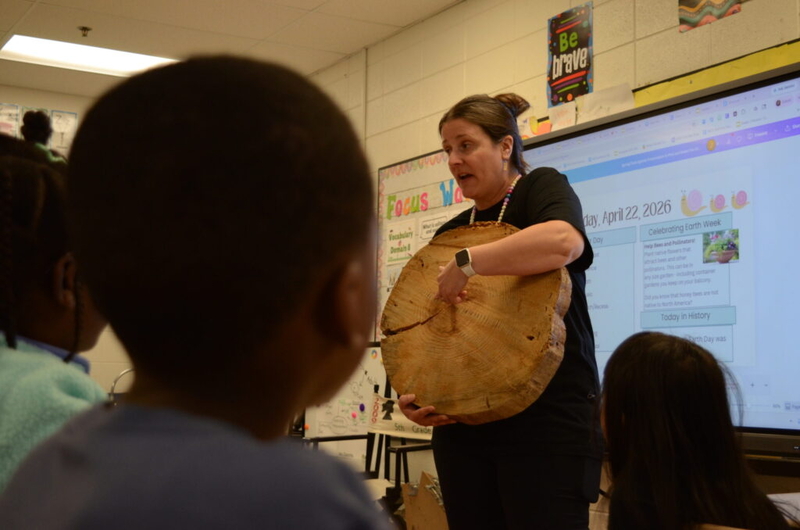
Rachel Bayer, a student teacher and former federal worker, teaches a lesson on April 22, 2026. (Photo by Alexander Taylor/Capital News Service)
Remember when Labor Day was the unofficial end of summer and schools started up again after that?
Your kids probably don’t either.
The 2026-27 school year started Wednesday in Frederick County, and the remaining 23 school systems will all be back in class within less than two weeks — almost a full week before they go on break for Labor Day weekend.
The last time Maryland schools started after Labor Day was a brief window in the 2017-18 and 2018-19 school years — when today’s high school seniors were entering third grade — when an executive order by Gov. Larry Hogan ordering the delay was in effect. Lawmakers reversed it in 2018, but Hogan vetoed it, buying his policy another year before his veto was overridden.
Here’s the list of starting dates for the rest of the state, including seven that start Monday: Anne Arundel, Baltimore City, Charles, Dorchester, Howard, Queen Anne’s and Talbot.
When students do return, they will be starting a school year in which they’ll face new — and shorter — comprehensive tests, a renewed emphasis on school attendance and new help for students struggling in math.
Maryland students continue minimal gains on test scores, but demographic gaps remain
School systems also start the year with nearly $15 million in grants announced Wednesday by Gov. Wes Moore (D) to decrease the state’s teacher shortage, under the state’s Grow Your Own initiative. This latest round of funding is expected to support 845 educators throughout the state. One of the largest awards is the $3.1 million going to Frederick County.
These grants are the second round of funding under the program, which will focus on high‑need areas such as special education and early childhood. After the first round of $19 million was announced in December, teacher vacancies were sliced nearly in half from slightly more than 1,600 to about 886 last year.
The goal of the initiative is expanding teacher and staff pipelines, boosting diversity in the profession and establishing apprenticeships.
“The Grow Your Own Educators Grant addresses the teacher vacancy gap and ensures our students receive the world class education they deserve by building pathways to work, wages and wealth for the professionals already dedicated to their service,” Moore said in a statement.
Some of the other school districts to receive grants are Anne Arundel County at $3.6 million, St. Mary’s County at $3.0 million, Charles and Howard counties at $1.5 million each. Seven Eastern Shore districts will receive approximately $1.1 million, and Worcester County will get $829,234, according to the governor’s office.
Although Wicomico County isn’t part of the shore’s consortium, it has a Grow Your Own teacher program.
The new tests students will face this year will come as the state transitions into the newly designed Maryland System of Testing Academic Readiness (MSTAR) that’s slated to begin in the spring 2027.
It will mark the end of the Maryland Comprehensive Assessment Program tests for students in third through eighth grades. When they took the MCAP tests this spring, nearly 52% were proficient in English Language Arts and about 27% of students were proficient in math. Both were gains of less than a percentage point from the previous year’s test.
State Superintedent Carey Wright said last month one change with the new test is that it will specifically measure each grade level by what’s being taught in the classrooms. In the current language arts test, for example, students receive a litany of questions that may be on different levels. One main difference, she said, is that the new tests will be shorter.
During a virtual news conference Tuesday, Wright said the state has launched an attendance awareness campaign called “Maryland Shows Up.” Part of its purpose is to improve school attendance from the 31% of students who were chronically absent in 2022. Currently that rate is about 22%.
“That says a lot about the work that our that our schools are doing,” Wright said.
Also starting this upcoming school year, school districts must develop a process “to identify and support students who exhibit difficulties with learning” math that would include students with disabilities.
State school board President Joshua Michael, who has children in the Baltimore City’s public schools, offered some parental advice such as asking a teacher or a school leader about a child’s social environment, especially in prekindergarten and middle school.
“Who are the adults that they are excited to see every day? Who are the young people that they’re building relationships with?” Michael said during the news conference with Wright. “Just learning and attending to the people they’re building relationships with is going to go a long way in their socio-emotional development.”
Annapolis, MD