Gray edges out Friess and Christensen in tight, crowded race for US House
Aug 19, 2026 | 1:01 am ET
Description
Photo courtesy of WyoFile
Republican Chuck Gray, who’s been the secretary of state since 2022, won a tight, crowded race Tuesday that puts him in a strong position to represent Wyoming in Congress.
The former statehouse representative from Casper narrowly beat Jackson Hole businessman Steve Friess and retired Bureau of Land Management employee Kevin Christensen, who finished respectively as the second- and third-place vote getters. As of 10:50 p.m., with 81% of ballots counted, Gray had 25% of the votes while Friess had 20% followed by Christensen, with 18%.
Gray has been a firebrand in state politics, frequently butting heads with Wyoming Gov. Mark Gordon.
During a July candidate forum in Casper, he explained to Wyoming voters why he was investing large sums of personal and family money in his U.S. House campaign. “Like President Trump,” he said, he was making the investment “to take on the insiders and the media.”
“I don’t back down to the media and the insiders,” Gray said.
Gray declined an interview on Tuesday night, but sent WyoFile a statement thanking Wyoming voters.
“This was a spirited race, but the primary is over,” he said. “Now is the time to come together, because what unites us is far greater than anything that divided us during this campaign.”
Gray’s statement called upon Republicans to work together to help President Trump “continue the work of rebuilding the country.”
FEC filing data shows that Gray gave himself a $1.38 million loan. That was supplemented by a PAC singlehandedly funded by Jan Gray, Chuck Gray’s father, who spent another $519,000 on Gray’s candidacy.
Gray becomes the heavy favorite to take over the seat currently occupied by outgoing U.S. Rep. Harriet Hageman. The sophomore representative gave up her seat to run for the U.S. Senate after Cynthia Lummis announced she was retiring. On Tuesday, Hageman beat challenger Sam Mead handily, winning nearly two-thirds of the vote.
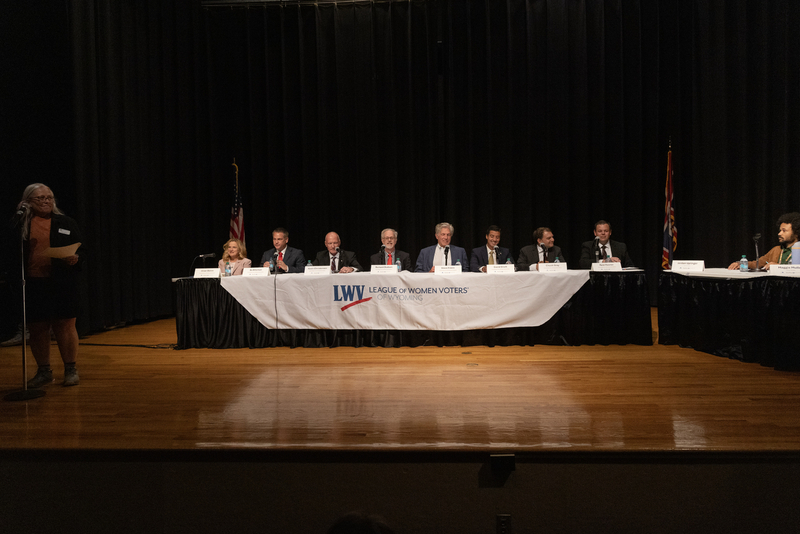
An unusually deep field of candidates competed in the Republican primary. Ten candidates vied for the seat, though Frank Chapman, a Moran guest ranch owner and lawyer, dropped out after he and the Fighting for Wyoming PAC spent roughly $3 million on his campaign.
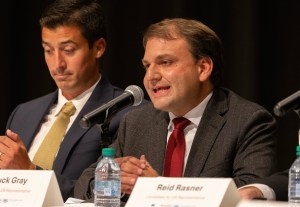
Besides Gray, Friess and Christensen, other candidates included former Superintendent of Public Instruction Jillian Balow, Wyoming Senate President Bo Biteman, actor and singer Richard Dodson, former Army Ranger David Giralt, Casper resident Keith Goodenough and Casper businessman Reid Rasner.
Big investments, often of personal and family fortunes, was a theme. Candidates making huge cash loans to their own campaigns is a change from previous competitive Republican primary races in Wyoming.
When former U.S. Rep. Liz Cheney won the lone seat a decade ago, she attracted $1.6 million in individual contributions, versus $70,000 in personal loans. In 2022, Hageman easily ousted Cheney. She did so with Trump’s endorsement and a campaign that raised $5.7 million, with over 90% of that sum coming from individual contributions.
The 2026 race was quite the contrast, with the overwhelming majority of campaign funds coming from the candidates themselves. Two of the three highest vote getters on Tuesday all spent a million-plus dollars on their races. Friess spent $3 million. Rasner also loaned his campaign $1.87 million.
Christensen’s campaign operated very differently, relying on less than $36,000. He loaned and contributed $18,000 of his own money and solicited another $18,000 in donations, according to FEC data.
There was never a crystal clear frontrunner. Gray likely had the greatest name recognition, having held a statewide seat for four years. Friess was the biggest spender, as of the last FEC filing deadline. Rasner, who’s been marketing his name for years and gained attention for a failed bid to buy TikTok, frequently made headlines for aggressive and bombastic campaign tactics. On Tuesday, Cowboy State Daily reported that an 11th-hour text to potential voters falsely claimed that Trump had endorsed Rasner.
Gray, Friess and Rasner all consistently tried to position themselves as Trump acolytes, although the president never endorsed any of them.
Gray will face Democrat Lisa Kinney, a former state senator who lives in Laramie, in the November general election. In a state where Republicans have long dominated statewide races, she’ll be a long shot to win. Wyoming hasn’t sent a Democrat to Congress since 1976, when Teno Roncalio was reelected.
This is a breaking news story that may be updated.
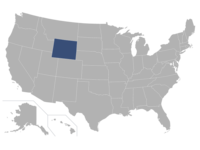
Cheyenne, WY