Utah’s 2026 election results are certified, solidifying Democrats’ gains in the Legislature
Nov 23, 2026 | 7:48 pm ET
Description
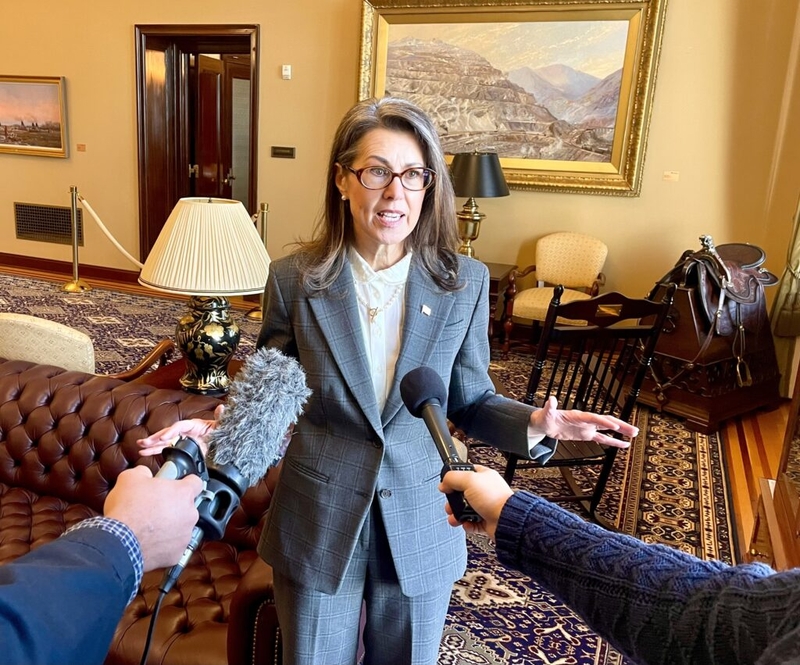
Utah Lt. Gov. Deidre Henderson speaks to reporters after the State Board of Canvassers certified the state's 2026 general election results at the Utah Capitol in Salt Lake City on Nov. 23, 2026. (Katie McKellar/Utah News Dispatch)
It’s official. Utah’s 2026 general election results were certified by the state Board of Canvassers on Monday — solidifying a blue wave election that doubled the Utah House’s Democratic caucus and shattered that chamber’s Republican supermajority for the first time in more than three decades.
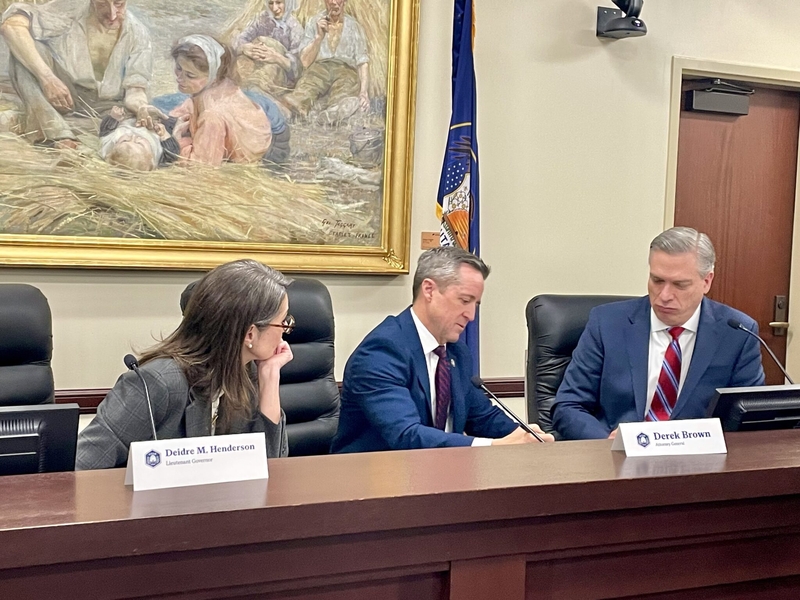
The board — made up of Utah’s top election official, Lt. Gov. Deidre Henderson, Attorney General Derek Brown, Auditor Tina Cannon and Treasurer Marlo Oaks — voted unanimously to certify the results.
On election night, there were no surprises from Utah’s congressional races. Democrat Ben McAdams won the newly-drawn 1st Congressional District. Republican Reps. Celeste Maloy, Mike Kennedy and Blake Moore will return to Congress representing the state’s other three congressional districts.
‘Blue tsunami’ hits Utah: House Republicans on pace to lose 17 seats, breaking supermajority
But the blue tsunami that swept the nation also washed over typically ruby red Utah in an unexpected way: 14 Democrats and two unaffiliated candidates flipped a total of 16 Republican seats in the Utah House.
That doubled the House Democratic caucus from 14 legislators to 28, knocking the House GOP’s two-thirds control down to a simple majority and therefore breaking Republicans’ veto-proof supermajority control over the Legislature.
In the Senate, Republicans took back one seat from the Forward Party’s only currently elected legislator in the country, Sen. Emily Buss, who narrowly lost to Republican Brooks Benson.
However, Senate Republicans also lost two seats to Democrats. That included one held by the Senate’s No. 2 highest ranking Republican, Senate Majority Leader Kirk Cullimore, who lost to Democrat Shana Anderson. And they also lost an open seat previously held by retiring Sen. Ann Millner, flipped by Democrat “CJ” Christina Hernandez.
Senate Republicans will maintain two-thirds supermajority control in that chamber, but Senate Democrats gained two seats, bringing their members from six to eight, while Republicans’ ranks dipped from 22 to 21.
‘Not a normal election’
Monday’s certification capped off an unusually exciting election year that had stunning election night results — far from the norm in Republican-controlled Utah, where usually the real contest happens in the June primaries.
It was also a highly contentious cycle for election officials, including Henderson, a Republican who has made national headlines for calling out President Donald Trump and his administration’s “gamesmanship” with voting rights.
Utah’s top election chief says Trump admin’s ‘gamesmanship’ with voting keeps her up at night
Henderson has refused to release private voter data despite threats of criminal prosecution by the U.S. Department of Justice. And earlier this fall, she learned the DOJ was investigating her as a result of her refusal.
But while the months leading up to Election Day were stressful for election officials, Henderson told reporters Monday that the election itself went smoothly.
“It was not a normal election on my end. It did not feel normal for me in the months and weeks and days leading up to the election,” Henderson said. “But Election Day itself, it was very smooth considering all of that.”
This year’s election turnout landed at 59.3%, or just over 1 million votes cast out of Utah’s nearly 1.8 million active registered voters — typical for a general election with no presidential or gubernatorial ticket.
The dynamics that propelled Democrats’ blue wave included many loyal MAGA or Trump Republicans who didn’t vote, while middle-ground voters like independents or moderate Republicans opted to vote for Democrats instead, according to recent research conducted for Brigham Young University’s Center for the Study of Elections and Democracy.
Analyzing Utah’s blue wave: Many Republicans didn’t turn out; others crossed over to vote blue
Even after individual counties had already canvassed their results in the weeks since the Nov. 3 election, Henderson in a social media post over the weekend said she received a “whopper” of a letter from what she called the “‘enthusiast’ wing of the Republican Party demanding we not certify election results” due to unverified concerns of election security.
Henderson told reporters after the statewide certification on Monday that other Republican secretaries of state have received similar pushback — and that the concerns listed in the letter had no merit.
“We worked really, really hard throughout every single step of the process to make sure things are done well, they’re done securely, they’re done in the open,” she said. “And if there are any concerns at any step along the way, we’d like to know about them. (But) right before we canvass the statewide results is not the time to bring up these issues.”
She noted that the State Board of Canvassers has one duty under the law: compute and determine the final vote tallies for ballot initiatives and statewide and multi-county races.
“That’s it,” she said.
In a time of distrust, how do we know Utah’s elections are secure? Clerks show us
Canvass documents — including individual county reporters — are available to view and download on the state’s election results website.
Final results on close races
While the leading candidates in several state legislative races flipped several times since election night due to narrow margins, Monday’s certification finalized the following results for those tight contests.
None of these margins are narrow enough to qualify any of the races for a recount under Utah law.
Senate District 11: Republican Brooks Benson beat Forward Party incumbent Sen. Emily Buss with 50.19% (16,358 votes) to Buss’ 49.81% (16,236).
House District 4: Democrat Zane Woolstenhulme won with 51.76% (10,006 votes) to Republican Rep. Tiara Auxier’s 48.24% (9,326).
House District 8: Democrat Kim James beat Republican Rep. Jason Kyle with 49.88% (7,430 votes) to Kyle’s 45.9% (6,837 votes). Forward Party candidate Libby Shelton had 4.22% (628 votes).
House District 11: Republican Rep. Katy Hall won a challenge from Democrat Dave Calder. Hall got 51.84% (5,970 votes) to Calder’s 48.16% (5,546 votes).
House District 16: Republican Bob Stevenson won against Democrat Abigail Treasure with 51.48% (6,673 votes) to Treasure’s 48.52% (6,290 votes).
House District 20: Democrat Phil Graves beat Republican incumbent Rep. Melissa Ballard. Graves had 51.31% (6,713 votes) to Ballard’s 48.69% (6,369).
House District 45: Republican incumbent Rep. Tracy Miller won against Democrat Rod Moser with 53.96% (8,333 votes) to 46.04% (7,110 votes).
House District 48: Republican incumbent Rep. Jake Hunsaker narrowly beat Democrat Benyde Walker with 50.65% (7,492 votes) to Walker’s 49.35% (7,301 votes).
House District 59: Democrat Celeste Johnson won with 51.35% (9,799 votes) to Republican Luke Searle’s 48.65% (9,282 votes).
House District 61: Republican incumbent Rep. Lisa Shepherd won against Democrat Alan Jimenez with 48.81% (4,878 votes) to Jimenez’s 47.21% (4,718 votes). Constitution candidate Jennifer Doud got 3.97% (397 votes).
Salt Lake City, UT