Federal contract documents show ICE 24-hour call center planned for Adams, Tennessee
Aug 11, 2026 | 6:02 am ET
Description
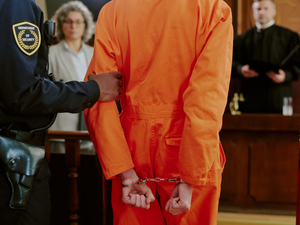
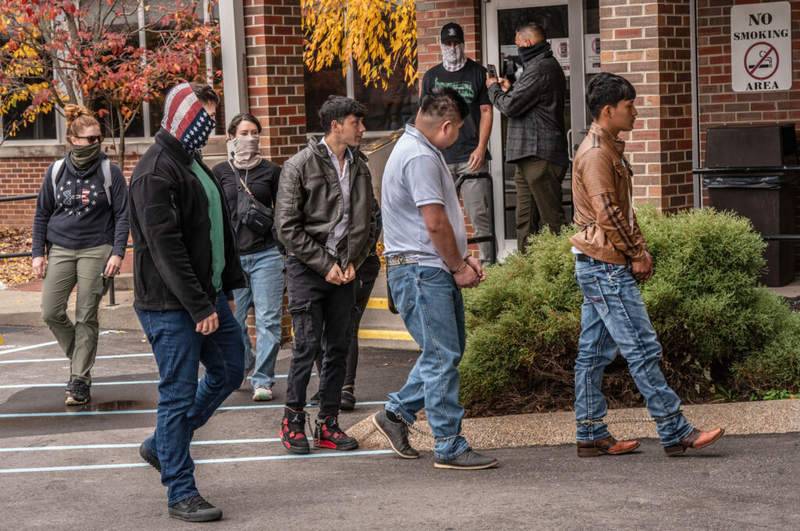
Federal contract documents show Adams, Tenn. in Robertson County as the site of a new ICE call center. Pictured: Five people detained after appearing in Robertson County General Sessions for traffic violations by masked and un-uniformed officers. (Photo John Partipilo/Tennessee Lookout)
The Department of Homeland Security has awarded a $63 million contract to an Alaska corporation to operate a national immigration enforcement call center in rural Tennessee, a federal contract database shows.
The city of Adams, a Robertson County town of about 600 people near the Kentucky border, is identified in the database as the future site of the planned call center, intended to function round-the-clock to support local police and sheriffs’ departments across the country that have entered into cooperative agreements with Immigration and Customs Enforcement.
The call center will also help locate unaccompanied migrant children and develop new technologies for ICE, contract documents show.
The one-year contract, effective Aug. 6, was awarded to Koniag Government Services. The company is a subsidiary of Koniag, a for-profit Alaska Native corporation created for the benefit of 3,400 Alutiiq shareholders, according to its website.
Local leaders, including Adams City Manager Anna Redfern, told the Lookout Monday they were unaware the town was even being considered. Officials could not immediately identify a potential physical location within the town’s 2.5-square-mile borders and expressed skepticism about the capacity of the city’s existing infrastructure to support a call center.
“I don’t know that little, ole sleepy Adams has got the things that you need to put in a call center,” Chris Traughber, assessor of property for Robertson County, said of the town that is perhaps best known for the 19th century legend of the “Bell witch” haunting that attracts supernatural enthusiasts and other visitors today.
Traughber said he was unaware of any recent property transactions that could account for an incoming call center. Portions of Adams lie within Montgomery County. The county’s property assessor referred the Lookout to online records, which did not yield any recent transactions by the Koniag company.
I don't know that little, ole sleepy Adams has got the things that you need to put in a call center.
Republican State Sen. Kerry Roberts, whose district encompasses Adams, said he had “heard rumors” about the plans but that his office “has had no contact with anyone with the federal government” about the project.
“They could handle it,” from an Internet connectivity standpoint because high-speed fiber is available, he said of Adams, but cautioned that a building likely would have to be constructed. Roberts said it is also unclear where the company would draw its workforce.
A Koniag spokesperson referred questions to ICE about the contract, including a facility’s precise location, estimated workforce and its physical size.
“Unfortunately, we are not at liberty to discuss this very recently awarded contract at this time,” said Joanie Barr, senior vice president for business operations for Koniag Government Services.
A spokesperson for ICE did not respond to a request for details about the newly awarded contract.
Contract documents show the primary function of the call center will be to handle an estimated 6,000-7,000 daily inquiries from law enforcement agencies across the nation that have entered into cooperative agreements with Immigration and Customs Enforcement.
Call center employees will “analyze data, perform database cross-checks and confirm enforcement actions in the field,” contract documents say. Employees will work round-the-clock eight-hour shifts
The documents, however, show the company will be tasked with a much wider range of duties, including tracking and reporting the locations of unaccompanied immigrant children and identifying “emerging technologies” to increase the effectiveness of local law enforcement’s work with ICE.
The center will also be tapped to “reduce the non-detained docket” of millions of non-citizens living in the U.S. — non-citizens who are going through immigration court proceedings — by providing law enforcement officers and sheriffs with “targeting focus and material.”
The establishment of a national immigrant and enforcement call center represents a significant expansion of the Trump administration’s coordination with local law enforcement departments and sheriff’s offices around the nation as the number of participating agencies increases.
Administration officials have called the agreements a “force multiplier” to extend the reach of enforcement actions into communities by local police and sheriffs deputized to perform immigration agent duties.
While the so-called 287(g) cooperative agreements have been in existence since the 1970s, they have dramatically expanded under the second Trump term from fewer than 200 before the president took office to 2,179, as of August, according to publicly-posted ICE data.
Lisa Sherman Luna, executive director of the Tennessee Coalition for Immigrant & Refugee Rights, characterized the plans as “trying to set up shop in middle Tennessee to facilitate this terror on a massive scale.”
Sherman Luna cited an expanded federal presence conducting immigration enforcement as part of the Memphis Safe Task Force and a package of recent Tennessee GOP immigration legislation, crafted in meetings between Republican House Speaker Cameron Sexton and White House advisor Stephen Miller.
“Tennessee is ground zero for this administration’s insidious attempt to embed immigration enforcement in all facets of our everyday life,” she said.
Sam Stockard contributed.
Nashville, TN