For U-M pro-Palestinian protesters, consequences linger after charges were dropped
Oct 05, 2026 | 1:35 pm ET
Description
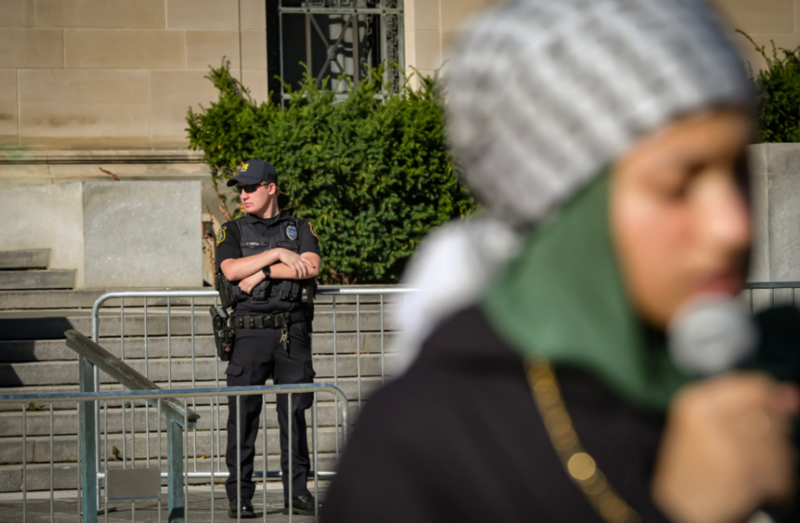
U-M police officer watches over pro-Palestinian student protestors from the steps of the Rackham School of Graduate Studies on Oct. 7, 2024. (Photo by Charles H.F. Davis III with permission)
Though their state-level criminal charges were dropped, pro-Palestinian activists at the University of Michigan say they still face repercussions for protesting.
Former students and organizers say arrests and disciplinary actions tied to demonstrations have continued to affect their ability to be present on campus, find work and move beyond accusations that were ultimately dismissed.
A nearly monthlong pro-Palestinian encampment at the University of Michigan in spring 2024 was cleared by police on May 21. The raid resulted in four arrests.
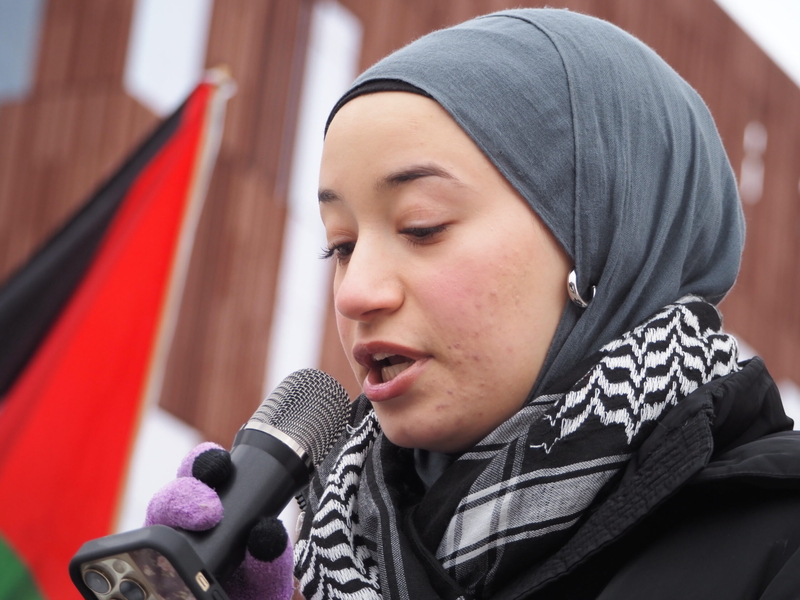
Salma Hamamy, a 2024 U-M graduate and former president of the pro-Palestinian Students Allied for Freedom and Equality, called the police response “brutal.”
“They were just grabbing anyone that they could get their hands on,” she said. “The people who were arrested were ultimately charged with felonies.”
Hamamy characterized the arrests as “a political tactic to repress the student movement, and to make an example out of a few when there were hundreds who were physically there in support and thousands across the state of Michigan.”
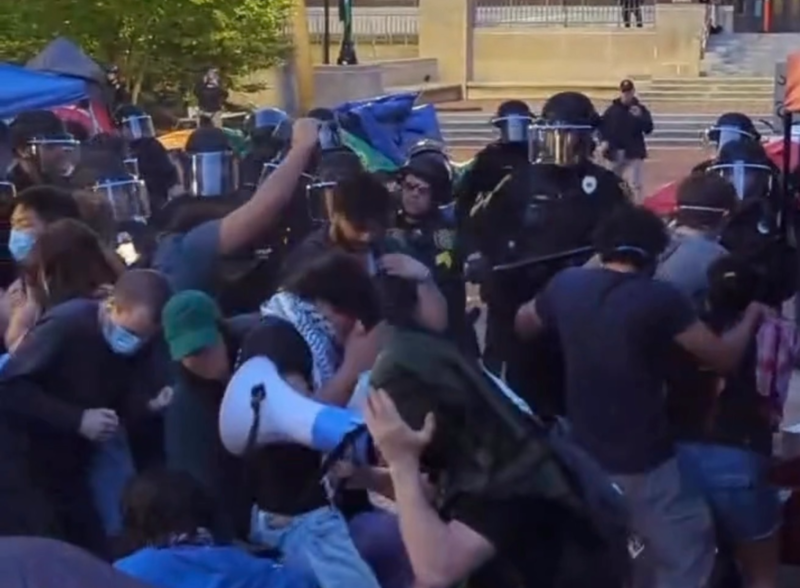
Amy Doukoure, staff attorney at CAIR-Michigan, added that while pro-Palestinian protesters were charged for trespassing, the same treatment was not given to pro-Israel protesters who were also present.
“They were allowed to stand and actually mock the pro-Palestinian protesters as they were being dispersed. I think that’s a very glaring example of the fact that they have been treated significantly different than other forms of speech,” Doukoure said.
When asked about allegations that the university had criminalized protesting, a university spokesperson declined to comment, citing ongoing litigation.
While charges connected to the encampment raid and other pro-Palestinian demonstrations were later dropped by Michigan Attorney General Dana Nessel’s office, several people who were charged in the course of their pro-Palestinian activism at the University of Michigan say there have been continued effects long afterward.
Arrests, bans and disciplinary actions followed protests
Hamamy was among 40 students arrested on Nov. 17, 2023 during a demonstration at the Ruthven Administration Building.
Protesters hosted an eight-hour sit-in, demanding a meeting with administrators and then-President Santa Ono to call for the university to divest its financial holdings from companies and entities associated with Israel.
According to a Sept. 2026 report from the ACLU, more than 50 police vehicles from at least 10 police departments were dispatched to address the protest. “Multiple individuals reported being physically harmed by police officers on the scene, with one student reporting that a police officer ripped off her hijab,” the report stated.
The charges are never individual. They are always a part of a broader tactic to suppress a community, a movement of people. What they fail to understand is while they can charge a few, they can’t stop the movement.
“Criminal charges at the state level ordered by the attorney general were an unprecedented escalation against divestment. It was an overreach, a political overreach,” Hamamy said. “It was designed to punish and suppress voices protesting genocide.”
Hamamy claimed that the charges were ultimately dropped by the attorney general’s office through public mobilization and media coverage.
When contacted for comment, Michigan Department of Attorney General Press Secretary Danny Wimmer linked a September 2024 press release describing each charge.
“Many of those charged were not students, and none were charged for protesting. The alleged criminal conduct is described in our office’s release. Charges filed included trespassing and resisting or obstructing a police officer,” Wimmer said in an email. “The police action to clear the encampment occurred in May 2024, and cases arising were only referred to our office in June.”
‘A campus should not be lawless’: AG charges 11 people involved in University of Michigan protests
In addition to being charged, Hamamy was also barred from entering campus for a year, ending in Oct. 2025.
“I think students seeing that their fellow classmates can now be kicked out and prohibited from stepping on any campus property on a campus that they once contributed to is extremely isolating. I think it’s dehumanizing,” Hamamy said.
A campus ban also removes a student from their community, Liz Jacob, lead staff attorney at the Sugar Law Center for Social and Economic Justice, added.
“It’s not only meant that they couldn’t go to campus protests or be a part of organizing, but it also took them out of their dining halls, their libraries, and their classrooms,” Jacob said. “Being cut off from those spaces can be really isolating.”
Eaman Ali, a 2025 University of Michigan graduate and former organizer with the pro-Palestinian TAHRIR Coalition, also experienced repercussions for her activism, which included protesting at the University of Michigan Museum of Art in May 2024.
In April 2025, Ali said she received a notice from the university’s human resources office alerting her that she had been suspended from her campus job. A few days later, Ali and eight other students were terminated. While the university contends the terminations were due to “violent conduct” and not merely for participating in the protest, attorneys representing the fired workers in a federal lawsuit deny there was any violence. That case is still pending.
In addition to losing her job, Ali received notification after graduating that she was also facing academic disciplinary charges and was barred from future employment by the university and its affiliates, which has impacted her ability to find work in Michigan.
A university hiring ban for protesting was unprecedented and can strongly affect students’ ability to find work, Jacob said.
“The University of Michigan is one of the state’s biggest employers. That’s a really egregious sanction,” Jacob said. “Being cut off from those opportunities has a lot of downstream impacts on someone’s life that could not only really impact their ability to get a job in the state, but also to really meaningfully build a career in the fields that they choose.”
Criminal charges followed campus activism
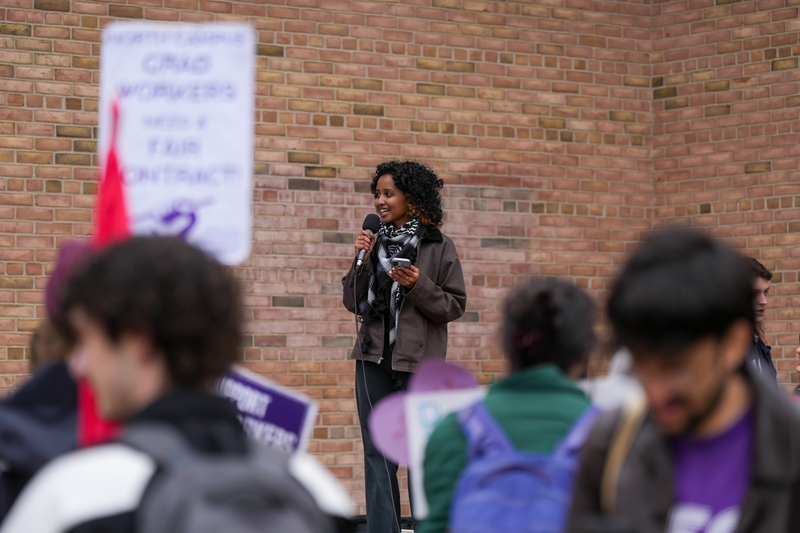
Hiab Teshome, an M.D.-Ph.D. candidate at the University of Michigan and president of the Graduate Employees Organization, also faced disciplinary charges after being accused of using university funds to buy laptops for a student organization.
According to the court records, a felony complaint was filed against Teshome on June 4 and a complaint was issued by the office of Washtenaw County Prosecutor Eli Savit on June 11. Savit is the Democratic nominee for Michigan attorney general.
During her arraignment on June 26, Teshome said she learned that university police had sought bond conditions that would have effectively imposed a campus ban. Although the request for a total ban was unsuccessful, she was barred from the Ruthven Administration Building, where the Board of Regents meets.
“The campus bans have been used as a tool here at the University of Michigan as a way to repress movement. The university arbitrarily will give these trespass bans to individuals and target individuals with these trespass bans in order to prevent people from going on campus and organizing,” Teshome said.
The charges were dismissed on Aug. 6. According to Drop Site News, the charges were dropped after it was determined that while Hiab was a co-signer on the laptop purchases, “she did not actually make the purchase, and never possessed the devices. Another member of the club used the laptop and was reimbursed for it.” Hiab claims that despite what was essentially a misunderstanding, she was targeted for prosecution because of her pro-Palestinian activism.
“The community came together throughout the summer to make sure the courts understood that these charges were ridiculous and insane,” Teshome said. “The first time it was presented to the court, it immediately fell apart.”
The Washtenaw County Prosecutor’s Office said the case was handled like any other matter.
“It was dismissed, like similar cases on the docket that day, following the court’s receipt of information indicating that repayment had been made by Ms. Teshome’s co-defendant,” Alyssa Fountain, an administrative assistant with the department, said in an email. “As with any case, our office handles cases based solely on the evidence that is presented to us.”
Hamamy said that while criminalization impacts individual protesters, it also has lingering effects on the university community and that the police and disciplinary responses were used as a “fear-mongering tactic” to quell future protests.
“These charges were not about what did or didn’t happen on the ground. It was entirely to suppress, to discriminate, to be a type of overreach, and to push and suppress voices protesting genocide because they did not want the status quo to be impacted,” she said.
Doukoure, the CAIR attorney, said that disproportionate government action creates a “community sense” that there’s something wrong with the viewpoint.
“They become criminalized in ideology, which then stigmatizes them. You create a hierarchy within the community because what government action is, it legitimizes one specific ideology,” Doukoure said. “If you’re saying a group is not legitimate and they’re criminal because of their speech, you’re legitimizing that specific viewpoint, which is exactly why we have freedom of speech protected under the Constitution to keep the government from being the arbiter of what is true and honest exchange of ideas.”
Ali said the tactics are about limiting protests and minimizing the movement.
“All of these things are laying the groundwork for future movements to be even more repressed and silenced and so that really is an untold legacy almost that is really disheartening,” Ali said.
Despite the challenges, Ali said her colleagues have not expressed remorse for their activism.
“I haven’t met anybody who regrets protesting for Palestine. I think our conscience has always been very clear that regardless of retaliation, we’re right to protest and we are right to call attention to the genocide in Gaza,” Ali said, referencing the ongoing military actions by Israel in Gaza, which multiple international organizations have called a genocide against the Palestinian people.
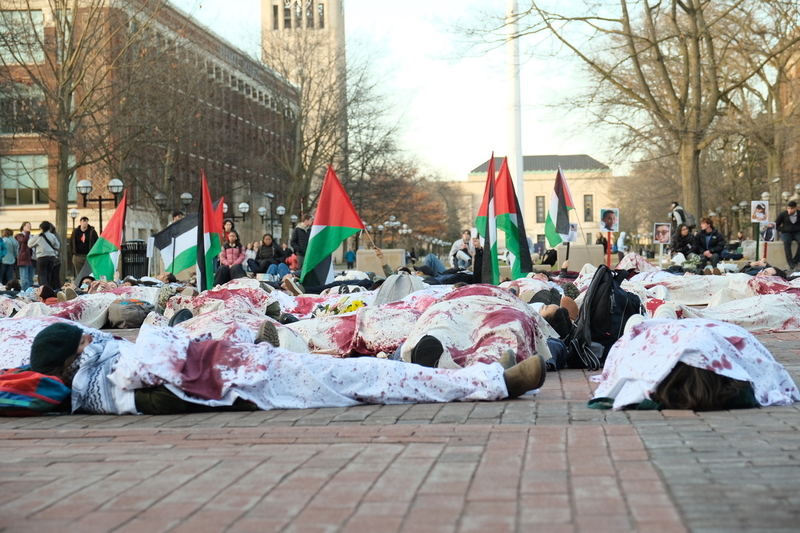
Ali said that the criminalization and disciplinary actions against protesters demonstrate a political attempt to silence pro-Palestinian sentiment.
“This really isn’t about me as an individual or any of us who were fired or blacklisted or what have you. This really is about an institution that is trying to protect its profits and its own interests in investing in the genocide and in the apartheid state of Israel and really, they will do just about anything to ensure that that goes unchallenged,” Ali said.
The university’s investment portfolio provides context for the financial interests Ali and other protesters point to.
The University of Michigan’s investments are not entirely public, but its annual endowment profile shows the fund was valued at $21.2 billion as of June 30, 2025.
A report published by the TAHRIR Coalition examined the university endowment and its alleged ties to Israeli companies. Data the report uncovered showed in fiscal year 2022, the university held $36.9 million in forward foreign-exchange contracts involving the Israeli shekel, which the authors described as a “direct connection” to the Israeli state. It also identified investments in companies including Boeing, Lockheed Martin, Airbnb and Hewlett Packard Enterprise, and claimed the endowment funded $6 billion in 333 Israeli companies and $5.7 billion in 241 defense-related companies.
The university has disputed those characterizations. In a 2024 Regents statement, Regent Michael Behm said the endowment has no direct investments in Israeli companies and that less than 0.1% is invested indirectly in them. The Regents reaffirmed their decision not to divest from companies linked to Israel, saying investment decisions would be based on “financial factors such as risk and return.”
But for the activists interviewed for this story, the fight over investments is only one part of a broader struggle over how U-M responds to dissent.
Hamamy agreed, focusing on the larger movement instead of individual arrests.
“The charges are never individual. They are always a part of a broader tactic to suppress a community, a movement of people. What they fail to understand is while they can charge a few, they can’t stop the movement,” Hamamy said.
“The University of Michigan has a long history of trying to repress activism, and we’ve seen it so strongly in the past three years with the pro-Palestine movement,” Teshome added.
Jacob said that while university reaction has seemingly escalated since the Oct. 7, 2023 Hamas attack on Israel, the protest actions themselves are similar to other movements.
“The student movement for Palestine, which has also been on the campus for decades, has adopted many of those really common protest tactics like sit-ins, marches, even encampments,” Jacob said. “But there has been a big departure with the university’s response.”
According to the ACLU report, “undercover investigators surveilled pro-Palestinian groups and followed them both on and off” the Ann Arbor
campus. Additionally, the ACLU said students reported that “investigators cursed at students, made threats, and, in one documented incident, drove a vehicle toward a student who was forced to jump away to avoid injury.”
Federal charges filed against U-M protesters
On June 10, the Department of Justice indicted eight pro-Palestinian activists associated with the University of Michigan for “their alleged roles in conspiracies to threaten University of Michigan leaders, law enforcement, and businesses,” according to a Justice Department press release. In addition to allegations of conspiracy to transmit threats, some of the defendants also were charged with witness intimidation and destruction of property.
Doukoure said the indictment was concerning due to its classification of constitutional rights as criminal.
“The indictment itself is troubling because it wraps in free speech and political ideology in a way that intends to paint that free speech and the topic of that speech as inherently dangerous or criminal because it is pro-Palestinian,” Doukoure said. “I don’t think I’ve ever read a criminal indictment that talks about lawful activity as a precursor for the criminal indictment the way this does.”
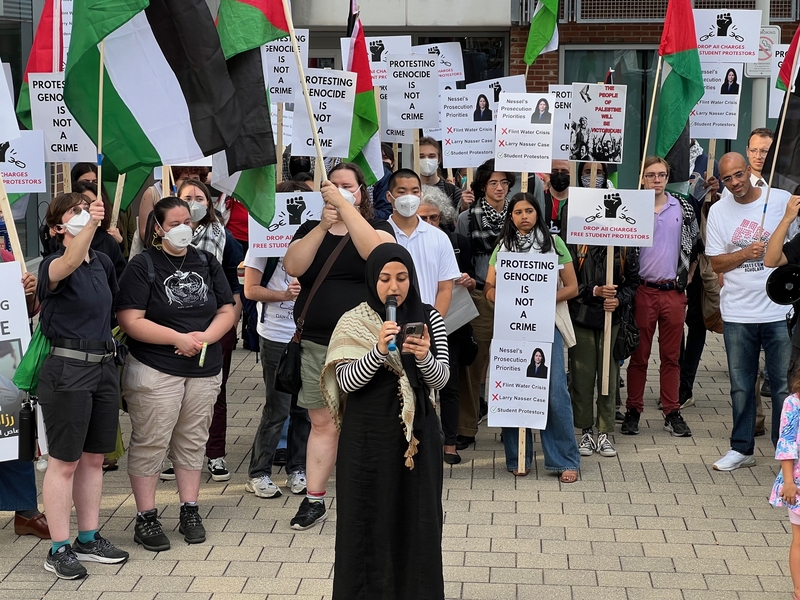
Hamamy, Ali and Teshome said they viewed the charges as a continuation of the politicization of the pro-Palestinian movement.
“The charges are not a reflection of what did or did not occur, but rather a reflection of the Trump administration’s war with the Palestine solidarity movement,” Hamamy said. “The Trump administration has moved to crush the movement domestically, whether it be through ICE abductions or attempted deportations of international students or lawsuits against the university and the weaponization of protections to cut federal funding.”
Hamamy said that while university, state and federal charges are important to pay attention to, they also divert attention from the subject of the protests.
“The charges are distraction from real violence, real crimes against humanity, that Israel continues to perpetrate every day,” Hamamy said.
She characterized the police and university pushback, including the charges against her, as a marker of victory.
“Something that comes along with the pushback is understanding that it occurs because we have been successful in advocating for the Palestinian people and advocating for people to be liberated throughout the world. The suppression is a measure of our commitment and our success in the movement, not a measure of our failure,” Hamamy said.
Lansing, MI